CERN shuts down the Large Hadron Collider until 2030
On June 29, 2026, the Large Hadron Collider—the most powerful particle accelerator in history—was shut down.
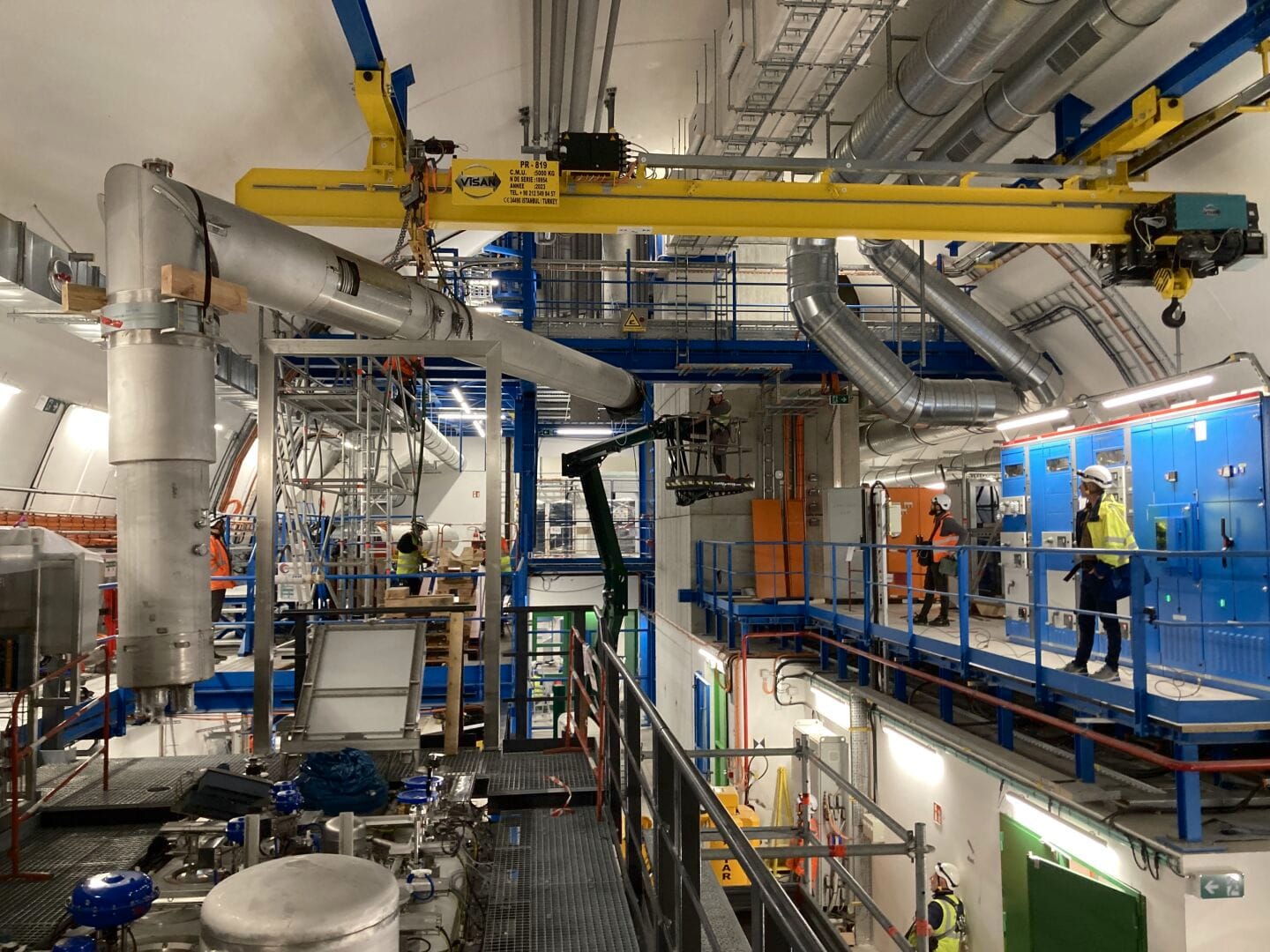
The third long technical shutdown (LS3) has begun and will last until 2030. During this time, the collider will not just undergo maintenance — it will be fundamentally rebuilt into a new machine: the High-Luminosity LHC, capable of generating ten times more particle collisions, reports Home.cern. For science, this is not the end of an era, but preparation for the next one.
The Gist
- On June 29, 2026, the LHC completed its third operational cycle (Run 3) and was shut down to begin Long Shutdown 3 — the most extensive upgrade since the collider was built.
- The main goal of LS3 is to install the High-Luminosity LHC (HiLumi LHC) equipment, which will increase the collider's luminosity by up to 10 times compared to its original parameters.
- In the collider tunnel, 1.2 km of magnets and components will be dismantled and replaced. The ATLAS and CMS detectors will effectively become new instruments.
- The HiLumi LHC is planned to start operations in 2030. Some parts of the accelerator complex will gradually restart from 2028.
- The LHC's main achievement over 18 years of operation is the discovery of the Higgs boson in 2012, as well as the detection of over 85 new hadrons and hundreds of other scientific results.
Farewell to the Machine That Changed Physics
Since the first particle beams in September 2008, the LHC has become synonymous with scientific breakthroughs. Its main achievement — the discovery of the Higgs boson on July 4, 2012, confirmed the mechanism proposed almost half a century ago. It is this particle that explains why other particles have mass.
"The LHC has exceeded all expectations," said Oliver Brüning, CERN's Director for Accelerators and Technology. "For almost two decades, it has transformed our understanding of the Universe and inspired generations of scientists, engineers, and citizens worldwide. Today, we say goodbye to the LHC as we knew it and prepare to meet its successor."
What Will Happen in Four Years
LS3 is not just a repair. In the 27 km long tunnel, 1.2 km of magnets and components will be dismantled and replaced with new HiLumi equipment. The ATLAS and CMS detectors — the two main "eyes" of the collider — will undergo such radical upgrades that they will effectively become fundamentally new instruments.
The new detectors must handle significantly higher loads: if during the last cycle about 60 proton-proton interactions were recorded per bunch crossing, the HiLumi LHC will generate between 140 and 200 simultaneous collisions. Data acquisition systems will have to select the most interesting events from over five billion interactions every second.
What Will Be Searched for After the Restart
A tenfold increase in luminosity primarily means the ability to accumulate incomparably larger datasets. The main scientific goals of the HiLumi LHC are the precision study of the Higgs boson: its properties, interactions, and possible deviations from the predictions of the Standard Model. Such deviations could point to new physics — phenomena beyond the current understanding of the structure of matter.
In parallel, during LS3, thousands of scientists will continue to analyze data accumulated over previous operational cycles. The LHC is silent — physics does not stop.
Kazakhstan Context
Kazakhstan is not a member of CERN, but Kazakh physicists participate in individual experiments of the organization under cooperation agreements. A more practical dimension is related to technology: CERN's developments in superconducting magnets, cryogenic systems, high-performance computing, and detector technologies find industrial applications far beyond particle physics — in medical diagnostics, materials science, and energy. These are precisely the areas that intersect with Kazakhstan's technological agenda within the framework of Pax Silica and science development programs.
Author's Conclusion
The LHC is not dead — it is evolving. Shutting down the planet's largest scientific machine for four years to create a machine ten times more powerful is an investment in knowledge, the returns of which are unpredictable in form but historically inevitable. The Higgs boson was found almost 50 years after its prediction. What the HiLumi LHC will discover — we will find out after 2030.



Comments ()