Scientists estimated how many lives the current super El Niño has already claimed — and how to save the rest
The University of Chicago's Climate Impact Lab published a forecast of excess heat deaths caused by the current El Niño.

Researchers deliberately built the report not around the number itself, but around the question of what can still be done in time.
The gist in brief
- According to the Climate Impact Lab estimate, during the first nine months of the current super El Niño (June 2026 — February 2027), heat could kill 451 thousand people more than in a normal year — of these, 239 thousand ± 11 thousand will occur in the next six months (September–February).
- For comparison, the report's authors cite their own estimate: this is roughly 65 times more than the number of dead and missing in the recent devastating flood in Nepal (about 6,800 people).
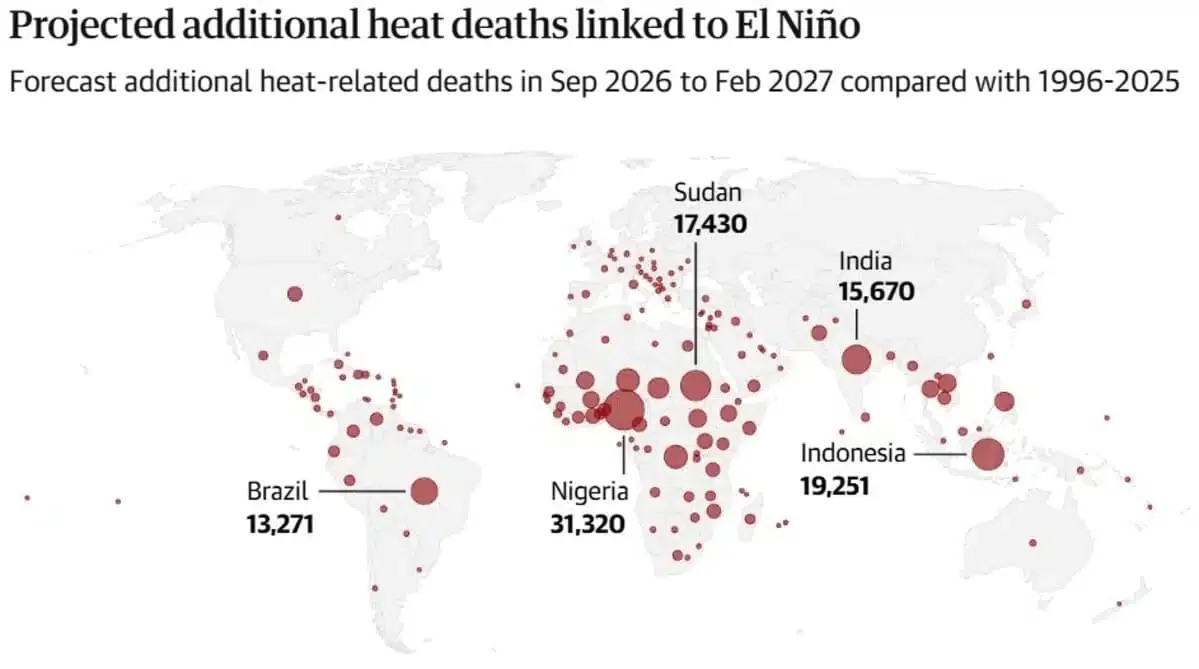
- Sub-Saharan Africa will be hit hardest in the next six months: the Sahel countries combined — 66,800 additional heat deaths, of which almost half (31,400) are in Nigeria alone; followed by Sudan (17,500), Niger (10,000), and Chad (8,000).
- In Southeast Asia, excess deaths are estimated at 19,400 (the Philippines, Vietnam, Thailand, and Cambodia combined) and 19,300 (Indonesia), in India — 15,800, in Brazil — 13,300.
Why this particular El Niño and why now
According to the scientists' calculations, global land temperatures in the coming months will be roughly 1.2°C above normal — largely because of the current super El Niño, which began in June and, according to forecasts, will continue until spring 2027 in the Northern Hemisphere. This should lead to 44% more abnormally hot days than in a normal year. The report's authors describe the meaning of what is happening figuratively: El Niño is effectively "pushing" humanity into the future — showing temperatures a couple of decades ahead of schedule that climate change would have brought anyway, but without time to adapt to them.
The forecast is built on a model linking temperature and excess mortality, taking into account local climate, population vulnerability, and already accumulated adaptation experience in 24,378 regions of the world; the calculations rely on the long-term seasonal forecast of temperature anomalies ECMWF SEAS5 and are compared with average mortality rates for 1996–2025.
Not just a forecast, but a map of opportunities to save lives
The key part of the report is not stating the expected losses, but an attempt to show where targeted action can save tens of thousands of lives before the deaths occur, rather than after. The authors note separately: in different countries, the peak mortality occurs at different times within the six-month forecast, which leaves different amounts of time for preparation. In Nigeria and Indonesia, the largest share of deaths is shifted to the second half of the forecast period (December–February) — 15,400 and 10,400 cases respectively; in Brazil and India — 8,000 and 7,400, also in the second half of the period, which means the authorities of these countries objectively have more time to react than if the peak had fallen in the coming weeks.
Among the measures that, according to the lab's own Adaptation Inventory database, have been proven to reduce heat mortality are early heat warnings, targeted work with vulnerable population groups, cooling and water distribution points, protection of manual laborers, and expanding the capacity of healthcare systems. The researchers explicitly call this a "postcard from the future" — a signal of where the climate as a whole is heading, but with one important difference: climate change itself still has more time to prepare than the current sharp jump.
Part of a series we are following
The excess mortality forecast logically continues the coverage of this El Niño season that we have already examined. We wrote about how NOAA raised the probability of a record-strength current event to almost 69%, that it also threatens a fifth of the vertebrates of the Galapagos Islands, that in Indonesia the number of peat fires has catastrophically increased, and that California faces the highest sea levels in the entire history of observations along the state's coast. The Climate Impact Lab forecast adds to this picture the most direct, human dimension — the number of lives that this particular climate anomaly can take or, with timely measures, preserve.
Author's conclusion
The value of such a forecast is not in the frightening number itself, but in the fact that it is broken down by region and timeframe in enough detail for specific governments and humanitarian organizations to direct limited resources exactly where and when they will have the greatest effect. The report's authors deliberately avoid fatalism: heat mortality is one of the few climate risks for which a proven set of relatively inexpensive protective measures already exists. The question the report poses is not whether the forecast will ultimately be confirmed, but whether the countries on the most vulnerable list will manage to apply these measures in the remaining months before most of the 239 thousand deaths expected in the next six months actually occur.



Comments ()