China is turning from the largest LNG buyer into a competing gas seller
China, the world's top importer of liquefied natural gas (LNG), is increasingly reselling it to other countries.
The surplus of long-term contracts is growing, while its own gas demand is plateauing. This is stated in the September 2026 report by the Institute for Energy Economics and Financial Analysis (IEEFA) "From Buyer to Broker".
The gist in brief
- In the first half of 2026, re-exports accounted for 47% of the LNG handled by vessels chartered by Chinese companies.
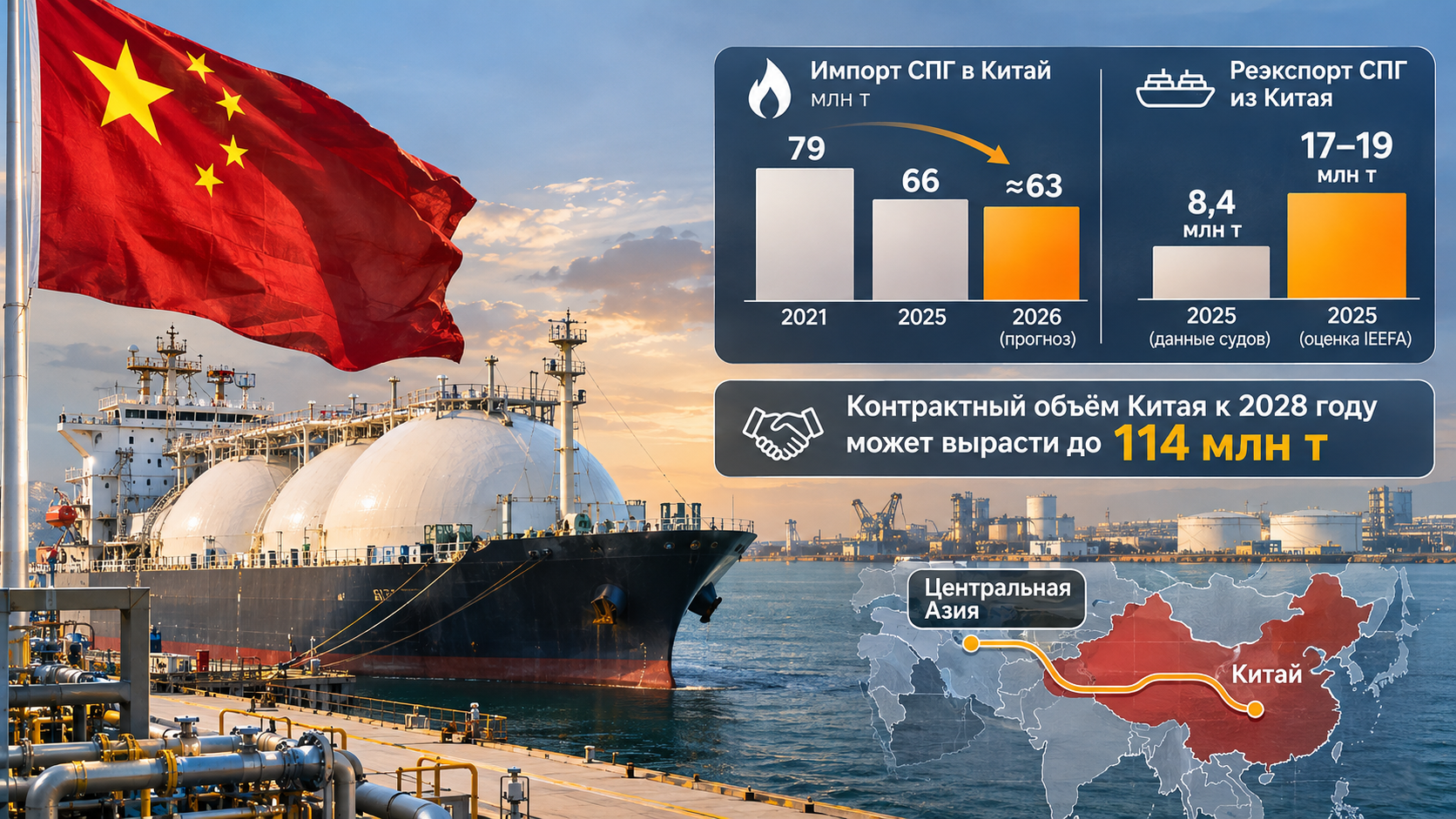
- China's LNG imports fell from 79 million tonnes in 2021 to 66 million tonnes in 2025; for 2026, IEEFA expects about 63 million tonnes.
- China's contracted volume could grow to 114 million tonnes by 2028.
- IEEFA estimates China's total re-exports in 2025 at 17-19 million tonnes; according to vessel data, 8.4 million tonnes.
What the report says
The main conclusion of the authors, Christopher Doleman and Sam Reynolds, is that the largest source of LNG demand is becoming a competing supplier. China signed many long-term contracts in 2021-2023, and now supplies are arriving under them, while demand in the country is not growing. LNG imports fell from 79 million tonnes in 2021 to 66 million tonnes in 2025; for 2026, about 63 million tonnes is expected, with footnotes indicating a range of 61-64 million tonnes.
Re-exports, according to IEEFA estimates, amounted to 17-19 million tonnes in 2025. The lower bound is derived from the assumption that chartered vessels carry half of the resold gas, while the upper bound is derived from the contractual surplus. The authors call the estimate conservative. According to data on vessels chartered by Chinese companies, 8.4 million tonnes were resold in 2025. The main destinations in 2025 were South Korea (19%), Japan (14%), and the Netherlands (9.9%).
Why China resells gas
According to the report, several reasons contributed to this. Flexible contracts with Australia and the United States allow cargoes to be sent where the price is higher. Due to trade tensions, U.S. LNG was not supplied to China from March 2025 to June 2026, so such cargoes were resold. After 2022, U.S. gas is also more profitable to sell in Europe. IEEFA estimates China's profit from reselling U.S. and Australian LNG from 2021 to June 2026 at $4.6 billion.
In November, ProFinance reported that LNG re-exports from mainland China in January-October 2026 tripled compared to the same period in 2025, with two-thirds going to South Korea and Thailand. The publication cites Bloomberg estimates and links the growth to supply disruptions from the Middle East due to the closure of the Strait of Hormuz, weak industrial demand in China, and rising domestic production. The absolute volume of re-exports over the ten months is not stated in that material.
What happens next
IEEFA expects China's contracted volume to grow to 114 million tonnes by 2028. From 2026 to 2032, about 46 million tonnes should arrive under contracts, 43% of which are flexible. The contract surplus in 2026, according to the authors' estimate, could reach almost 32 million tonnes excluding new contracts with the Persian Gulf. In the early 2030s, it is estimated in the range of 11-48 million tonnes. According to ProFinance, Chinese companies signed seven new long-term import contracts for 10.65 million tonnes per year with supplies starting in 2027.
What about gas from Central Asia in China
China receives gas not only as LNG but also via pipelines. In March 2026, inbusiness.kz wrote that Turkmenistan announced its intention to increase gas supplies to China from 40 to 65 billion cubic meters per year. The gas flows through Kazakhstan along the Central Asia-China mainline; the Kazakh section is operated by Asian Gas Pipeline LLP, a joint venture of Qazaq Gas and CNPC. The design capacity of lines A, B, and C is about 55-60 billion cubic meters per year; from 2009 to March 1, 2026, about 460 billion cubic meters were supplied to China. The operator's revenue for 2024 amounted to almost 900 billion tenge, with net profit of more than 650 billion tenge.
Which figures diverge
In the IEEFA report, the contract surplus in 2026 is cited both as "almost 32 million tonnes" and as 40 million tonnes, with the difference unexplained. For the early 2030s, different parts of the report give ranges of 11-48 million tonnes, "more than 47 million tonnes," and 4-40 million tonnes. The 47% share in the first half of 2026 refers to LNG that passed through vessels chartered by Chinese companies, not to the country's total imports.
What remains unknown
There is no exact figure for China's re-exports in 2026 in either the IEEFA report or the ProFinance material. It is unclear how the LNG surplus will affect China's demand for pipeline gas from Central Asia: in the IEEFA report, Central Asia and Kazakhstan are not mentioned in this context.
What is happening with gas in Central Asia
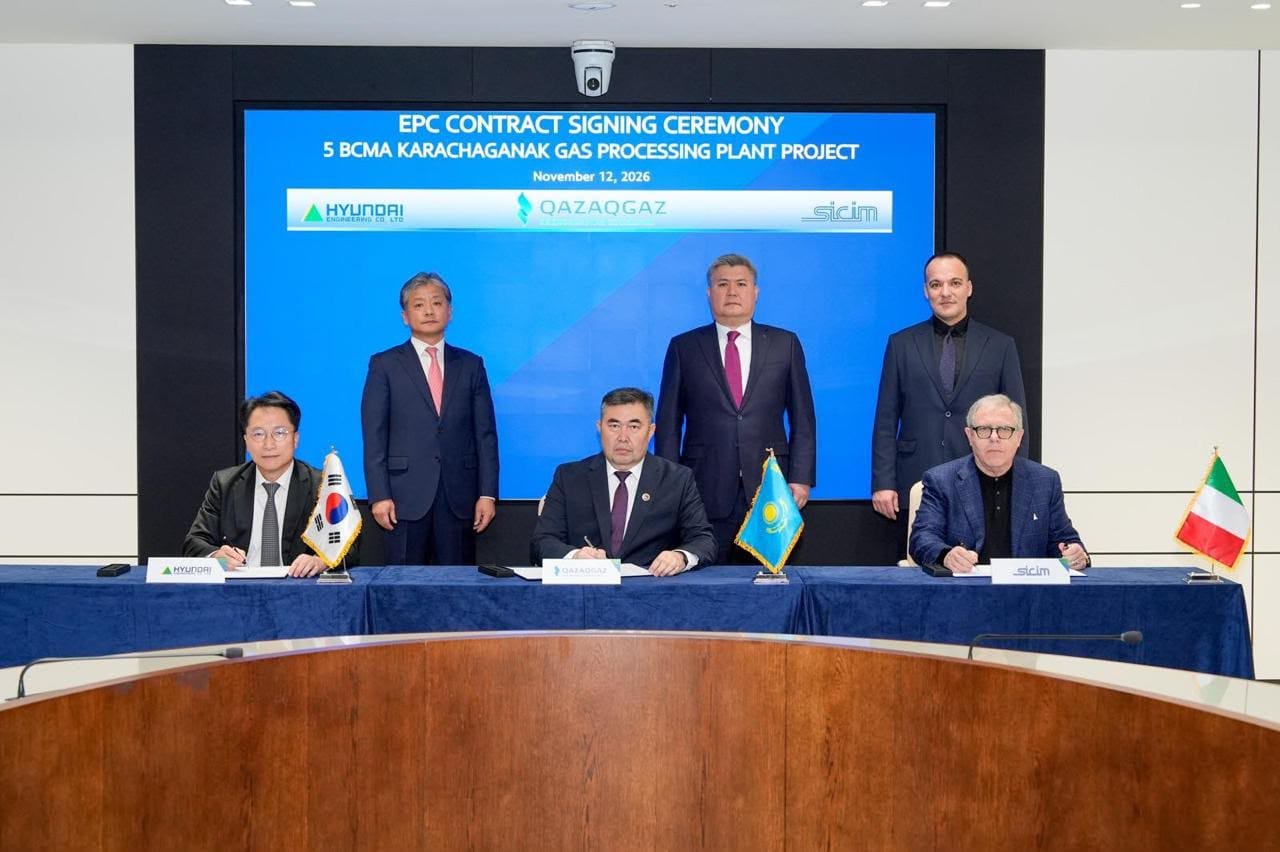
Over ten years, the region has come to consume more gas and export less: exports declined from 89.6 billion cubic meters in 2015 to 47.4 billion cubic meters in 2025, while consumption grew by 76% to 119.6 billion cubic meters. Kazakhstan exports 4.77 billion cubic meters. Domestically, processing capacity is being expanded: QazaqGaz Processing signed a contract in China for a second gas processing plant at Kashagan with a capacity of up to 2.5 billion cubic meters per year; together with the first plant, capacity will reach up to 3.5 billion cubic meters. In Uzbekistan, the volume of seismic exploration increased fivefold, and five gas fields were discovered, but gas imports by 2030 could reach 10-11 billion cubic meters per year. Expert Askar Ismailov proposes connecting the gas networks of five countries in a ring of over 3,000 km for approximately $5 billion, but financing and agreements between governments have not yet been coordinated.
Author's conclusion
China increasingly looks less like a market that takes any gas and more like a trader with a surplus of contracts. For Central Asia, this matters as background: the transit route to China is designed for 55-60 billion cubic meters per year, while the neighboring market receives more and more flexible LNG. The IEEFA report does not directly link these flows, so it is too early to judge the impact on Kazakh transit.

Comments ()