China restores degraded pastures in Uzbekistan — Central Asia becomes a testing ground for the "Green Wall
Chinese M-Grass Ecology and Environment Group signed an agreement with Uzbekistan’s Green University to restore degraded pastures and combat desertification.
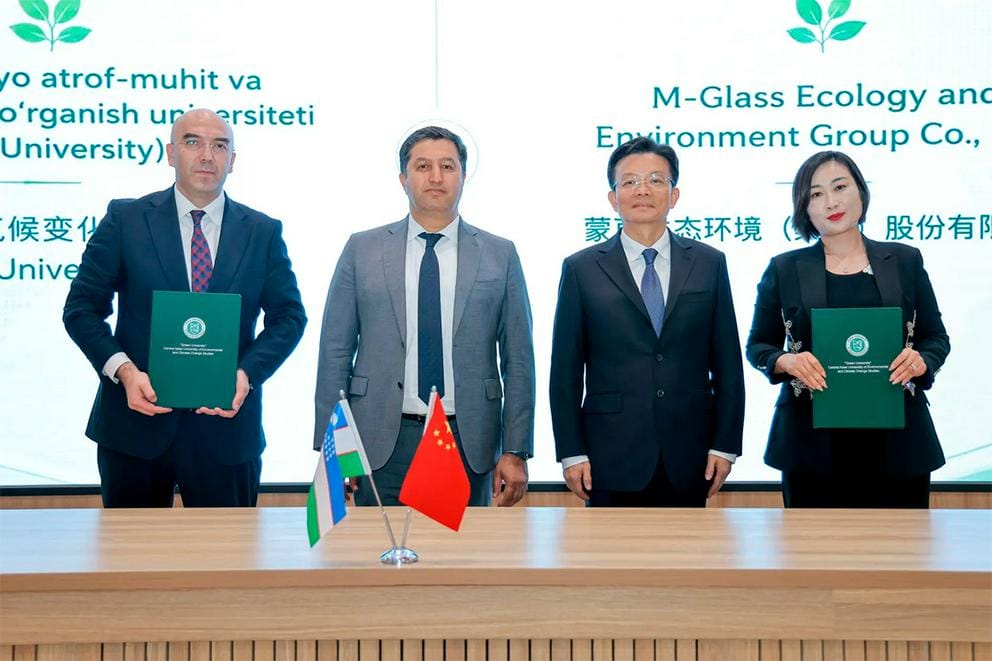
The event took place in Tashkent on July 21, 2026, as part of an exhibition on China's achievements in creating an ecological barrier in Inner Mongolia, reports FerganaNews. This is already the second major signal in a week: China is systematically promoting its desertification control technologies in Central Asia — following the creation of the China-Central Asia Center for Desertification Prevention. For Kazakhstan, whose pasture lands are degrading across tens of millions of hectares, what is happening in neighboring Uzbekistan is a direct call to action.
The Gist
- M-Grass Ecology and Environment Group — a Chinese company specializing in ecosystem restoration, grassland rehabilitation, desertification control, and seed technologies — has signed an agreement with Uzbekistan's Green University.
- The document provides for the rehabilitation of degraded pastures, joint cultivation of seeds and seedlings, and the introduction of modern eco-technologies.
- The exhibition was dedicated to China's experience in Inner Mongolia — a region where the country first stopped the advance of the Gobi Desert and created a large-scale "green barrier."
- In 2024, China became the first country in the world to achieve zero net growth in the area of degraded land. Over 40 years, more than 4 million hectares have been restored.
- Green University is the Central Asian University for Environmental Studies and Climate Change, established in Uzbekistan by presidential decree in 2023.
Inner Mongolia as a Textbook for Central Asia
It is no coincidence that the exhibition in Tashkent featured the experience of Inner Mongolia — an autonomous region of the PRC bordering the Gobi Desert. It was here that China perfected the technologies it later scaled across the entire country: planting drought-resistant grasses and shrubs, creating protective belts, and using special seeds adapted to arid conditions.
M-Grass is a direct product of this experience: the company specializes specifically in grassland rehabilitation and seed technologies for arid territories. Its entry into Uzbekistan means the transfer not just of ideas, but of specific agro-ecological practices with proven results.
Central Asia as a New Front in the Fight Against Desertification
Uzbekistan is not the first point of China's eco-expansion in the region. We have already written that China has tamed the Taklamakan Desert and is now sharing its experience with Central Asia: in 2026, the China-Central Asia Cooperation Center for Desertification Prevention was launched. The agreement between M-Grass and Green University is the next practical step in the same logic: moving from institutional cooperation to real field projects.
Central Asia is objectively one of the most vulnerable regions on the planet in terms of land degradation. Cotton farming depleted the soils of Uzbekistan and Turkmenistan for decades. The drying of the Aral Sea left millions of hectares of saline seabed. Soviet-era extensive livestock farming degraded pastures in Kazakhstan and Kyrgyzstan. Chinese restoration technologies address precisely these problems.
The Kazakhstan Context
According to the Ministry of Ecology and Natural Resources of the Republic of Kazakhstan, more than 70 million hectares of Kazakhstan's pasture lands are subject to some degree of degradation. This is a colossal area — larger than the entire territory of France. The causes: overgrazing, wind erosion, salinization, lack of watering points, and a long-term absence of systematic management.
While Uzbekistan is signing agreements with M-Grass, Kazakhstan has its own tools: the state program "Zhasyl El" provides for large-scale reforestation, and the Law "On Soil Protection" adopted in June 2026 creates an institutional framework for monitoring degradation. The China-Central Asia Center for Desertification Prevention, established in 2026, is formally accessible to Kazakhstan as well.
The question is the speed of using these tools and the willingness to adopt proven technologies rather than inventing its own from scratch.
Author's Conclusion
China is consistently becoming an exporter of land restoration technologies for Central Asia — and it is doing so through concrete corporate agreements, not just political declarations. For Kazakhstan, where pasture degradation has reached the scale of a national problem, the Uzbek experience of attracting M-Grass is worth studying in detail — not as someone else's story, but as a model for adaptation.



Comments ()