Climate discrimination and the end of the garden city era in Almaty
Green deficit confirmed by satellite data: nature retreats massively before Almaty’s development. A climate inequality map reveals the city split into shady oases and concrete heat traps. Loss of natural filtration in treeless areas turns dust and smog into
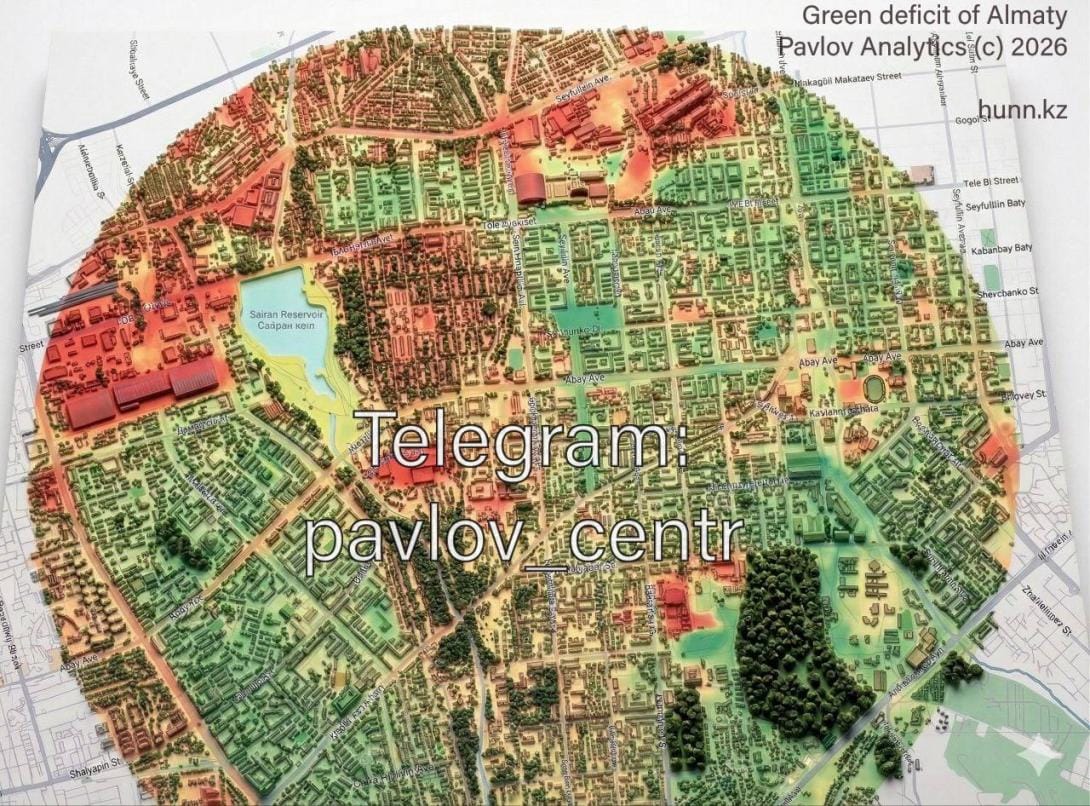
The familiar designation of Almaty as a "green city" is increasingly coming into conflict with a reality where landscaping is becoming an element of property qualification rather than a citywide standard. Satellite monitoring records a large-scale "green deficit," which experts characterize as a documented capitulation of urban flora to aggressive space concreting.
In a Nutshell
- The green deficit is confirmed by satellite data as a fact of large-scale retreat of nature before development.
- The climate inequality map reveals the division of the metropolis into shady oases and concrete heat traps.
- The loss of natural filtration in treeless areas makes dust and smog a permanent part of the atmosphere.
- Quality of life has become a geographical factor, rigidly tied to specific coordinates of residence.
The Phenomenon of Documented Capitulation of Nature
Almaty's status as an ecological benchmark in modern conditions is turning into a formality. Satellite analysis of the city has revealed that vegetation is rapidly giving way to concrete. This process is not just an aesthetic problem, but an actual admission of the ecosystem's defeat in the struggle against urbanization. Today, the abundance of greenery in a neighborhood serves more as an indicator of the social status of its residents than a characteristic of the entire metropolis.
Anatomy of Heat Traps and Oases
Of research interest is the climate inequality map, which clearly demonstrates the geography of discrimination within the city. While some areas enjoy the protection of shady avenues, others are turning into powerful "heat accumulators." These urban traps, made of concrete and asphalt, actively absorb solar energy during the day and continue to radiate heat into the windows of residential buildings even at night.
Beyond temperature discomfort, the lack of foliage deprives the city of natural air filtration mechanisms. In areas without trees capable of mitigating heat and purifying the environment, dust and smog become a habitual and inevitable atmosphere.
Fragmentation and Disintegration of Urban Space
Modern Almaty shows signs of deep urban disintegration, where the unified fabric of the "garden city" is torn into separate patches. The quality of life now directly depends on specific coordinates: the boundary between a cool, well-maintained oasis and a concrete "ghetto" is physically felt when moving from one neighborhood to another.
This situation reinterprets an old truth: in the height of an Almaty summer, all gardens are equal, but some are definitely "more equal" than others.
Author's Conclusion
The transformation of Almaty from a holistic ecosystem into a set of isolated microclimates with varying levels of comfort underscores a systemic crisis in urban planning. When the right to clean air and coolness becomes a privilege rather than a basic norm, the city loses its identity, turning into a space of climatic segregation.

Comments ()