Land restoration area in Kazakhstan ranked third in the world according to UN report
Kazakhstan ranks third globally by area of land covered by restoration measures, according to the UN's first global "Nature's Comeback" report.
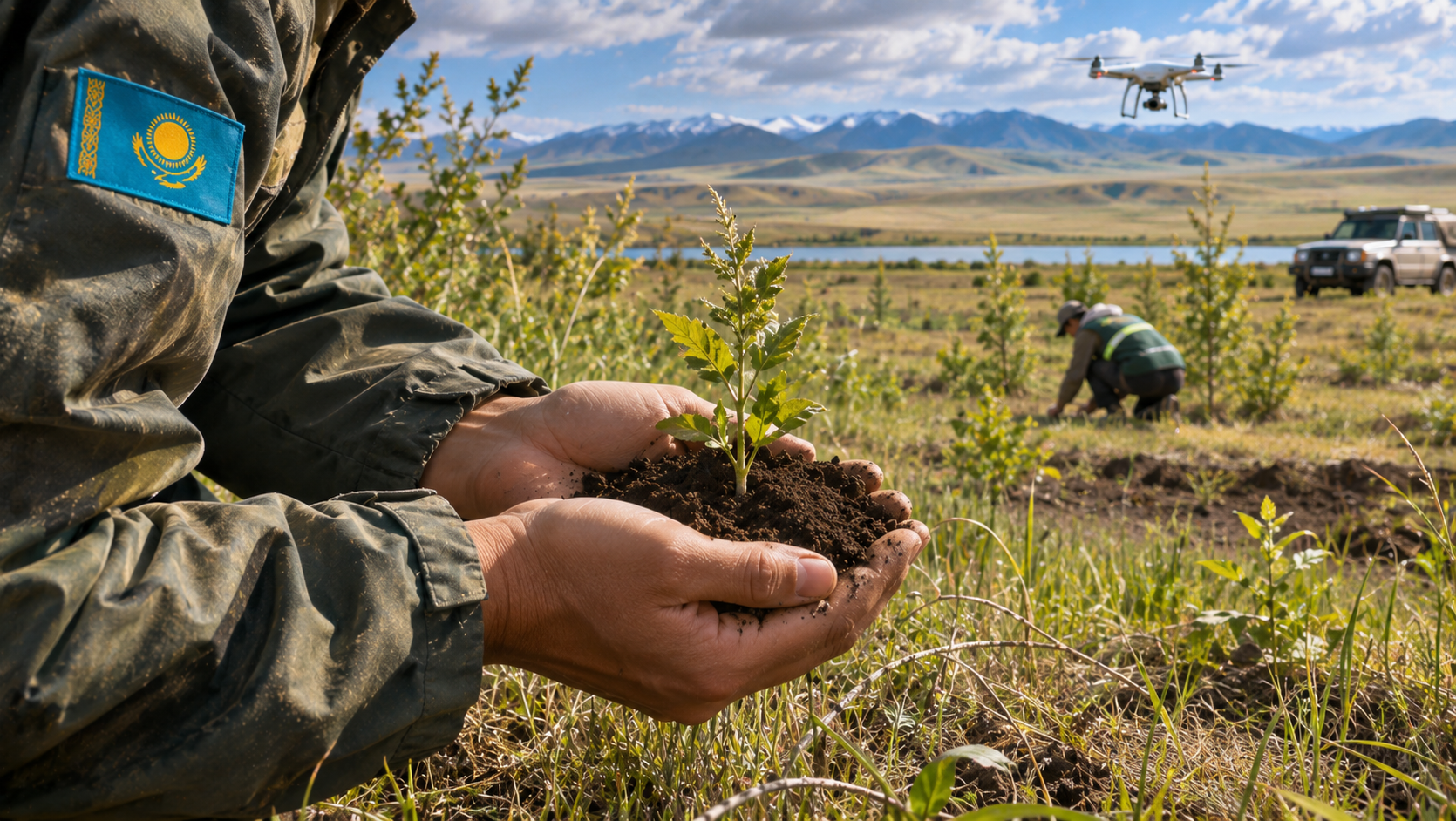
The country has such works ongoing on 8.13 million hectares, about 3% of the territory. This is reported by the Ministry of Agriculture of Kazakhstan.
The gist in brief
- In Kazakhstan, restoration measures cover 8.13 million hectares, about 3% of the country's territory.
- Ahead are only China (127.4 million hectares) and Mongolia (12.18 million hectares).
- In 2025-2026, electronic land degradation maps covered 114 million hectares, and 2.7 million hectares of degraded farmland were identified.
- The Law "On Soil Protection" was adopted on July 8, 2026; the regions are working out soil protection plans.
What the UN report showed
The report "Nature's Comeback" (full text) was prepared by FAO, UNEP and the Secretariat of the Convention on Biological Diversity. As reported by FAO, it documents restoration work on approximately 252 million hectares in 149 countries, of which about 232 million hectares are in terrestrial ecosystems.
In the list of countries with the largest declared area of terrestrial ecosystems under restoration, Kazakhstan ranks third: 8.13 million hectares, or 3% of the country's territory. Ahead are China with 127.41 million hectares (13.5%) and Mongolia with 12.18 million hectares (7.8%). Next come Ethiopia (5 million), Indonesia (4.69 million) and Brazil (3.41 million).
The authors themselves stipulate that the figures are given for comparison and should not be read as a ranking of effectiveness: the difference in areas depends on the size of countries, the scale of programs and the completeness of monitoring. FAO emphasizes that the territory under restoration has not necessarily already been restored: the return of ecosystem functions may take decades. In addition, 46 countries did not provide quantitative data for any of the assessed reporting systems, and differing definitions and monitoring methods complicate comparison.
What the Ministry of Agriculture is doing for soil protection
The ministry states that it is stepping up work on preserving land resources: assessing the condition of soils, identifying degraded areas and introducing digital monitoring tools. In 2025-2026, electronic land degradation maps covered 114 million hectares, and surveys identified 2.7 million hectares of degraded agricultural land. According to the ministry, these data make it possible to identify priority territories and plan targeted measures.
The Law "On Soil Protection" was adopted on July 8, 2026. It establishes legal mechanisms for soil survey, protection and restoration. The ministry, together with local executive bodies, is working out regional action plans: they provide for measures against degradation, restoration of agricultural land and preservation of its productivity.
What is happening with soils and land in Kazakhstan
The soil protection law came into force on September 8 and obligated landowners to preserve the fertile layer and prevent erosion and soil depletion. Kazakhstan and FAO launched three projects: on soil carbon, on combating locusts with drones and on reviving the aport apple.
Earlier, in the report "The State of the World's Forests - 2026," FAO reported that more than 460 million hectares of forests have degraded worldwide. The same report also describes the Kazakh project to restore tugai forests in the Ili delta. In two forest reserves, "Ertis Ormany" and "Semey Ormany," over an area of more than 1.2 thousand hectares, 5 million pine seedlings will be planted to restore forests damaged by fires.
On the bottom of the Aral Sea, phosphogypsum from fertilizer waste is being tested for restoring saline soils, and chernozem, in whose reserves Kazakhstan ranks second in the world, according to Russian expert Sergei Korshunov, has finally begun to be protected.
Author's conclusion
The place in the report shows the scale of restoration work, but not the condition of the soils: the Ministry of Agriculture itself cites 2.7 million hectares of degraded farmland. The real picture will be provided by the regional soil protection plans and by how the law begins to work in practice.
Comments ()