Cloud seeding in Kazakhstan — dispute with neighbors persists three months later
Kazakhstan's drought-fighting program, launched in May, still sparks controversy three months later.
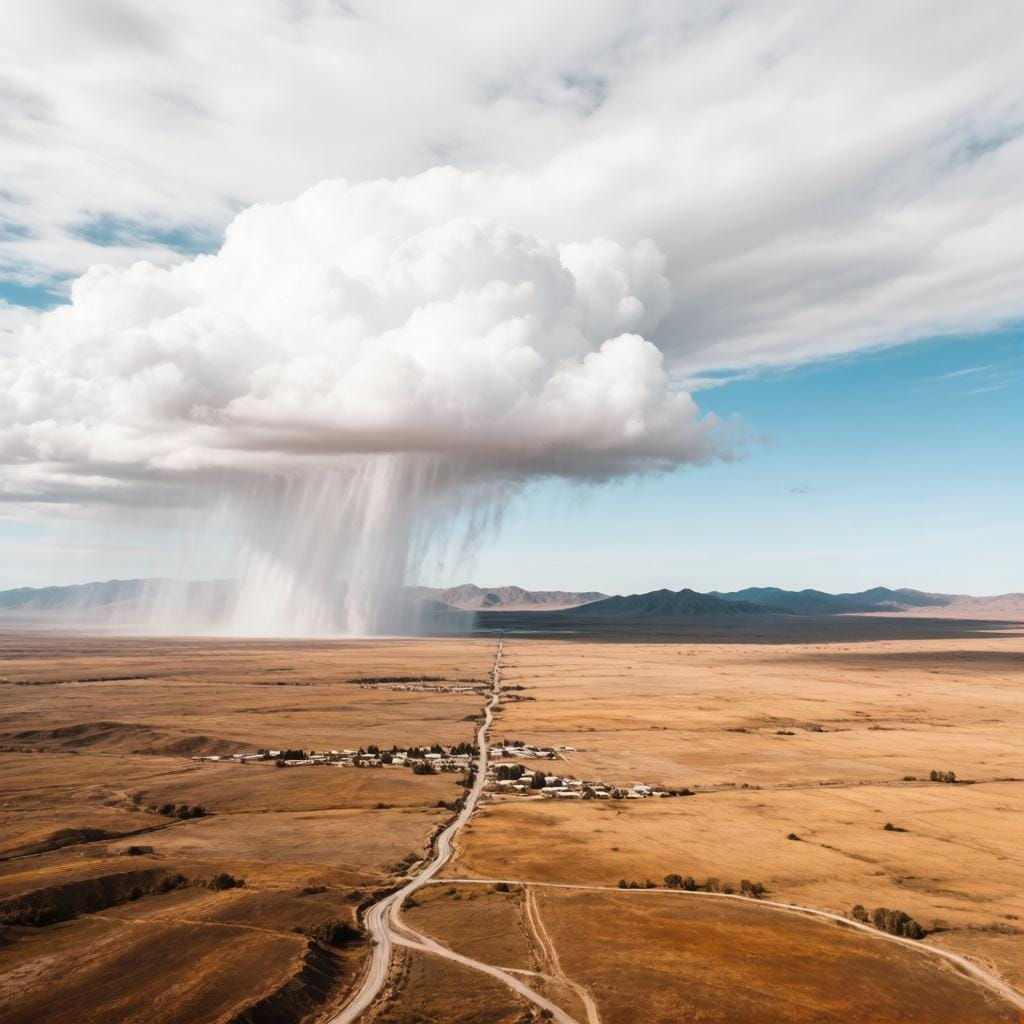
Neighboring countries in the region are concerned that Kazakhstan might be taking their rain — although surveyed scientists consider this scenario scientifically unfounded, water diplomacy experts point to a real gap in the rules of the game, and no confirmed damage has been recorded over the past months.
The gist
- On May 17, 2026, Kazakhstan launched Central Asia's first large-scale cloud seeding program — in the Turkistan region with support from the UAE, covering more than 900,000 hectares of drought-vulnerable agricultural land.
- The program has caused concern among neighbors: former Kyrgyz Prime Minister Akylbek Japarov warned that atmospheric processes do not recognize state borders and could affect the entire water balance of the region.
- Atmospheric scientists surveyed by RFE/RL call the "rain theft" concerns scientifically unfounded: the effect of cloud seeding is purely local and cannot redirect atmospheric moisture across borders.
- At the same time, water diplomacy experts point to a real regulatory gap — Kazakhstan's obligations under the Espoo Convention require consultations with neighbors before actions that could affect their territory.
What Kazakhstan launched
The cloud seeding program — a technology that disperses substances in clouds to stimulate precipitation — started in the southern Turkistan region as a response to drought, water scarcity, and accelerating desertification in one of the country's most arid regions. The project is implemented jointly with the United Arab Emirates and covers over 900,000 hectares of vulnerable agricultural land. Significantly, the discussion around such technologies is unfolding against a broader trend: weather modification is increasingly turning from a scientific topic into a matter of geopolitical disputes — previously, similar "cloud theft" accusations were leveled at the UAE and Saudi Arabia by Iran.
Social media blew up the story before science did
Literally the day after the program was launched, Kazakhstan's Kazhydromet forecast heavy rains in several southern regions. When the downpours actually came, social media instantly filled with speculation that this was a direct result of cloud seeding. Kazhydromet had to issue a separate clarification: the rains were caused by a natural cyclonic system passing through the region, not by artificial intervention. But by that point, the discussion had already moved beyond Kazakhstan and grown into a broader regional conversation about weather control and water security.
What science says
Professor of Climate and Atmospheric Sciences at the University of Illinois at Urbana-Champaign Robert Rauber, when asked directly whether artificial rain in one country could reduce precipitation in neighboring ones, answered unequivocally: "No. The effect is very local." According to him, cloud seeding enhances precipitation in already existing cloud systems rather than creating new weather patterns or redirecting atmospheric moisture — he cannot assess the specific Central Asian project without additional details, but in general the technology's effectiveness strongly depends on local atmospheric conditions. Rauber also dismissed concerns about the environmental danger of silver iodide, which is sometimes used for seeding: the amount of the substance is so small that it is not detected in water samples on the ground.
A gap in the rules of the game
Even experts who reject the very idea of transboundary "rain theft" point to another problem — the lack of transparency and a common legal framework for such atmospheric interventions in Central Asia. Coordinator of the Central Asian Expert Platform on Water Resources Management Bulat Yessekin noted that cloud seeding falls into the category of geoengineering solutions that are currently not supported at the UN level or by the scientific community as a whole.
"There are several UN resolutions on geoengineering solutions. They say we need to be careful. Until we have studied all the consequences, we do not recommend their application," believes Bulat Yessekin.
According to him, the neighbors' desire to get clarifications is completely normal — just as it is natural to ask a neighbor how repairing their roof will affect your apartment — and Kazakhstan, as a party to the Convention on Environmental Impact Assessment in a Transboundary Context (Espoo Convention), is formally obliged to conduct consultations and scientific assessments before actions that could affect neighboring regions. Professor at the Kazakh-British Technical University Zhanai Sagin added that introducing such technologies without regional consensus could increase mutual distrust between countries.
Two months later — no confirmed damage yet
Almost three months have passed since the program was launched in May, and since then no new official protests or specific data on damage to neighboring countries have emerged — neither from Kyrgyz authorities nor from independent observers. At the same time, the harvest campaign in Kazakhstan itself is already providing the first practical benchmarks: as of mid-August, in the southern and western regions of the country, where the cloud seeding program operates, winter crop yields reached 20.6 centners per hectare — above the national average of 19.1 c/ha, while eastern and central regions faced more pronounced drought. This neither proves nor disproves the effectiveness of cloud seeding itself — too many factors affect yields simultaneously — but it shows that the dispute remains at the level of concerns and diplomatic formulations rather than confirmed damage figures.
Kazakhstan's official response
Kazhydromet itself refused to comment on the transboundary discussion, stating that the issue falls outside its institutional competence.
A more detailed response came from Kazakhstan's Digital Government Support Center, which rejected claims that cloud seeding could deprive neighboring countries of precipitation: "Despite the long-term use of such technologies in various border regions of the world, the scientific community has so far not provided evidence that local artificial precipitation enhancement operations in one country have led to reduced precipitation in neighboring countries."
The center also noted that Uzbekistan has announced plans to introduce similar technologies — since 2023, the country has been gradually expanding its own, still more modest in scale, ground-based programs.
Author's conclusion
The dispute over Kazakhstan's cloud seeding is telling in that the scientific and diplomatic sides of the issue diverge: from the standpoint of atmospheric physics, concerns about "rain theft" do indeed look exaggerated, but from the standpoint of regional water diplomacy, the real question is not whether Kazakhstan stole someone else's water, but how transparently and jointly with neighbors decisions are made about intervening in the atmospheric system shared by the entire region. Three months after the program's launch, the discussion has remained at the level of statements and concerns, neither escalating into confirmed damage nor into a formal diplomatic protest — but as such technologies spread to Uzbekistan and, likely, other neighbors in the region, the question of common consultation rules will not disappear on its own.

Comments ()