Copper ore mining in Kazakhstan increased 4.3 times, while copper output rose 1.3 times
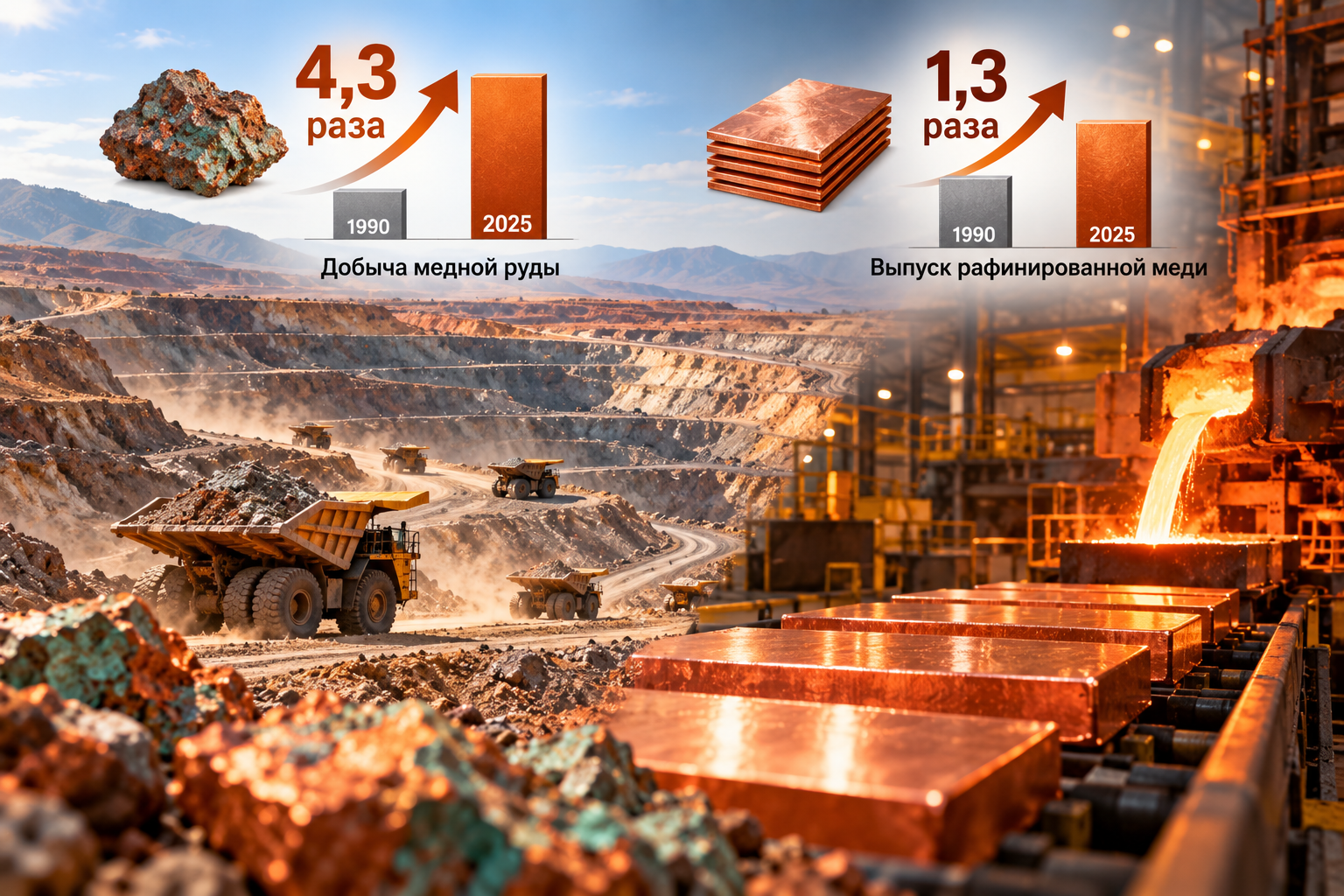
In 2025 Kazakhstan mined 163.7 mln t of copper ore, 4.3 times more than in 1990, and produced 471,800 t of refined copper, 1.3 times more. The 2020 record of about 477,000 t has not been beaten in five years.
Economist Zhanat Nurgaliyev, an expert in the mining and metallurgical complex, drew attention to the gap between extraction and processing in an author's column on BES.media. His data is taken from statistics of the Bureau of National Statistics and government reports; the conclusions are his own assessment.
The essence in brief
- Ore extraction grew from 38.5 million tonnes in 1990 to 163.7 million tonnes in 2025, while refined copper output rose from 365 thousand tonnes to 471.8 thousand tonnes.
- In 2016-2025, 1.26 billion tonnes of ore were extracted (59% of the volume over 36 years), while 4.4 million tonnes of copper were produced (32%).
- Abai and Pavlodar regions produce almost three-quarters of the ore, while the main copper output remains in Karaganda region and Ulytau region.
- According to the author, extraction has already made a "first leap"; now a "second" is needed — in processing.
What the figures show
Until the mid-2010s, Kazakhstan extracted about 30-40 million tonnes of ore per year. Since 2016, extraction has been rising: that year refined copper output grew by 3.5% to 408.4 thousand tonnes, while ore extraction grew by 85%. The maximum copper production, 477 thousand tonnes, occurred in 2020, and it has not been exceeded since.
The geography has also changed. Abai and Pavlodar region produce almost three-quarters of the ore, while the share of Karaganda region and Ulytau region, where the main processing is concentrated, in extraction fell from 62% in 2015 to 24%, although their own volumes grew.
Nurgaliyev notes that ore and finished metal cannot be compared directly: there is beneficiation between them, and copper content in deposits varies. But, in his assessment, the long-term dynamics show the main thing: the raw materials segment expanded noticeably faster than the processing segment.
What about the plants
The Balkhash copper smelter has been operating since 1938 and produces about 51% of the country's cathode copper. In 2026, Kazakhmys is investing 21.8 billion tenge in its modernization. By 2030, according to the government, a new copper smelter with a capacity of 300 thousand tonnes of cathode copper per year at a cost of 750 billion tenge is planned.
In addition, on October 20, President Tokayev launched the construction of the Aktogay copper smelter by KAZ Minerals with a capacity of 300 thousand tonnes of cathode copper per year; the first cathode there is planned to be produced in 2030.
What the author proposes
Nurgaliyev believes that new plants alone will not solve the problem: they need a stable raw materials base, and existing metallurgy needs conditions for modernization. He proposes:
- to create economic conditions under which most of the added value remains in the country;
- to provide existing plants with the opportunity to invest in modernization;
- to give mining companies clear and competitive conditions for selling concentrate, taking into account the new rules under discussion.
What this means for Kazakhstan
These new rules are already being discussed: the Ministry of Industry is working on an export duty on copper concentrate and a methodology for the processing tariff; no decisions have been made on them yet. At the same time, growth in extraction is also built into the plans: the goal is to double copper ore extraction to 300 million tonnes per year by 2030.
Other projects are also expanding the raw materials base. British Central Asia Metals, which extracts copper from old tailings at Kounrad, is looking for new reserves at the Yuzhnoye, Shaiyndy and Teniz sites. The company Georesource Asia, with a Hong Kong owner, will search for copper and molybdenum 40 km north of Balkhash; the work is scheduled for 2027-2031. And at the Zhuantobe polymetallic deposit in Pavlodar region, they plan to build a beneficiation plant with a capacity of up to 500 thousand tonnes of ore per year.
Author's conclusion
The figures show that the growth in ore extraction has so far not been accompanied by the same growth in metal output. Whether the new plants will change this will be shown by how quickly they are built and supplied with raw materials, as well as what conditions domestic processors receive.


Comments ()