Nearly 12,000 new viruses found in deep-sea metal mining zone of the Pacific Ocean
Chinese scientists found 11,742 viruses in seabed sediments of the Clarion-Clipperton Zone in the Pacific Ocean, home to vast metal nodule deposits.
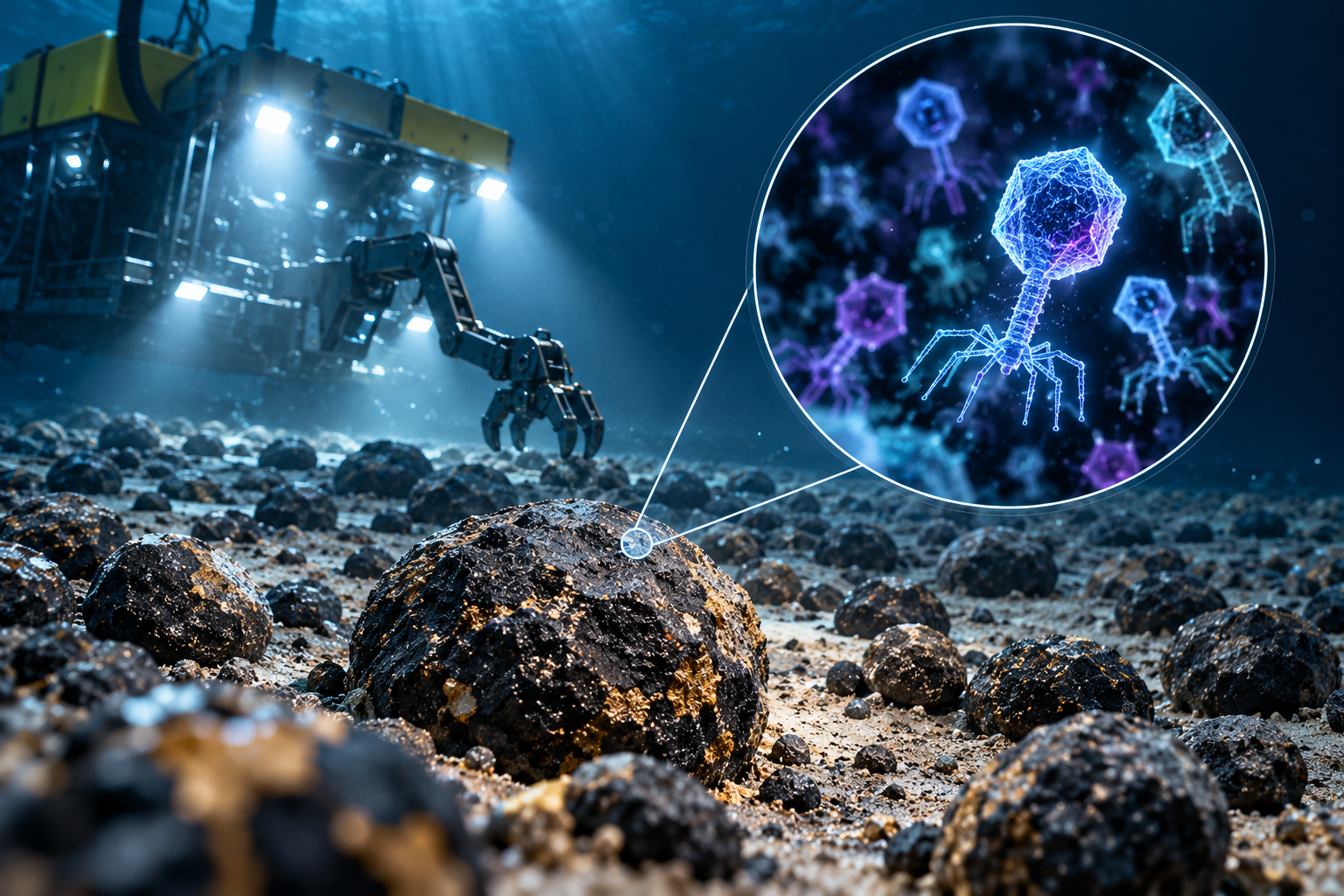
More than 99% of the viruses (11,662) were previously unknown to science, reports South China Morning Post. The study was published by the journal Nature Communications.
The gist in brief
- In the Clarion-Clipperton Zone, 11,742 viruses were discovered, of which 11,662 (more than 99%) were found for the first time.
- The samples are 60 seabed sediment samples collected in 2023 and 2024 by the China Ocean Mineral Resources R&D Association, which holds a contract to explore the zone.
- Most of the viruses are bacteriophages; they infect bacteria and are generally not dangerous to humans.
- The International Seabed Authority has issued 17 exploration contracts in the zone, 5 of them to China; there is no commercial mining yet.
What was found
The Clarion-Clipperton Zone lies in the Pacific Ocean between Mexico and Hawaii at depths of up to 6,000 m. The seabed there is covered with billions of potato-sized metal nodules. According to some estimates, the zone may contain more nickel, cobalt and manganese than all known onshore reserves.
Researchers studied 60 sediment samples and found 11,742 different viruses. To determine how new they are, the scientists compared them with viruses from seawater, ocean trenches and hydrothermal vents: only about 4% of the protein clusters were found in at least one of the external datasets. This means that viral lineages unknown to science live in the zone.
The viruses likely possess unusual properties due to the environment in which they evolved: it is rich in heavy metals and extremely poor in available nutrients.
What kind of viruses these are
The vast majority of the viruses found belong to the class Caudoviricetes. These are tailed bacteriophages: they inject genetic material into a bacterium like a syringe. Viruses of this class are found in the ocean, on land and even in the human gut. They are generally not dangerous to humans, since they infect only bacteria.
What this means for mining
The study's first author, Hou Bowen, a graduate student in a joint program of Chongqing University and the Second Institute of Oceanography of China's Ministry of Natural Resources, wrote that the results provide a "baseline assessment of the microbial ecosystem before mining begins" for future environmental impact assessments.
When mining disturbs the structure of sediments, viruses may lose their ability to perform their role in the seabed ecosystem: decomposing organic matter and releasing nutrients.
Author's conclusion
The discovery shows how little is known about the inhabitants of deep-sea zones that are set to be developed for nickel, cobalt and manganese. For now, the scientists' work is a starting point for future environmental assessments; there are no decisions on commercial mining.

Comments ()