Gold production in Kazakhstan decreased by 11% in nine months
Kazakhstan produced 84.7 tonnes of raw and semi-processed gold in Jan-Sep 2026, down 11% year-on-year.
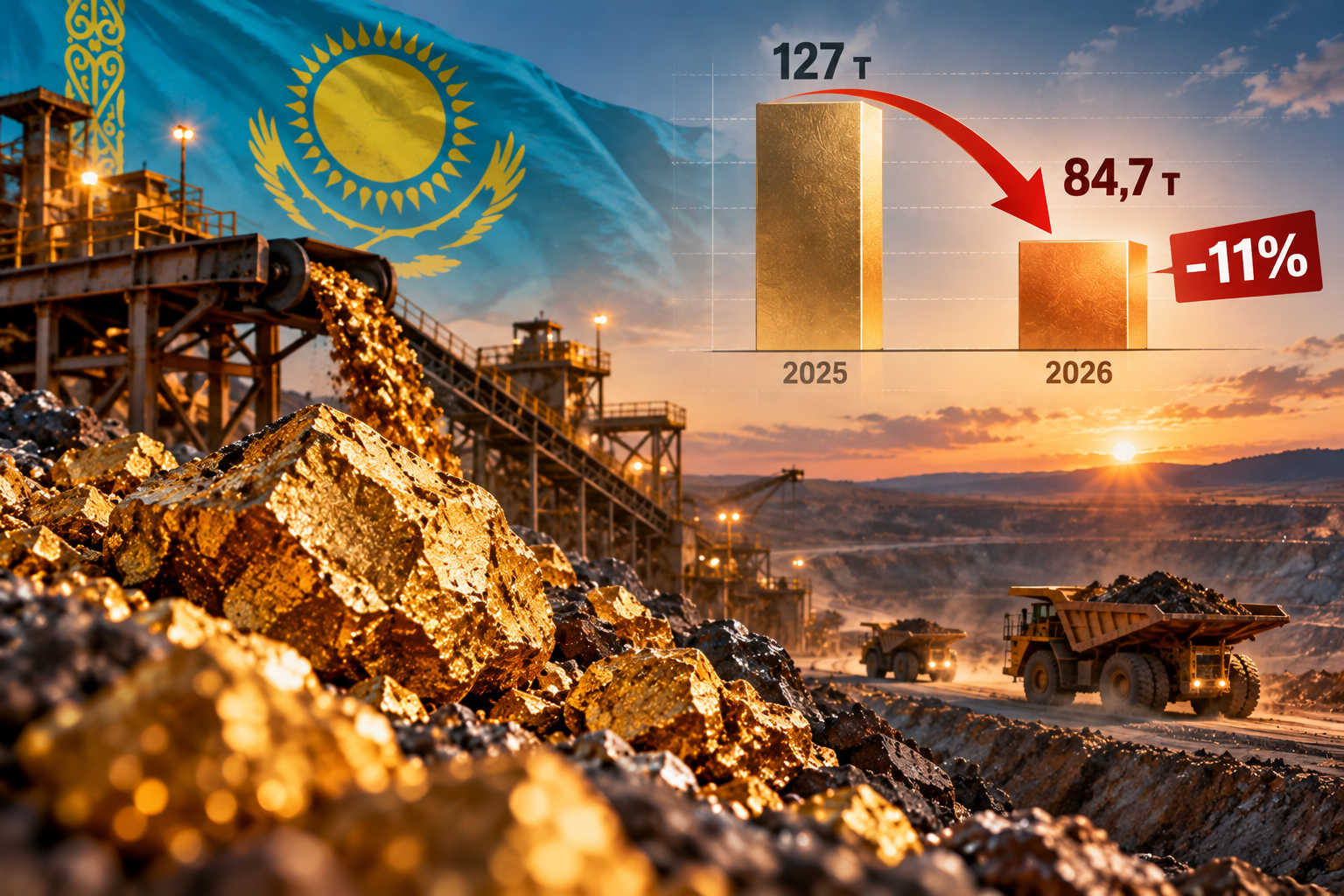
This is the second year of decline: in 2025, output fell by 4%, to 127 t. The data from the Bureau of National Statistics is cited by Energyprom.kz.
The essence in brief
- In the nine months of 2026, 84.7 t of unprocessed and semi-processed gold was produced versus 95.2 t a year earlier, and 47.7 t of refined gold versus 53.5 t, a decline of about 11% in both indicators.
- Results for 2025: 127 t of unprocessed and semi-processed gold (minus 4%, compared with 132.3 t in 2024) and 71.2 t of refined gold (minus 4.2%).
- Gold ore mining in 2026 grew by 9.4%, to 30.5 million t, while concentrate output fell by 16.9%, to 197.8 thousand t.
- In the 2025 global ranking, Kazakhstan is in 15th place with 82.4 t.
What the statistics show
In statistics, gold is divided into unprocessed and semi-processed (including powder) and refined, that is, purified to a high grade. For both indicators, the nine months of 2026 turned out worse than last year. In 2025, 127 t of unprocessed and semi-processed gold was produced versus 132.3 t a year earlier, and 71.2 t of refined gold versus 74.3 t.
In 2025, 39.2 million t of gold ore was mined, 6.2% less than a year earlier, and 307.4 thousand t of concentrate was produced, 26.4% less. In 2026, more ore is being mined, but less and less concentrate is being produced. The reasons for the decline are not stated in the material: the author only notes that an increase in ore mining does not necessarily increase final output, because the result depends on the gold content in ores and concentrates.
Kazakhstan in the world
In the 2025 global ranking, Kazakhstan occupies 15th place with 82.4 t, about 2.2% of the global volume. Compared with 2024 (87.1 t), the indicator decreased by 5.4%. China leads (384.3 t), followed by Russia (345 t). The figure of 82.4 t differs from the 127 t of national statistics: the author explains this by differences in methodology and in the accounting of commodity classifications.
What this means for Kazakhstan
The search for new reserves continues. In Aktobe Region, the company Geoland Minerals plans to explore the Borlinskoye-2 site: gold, tungsten, copper and cobalt will be sought there. For now this is only exploration; whether a deposit exists remains to be determined.
Reserves, meanwhile, are growing. Based on the results of geological exploration in 2024-2025, the increase in gold reserves amounted to 157,210.6 kg, and copper - 122.7 thousand t. This is an estimate of the subsoil, not output: for reserves to reach production, mines and processing capacities are needed.
Author's conclusion
Concentrate has been declining faster than ore for two years in a row: in 2025 it fell by 26.4% while ore mining decreased by 6.2%, and in 2026 by 16.9% while ore mining grew by 9.4%. These figures show that the problem is not the volume of mining, but why the metal yield is falling is not stated in the data.


Comments ()