Cotton in Uzbekistan will no longer be harvested by hand starting next year, minister says
Uzbekistan plans to switch entirely to machine cotton harvesting starting in 2027.
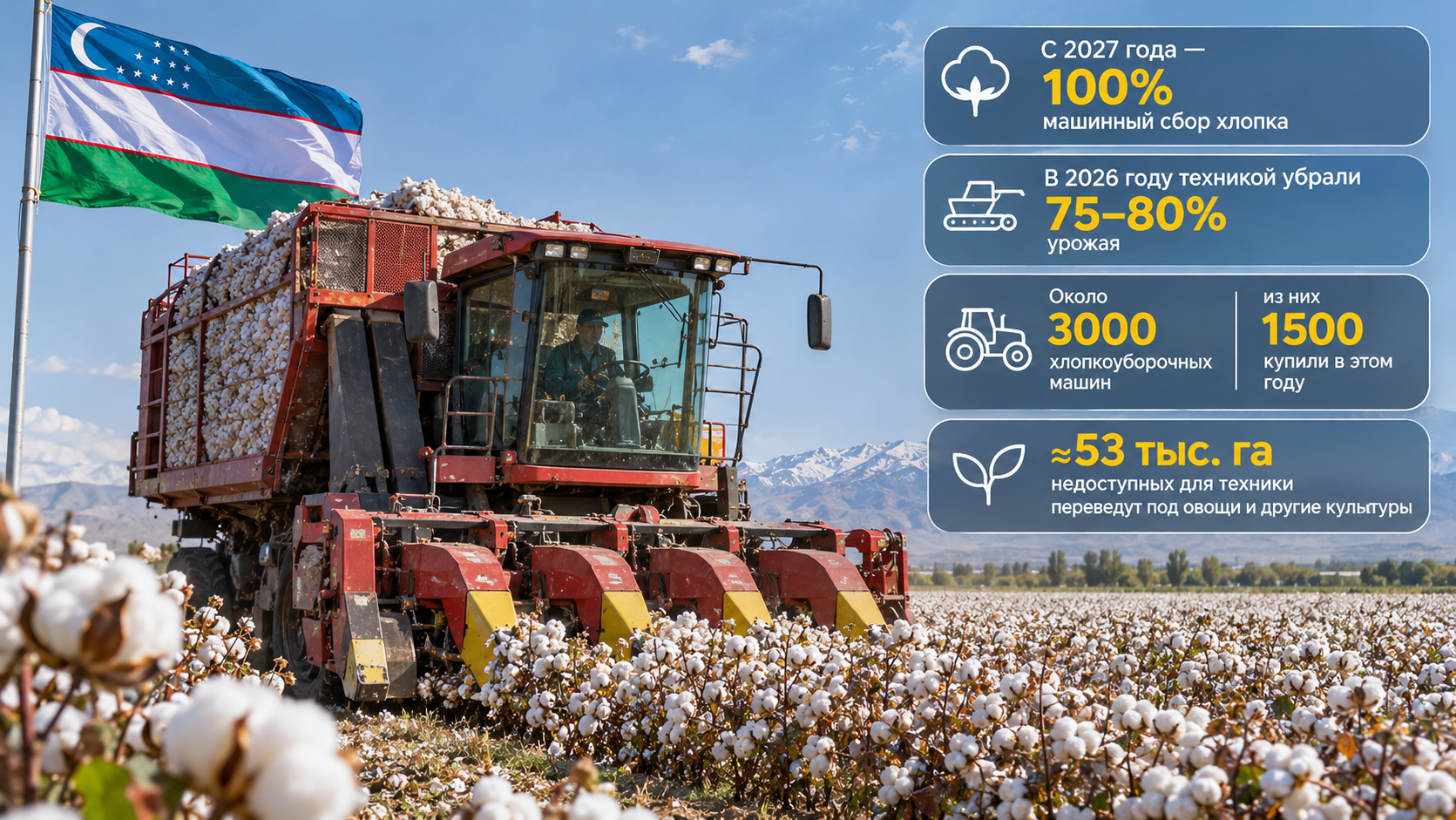
This season, 75-80% of the harvest, which exceeded 5 million tonnes of raw cotton, was collected by machinery. This was stated by Minister of Agriculture Ibrokhim Abdurakhmonov, according to Gazeta.uz.
The gist in brief
- The minister stated that the main strategic task is to completely abandon manual harvesting, and in 2027 the country will move to 100% mechanisation.
- In 2026, 75-80% of the harvest was collected by machinery, manual labour accounted for about 20-23%, and in Syrdarya and Jizzakh regions harvesting is fully mechanised.
- About 3,000 cotton harvesters took part in the harvest, of which 1,500 were purchased this year.
- About 53,000 hectares inaccessible to machinery are planned to be converted to vegetables and other food crops.
What the minister said
The statement was made on 6 November at a press conference.
"Our main strategic task is to completely abandon manual cotton harvesting," Abdurakhmonov said.
When asked about the timeline, he replied:
"Next year we will move to 100%."
According to him, the 2026 harvest exceeded 5 million tonnes of raw cotton.
How cotton is harvested now
This season, 75-80% of the harvest was collected by machinery, about 20-23% was harvested manually, mainly on small plots and fields between orchards. In Syrdarya and Jizzakh regions, harvesting is fully mechanised. About 3,000 cotton harvesters took part in the harvest, of which 1,500 were acquired this year.
What will happen to fields inaccessible to machinery
About 53,000 hectares where machines cannot operate are planned to be converted to vegetables and other food crops. The minister did not specify what costs and what effect on employment are expected from a complete transition to machine harvesting.
How things stand with cotton in Kazakhstan
In Kazakhstan, cotton is grown in the Turkestan region. According to a statement from the Ministry of Agriculture of the Republic of Kazakhstan dated 29 October 2025, about 142,300 hectares were harvested there, which is 98.5% of the sown area, and 422,000 tonnes of raw cotton were collected with an average yield of 24.9 c/ha. The cotton area in 2025 was 144,500 hectares, of which 50,000 hectares were under drip irrigation. Processors' prepayment was 200,000 tenge per tonne, and the final price, depending on quality, reached 250,000 tenge.
In 2026, according to the regional akimat, they planned to harvest 556,000 tonnes with a yield of 32 c/ha, and water-saving technologies are used on 91,000 hectares. In the Maktaaral district, as reported by 24.kz, 275 cotton harvesters are taking part in the harvesting.
What remains unknown
No data on the share of machine harvesting in Kazakhstan for 2026 could be found in open sources, and the season's results in the region have not yet been published. Nor is it stated how much manual labour remains on Kazakh fields.
What is happening with water conservation and agricultural machinery
Saving water and resources is also important for Uzbek fields: on a cotton plot in Khorezm, farmers gave up one of two chisel ploughings, reduced irrigation from five to three and ammonium phosphate consumption from 300 to 100 kg per hectare. In Kazakhstan, according to the results of the 2026 sowing campaign, drip irrigation grew by 29,800 hectares to 79,800 hectares, while rice and traditional cotton are reducing areas due to water restrictions. As for machinery, agricultural machinery output in the country in 2025 grew by 22.3%, including 1,236 combine harvesters produced.
Author's conclusion
Uzbekistan is addressing the issue of manual harvesting through two steps: purchasing machinery and removing about 53,000 hectares from cotton. For Kazakhstan, the authorities name water conservation, rather than mechanisation, as the main direction: drip irrigation already accounts for 50,000 hectares out of 144,500. The indicator that is currently missing is the share of machine harvesting in the Turkestan region.
Comments ()