Agricultural trade with Tajikistan grew by a third, the parties are preparing a roadmap
Agricultural trade between Kazakhstan and Tajikistan exceeded $564 million in the first nine months of 2026, up 32.5% year-on-year.
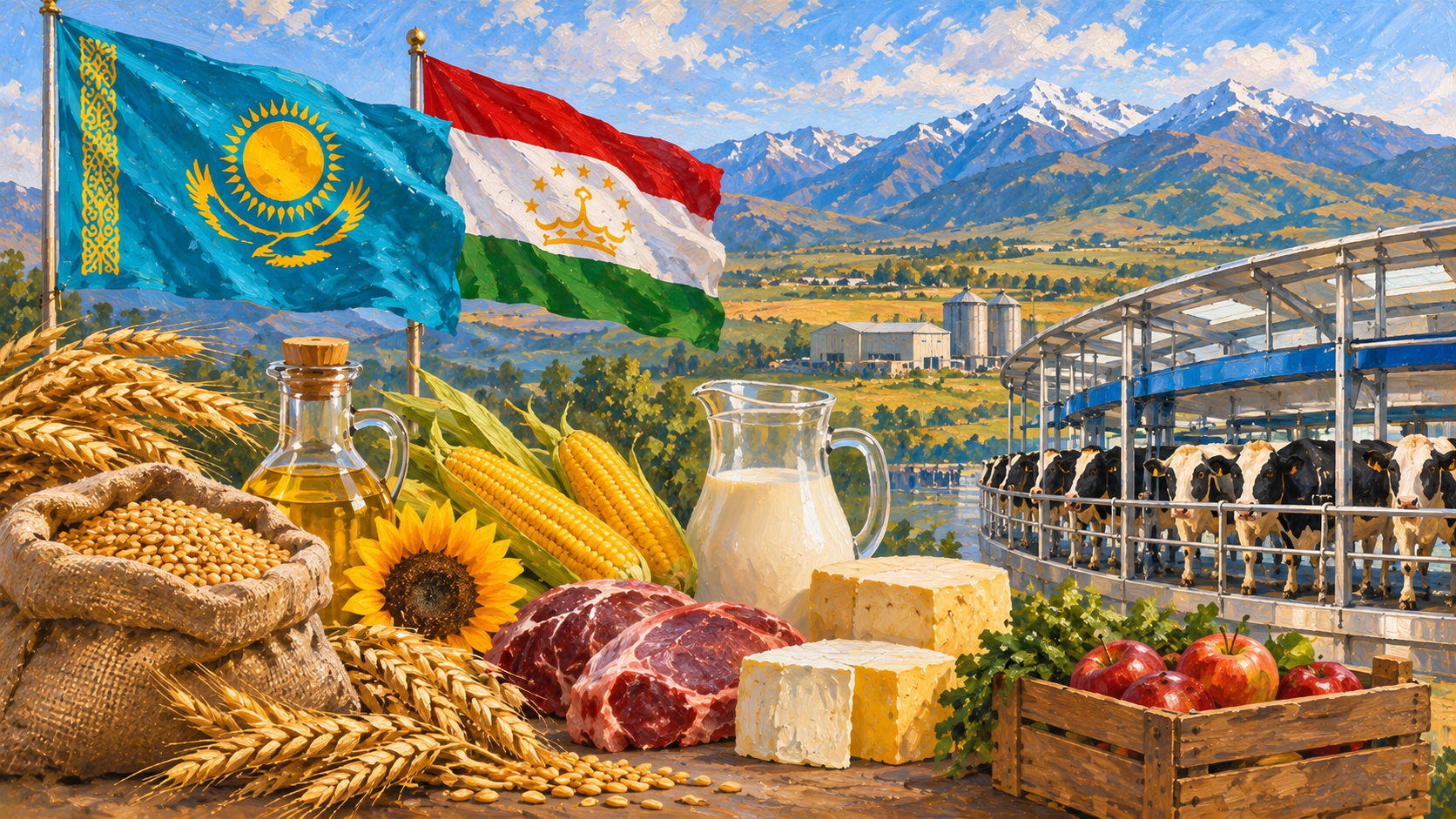
The parties plan to sign a roadmap for cooperation in agriculture for 2027-2028, the Ministry of Agriculture reports.
The essence in brief
- Trade in agricultural products for January-September 2026 exceeded $564 million (+32.5%), with Kazakh exports amounting to $550.2 million.
- Agricultural products account for 49% of the two countries' total trade.
- Minister of Agriculture Aidarbek Saparov discussed cooperation with the Chairman of the Sughd Region Rajabboy Ahmadzoda during the official visit of Emomali Rahmon to Kazakhstan.
- The Tajik delegation visited the Rodina agro-firm, where a robotic milking carousel for 80 cows is in operation.
What the minister and the chairman of the Sughd Region agreed on
Aidarbek Saparov met with Rajabboy Ahmadzoda, who heads the Sughd Region and is First Deputy Chairman of the Majlisi Milli of the Majlisi Oli of Tajikistan. Saparov called agriculture one of the key practical areas of interaction and noted that agriculture accounts for 49% of trade between the countries. Ahmadzoda stated that Tajikistan is interested in cooperation with Kazakhstan in crop production, livestock breeding, selection, and the introduction of modern technologies.
What Kazakhstan supplies to Tajikistan
Kazakhstan remains one of the main food suppliers. Key export items are wheat, sunflower oil, corn, and pasta. In 2026, grain supplies amounted to about 1.1 million tonnes, including about 900,000 tonnes of wheat. Under the contract between Prodcorporation JSC and Tajikistan's Agency for State Material Reserves for 100,000 tonnes of wheat, 50,800 tonnes have been shipped.
In 2025, sunflower oil supplies reached 83,000 tonnes (+23%). Rapeseed oil supplies grew sixfold, soybean oil by 35%, and oilseed meal by 23%. Exports of Kazakh lamb increased 26-fold in 2025, and beef 2-fold.
What the roadmap for 2027-2028 provides for
The document the parties plan to sign contains measures to expand mutual trade, develop crop production, seed farming and selection, improve livestock productivity, and strengthen veterinary and phytosanitary safety. It separately provides for the digitalization of agriculture, the introduction of modern agricultural technologies, scientific research, exchange of experience, and personnel training.
What the Tajik delegation was shown at the Rodina agro-firm
As part of the visit, Tajikistan's Minister of Agriculture Kurbon Hakimzoda visited the Rodina agro-firm. The guests were shown the full production cycle: from crop cultivation and feed base formation to the production and processing of livestock products. Particular interest was aroused by the dairy complex with a robotic milking carousel from the Swedish brand DeLaval, launched in January 2025. The carousel accommodates 80 cows simultaneously and is capable of servicing up to 2,000 head in five hours, with a shift handled by 12 specialists.
What is happening with Kazakhstan's agricultural exports
Tajikistan has become a notable market not only for grain. In January-June 2026, potato supplies there grew 671.9-fold, to 43,600 tonnes, while total potato exports from Kazakhstan increased 10.6-fold, to 255,500 tonnes. Potatoes were meanwhile included in the list of exchange-traded goods with a minimum lot of 1,000 tonnes, and exporters of wheat and barley must sell through the exchange at least 5% of the grain sold outside the exchange in the previous month. At the level of the Eurasian Economic Union, Saparov named as a goal the doubling of gross agricultural output: exports of agricultural products have already exceeded $7 billion, and grain exports have reached 15.3 million tonnes.
Author's conclusion
The Tajik side speaks of livestock breeding and selection, and these are precisely what stand in the roadmap alongside trade in grain and oil. So far, crop production and processing are the most visible in exports, while meat is coming from a low base: a 26-fold increase in lamb reflects small starting volumes rather than a large shipment. To understand what a dairy farm as a technology demonstration will yield, one needs to see whether the final document names specific volumes of supplies of livestock, equipment, or feed.
Comments ()