Countries ranking showed who uses AI tools the most
Global traffic to AI tool websites nearly doubled in just a year — and the leaders of this growth were not quite what you might expect.
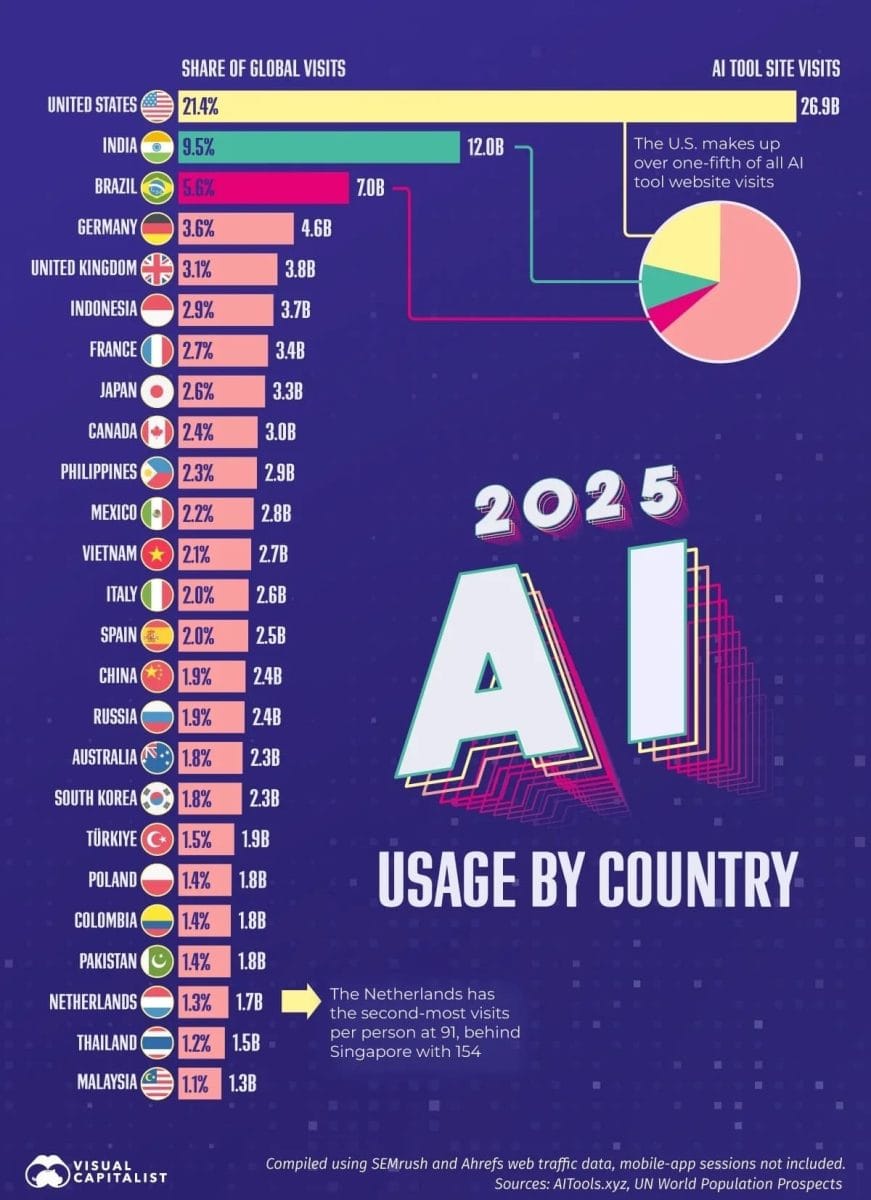
The rating was published on the NAKET science website. Large developed economies sit alongside far less obvious participants in the list, such as Indonesia and the Philippines.
The gist in brief
- In 2025, AI tool websites were visited 125.7 billion times — 46% more than a year earlier; the data was provided by the AITools.xyz platform based on SEMrush and Ahrefs estimates for more than 9,500 AI services.
- The United States confidently leads in the number of visits, more than twice ahead of India; the three leading countries — the United States, India, and Brazil — accounted for 36.5% of all visits worldwide.
- The top 10 unexpectedly included Indonesia (6th place, 3.7 billion visits) and the Philippines (10th place, 2.9 billion) — both countries surpassed Italy, Spain, and South Korea.
- China took only 15th place (2.4 billion visits, on par with Russia) — not because of low interest in AI, but because the largest Western services are only partially available there, while China's own tools such as DeepSeek operate mainly through mobile apps that are not counted in these statistics.
Why the rating does not show the full picture
The authors' methodological caveat is fundamental: this is specifically about website visits, not the number of unique users, and sessions in mobile apps are not included in the statistics. This understates real figures where users primarily work through apps — above all in China. Another discrepancy is telling as well: by traffic volume, the United States is the undisputed leader, but by the level of actual AI adoption among the population, the country ranks only 21st in the world according to Microsoft — 31.3% of the working-age population regularly uses AI, whereas in the UAE this figure reaches 70.1%, the highest in the world.
What stands behind the unexpected leaders
A large population partly explains the high positions of India and Brazil, but the presence of several Southeast Asian countries in the top ten at once is an even more interesting detail. Indonesia and the Philippines surpassed the economically more developed Italy, Spain, and South Korea — likely due to their demographic structure (a young population actively embracing new technologies) and the fact that many users in these countries are gaining access to digital services for the first time specifically through the web, rather than through an established app ecosystem as in more mature digital markets.
The Kazakh context
Kazakhstan did not make the rating itself, but indirectly it turns out to be part of the same global picture from two sides at once. We have already written that the country is building Central Asia's largest AI hub, the "Data Center Valley," in Ekibastuz — a bid for the status of a regional supplier of computing capacity specifically for the traffic that the Visual Capitalist rating records, while in parallel the creation of a technology town, Network City in Burabay, is being discussed as another point of attraction for the international technology community. That is, Kazakhstan is betting not so much on its own place in such user-traffic ratings as on the role of an infrastructure platform for others' demand for computing.
From website visits to autonomous agents
The very nature of AI tool usage that this rating measures — primarily one-off visits to chatbot websites — may also prove to be a transitional form. We have already written about the forecast by Salesforce head Marc Benioff: the number of autonomous AI agents independently performing work tasks without constant human involvement may exceed the Earth's population within just a few years. If this shift occurs, the familiar metric of "website visits" risks becoming as outdated as telephone call statistics would have become in the era of messengers — agents work in the background, not through one-off human visits to a website.
Author's conclusion
The Visual Capitalist rating illustrates well how deceptive simple visit statistics can be on an issue where the real spread of a technology is determined by dozens of factors — the availability of specific services, user habits, and the presence of mobile alternatives. For Kazakhstan, a direct place in such a rating is still less significant than the role the country manages to secure in the infrastructure serving growing global demand for AI computing — and that demand, judging by the 2025 figures, continues to grow at a pace that subsequent ratings of this kind will almost certainly capture even more clearly.



Comments ()