Uzbekistan introduces "exemplary consumer" status for energy resources — and reduces prepayment from 90% to 15%
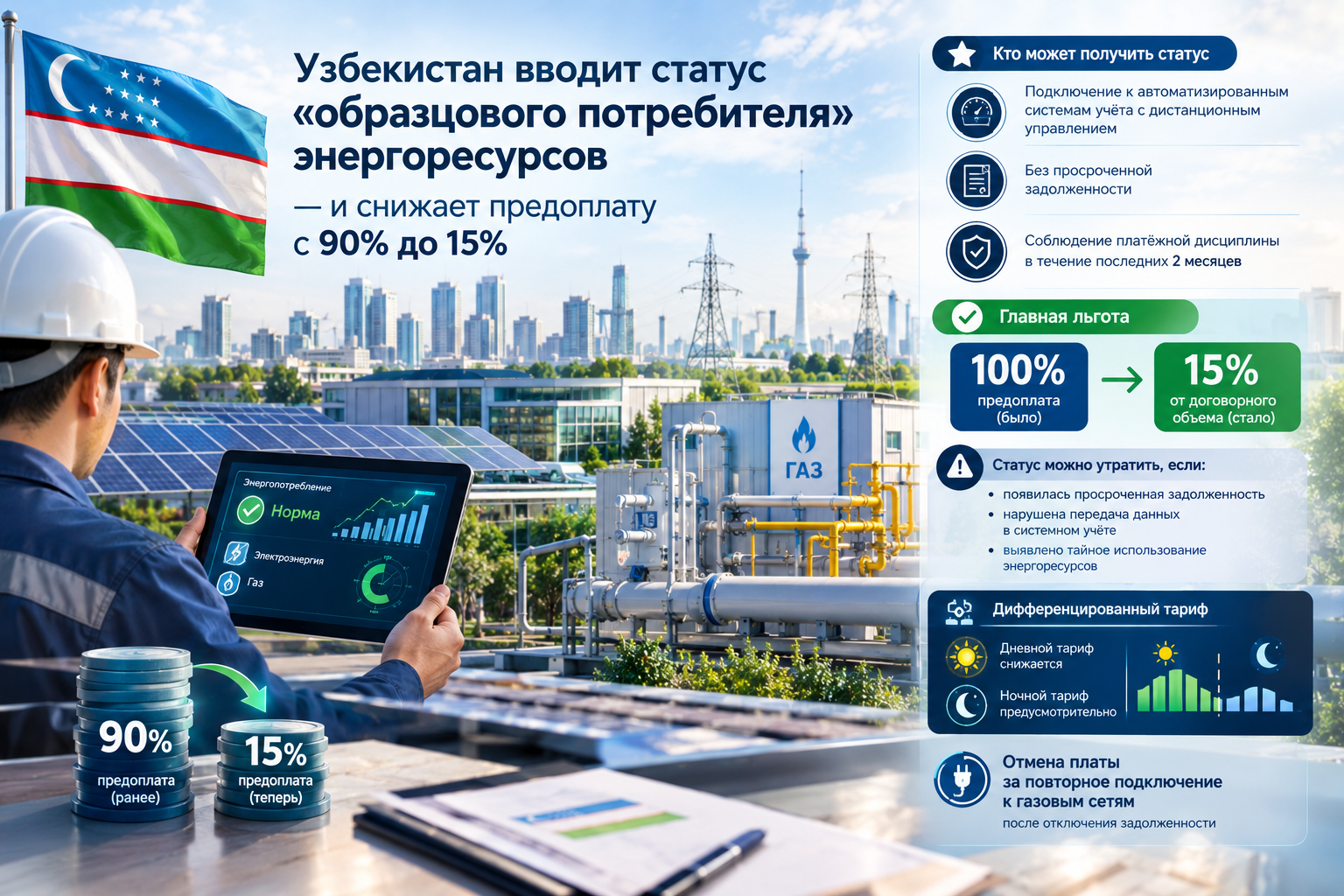
Uzbekistan's President Mirziyoyev signed a decree introducing "exemplary consumer" status for businesses using electricity and gas, cutting mandatory prepayment for energy from 100% to 15%.
The reform is taking place against the backdrop of the country's large-scale energy transformation: Uzbekistan is consistently building a system of incentives for efficient consumption and own generation, UzDaily reports.
The essence in brief
- The "exemplary consumer" status is granted to non-household enterprises connected to automated metering systems with remote control, without overdue debt and with compliance with payment discipline over the last two months .
- Main benefits: instead of 100% prepayment — only 15% of the contractual volume of consumption per month.
- The status can be lost if overdue debt arises, if data transmission in system metering is violated, or if energy resources are secretly used.
- At the same time, a differentiated tariff is being introduced for major consumers: the daytime tariff is reduced, the nighttime one is prudently , encouraging a shift of load to nighttime hours.
- The fee for reconnection to gas networks after disconnection for debt is being abolished.
Where the 100 percent prepayment came from
Full prepayment for electricity and gas for legal entities was introduced in Uzbekistan on July 1, 2024 — as a tool to combat the accumulation of enterprise debts to energy suppliers. The logic is clear: a system of constant financing for the financial stability of companies and the creation of cross-subsidies.
However, the price turned out to be high. Businesses were forced to keep significant funds "frozen" in advance payments — especially now this was felt in the manufacturing and trade sectors with high levels of energy consumption. President Mirziyoyev back on August 18 at a meeting with entrepreneurs in the Khorezm region noted that the requirement for full prepayment restricts business working capital.
Digitalization as a condition for benefits
A fundamentally important detail: the new status is not simply a reward for payment discipline. It is inextricably linked to the accounting of digitalization. To have the possibility of owner status subject to the following conditions: connection to automated systems for monitoring and metering of electricity (ASKUE) and gas (ASKUG); the meter installation is far from remote control.
This is a double effect: the state constantly increases the burden on the working capital of conscientious enterprises and obtains full transparency of consumption in real time. Digital meters make it possible to see not only the volume but also the consumption profile — which is critical for managing the peak power grid.
Differentiated tariff: night is cheaper than day
In parallel with the introduction of the new impact for major consumers, the tariff structure is changing. The daytime tariff is reduced, the nighttime one is provided for. This is a classic demand management tool: enterprises receive economic incentives to shift energy-intensive processes — the operation of pumps, compressors, charging equipment — to nighttime hours, when the load on the grid is minimal.
In the context of the rapid growth of renewable generation, this tool has additional significance: solar panels produce maximum output during the day, but the energy system has a shortage during peak evening hours. Shifting industrial load to the night is a way to balance the system without providing additional reserve capacity.
A broader context: Uzbekistan is creating a system of incentives
The decree of September 22 is not an isolated measure, but part of a continuous policy. By a resolution of the Cabinet of Ministers of May 14, 2026, a set of measures to improve energy efficiency was approved. Industrial enterprises can now receive a subsidy of 50% of the cost of an energy audit if, based on the results of the inspection, the possibility of saving at least 10% of energy resources is confirmed. The maximum amount is up to 100 million soums for one enterprise.
At the same time, Uzbekistan is working on several fronts at once. The country is attracting $15 billion for the development of renewable energy and at the same time preparing for the construction of a second nuclear power plant — that is, it is increasing both generation and demand management. This is fundamental: the mass commissioning of renewable energy capacities creates a balancing problem — a surplus of energy during solar hours and a deficit in the evening. It is precisely to solve this that tools such as differentiated tariffs and digital metering are needed.
Thus, Uzbekistan is building an integrated system of incentives: audit — subsidized, digital metering — provides benefits on prepayment, nighttime consumption — lower production, own solar energy — paid directly to the card .
The Kazakh context
Kazakhstan and Uzbekistan are solving current tasks: balancing the energy system amid the growth of renewable energy, reducing losses and improving consumer payment discipline. We wrote that green electricity costs Kazakhstan 71 billion tenge per quarter — and one of the key tools for reducing these costs is precisely management through tariff incentives.
The Uzbek model of the "exemplary consumer" is a concrete regulatory tool: not a fine for bad behavior, but a benefit for good behavior. It simultaneously solves three tasks — it stimulates the digitalization of metering, reduces the debt burden on energy companies and frees up the working capital of conscientious businesses. Kazakh regulators should study this experience in detail.
Author's takeaway
Uzbekistan is consistently assembling systemic incentives for energy efficiency — brick by brick. Subsidized audits, digital meters in the form of conditional benefits, differentiated tariffs, payments for solar generation. Each measure individually is a small step. Together they build a market environment in which energy efficiency becomes profitable, and this is not just logical. For Kazakhstan, a neighbor with similar challenges and a good structural economy, the Uzbek experience is a ready-made set of tools for adaptation.
Comments ()