China launched an offshore wind farm with 18-megawatt turbines
One turbine at the Fanshi wind farm generates enough energy in a year to power several thousand households.
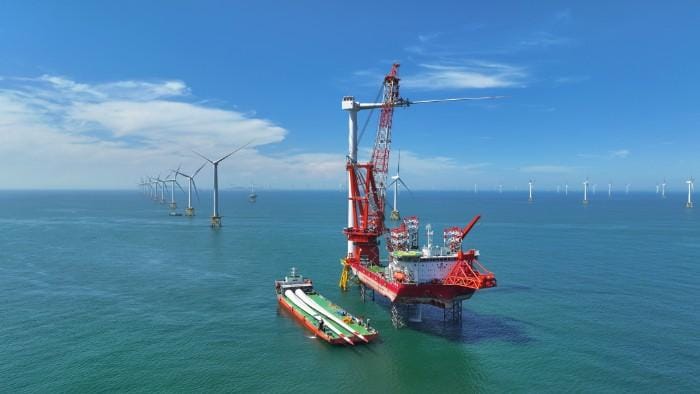
China General Nuclear Power Corporation has put the first large-scale project of this class into full commercial operation.
The gist in brief
- CGN has completed the Fanshi offshore wind farm project off the coast of Yangjiang in Guangdong Province — the electricity will be supplied, among other areas, to the Guangdong–Hong Kong–Macao Greater Bay Area.
- The wind farm includes 131 turbines installed 81 km from the shore; of these, 33 belong to the 18-megawatt class — according to Global Times, this is the world's largest cluster of offshore turbines with such high unit capacity.
- The rotor diameter of each such turbine is 292 meters, with a swept area of about 66,000 sq. m, comparable to the area of nine football fields; one unit can produce up to 56 million kWh of electricity per year.
- Once at full capacity, Fanshi will be able to supply more than 6.6 billion kWh to the power grid annually.
Why turbine unit capacity matters
The shift to larger turbines is not just a matter of impressive numbers. With the same total wind farm capacity, fewer installations mean fewer offshore foundations, fewer submarine cable lines, and a smaller water area occupied. One rotation of the rotor of an 18-megawatt turbine at full load produces about 43 kWh — according to CGTN estimates, this is enough to power an average household for about nine days.
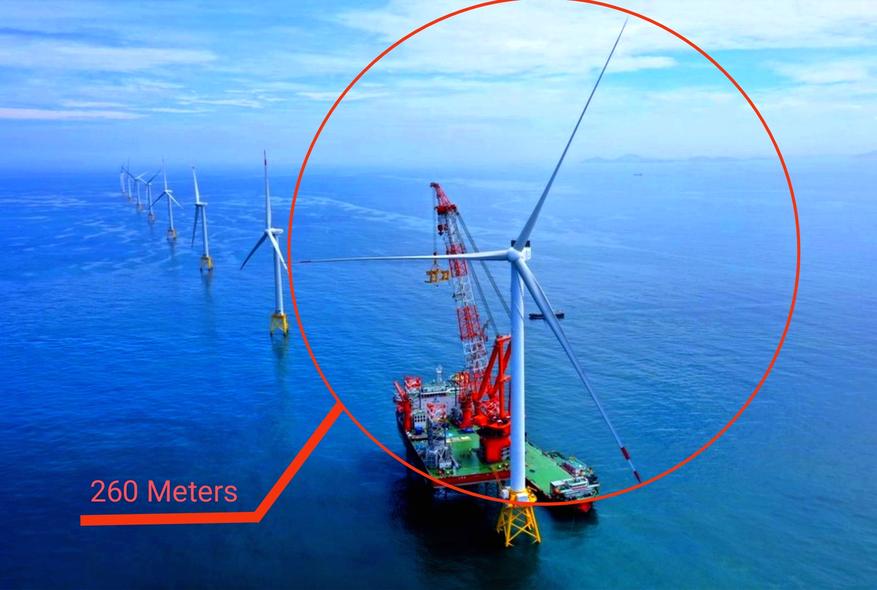
Part of a broader Chinese strategy
The development of offshore wind power with ever more powerful turbines is a logical continuation of China's overall course toward scaling up renewable generation, which we have written about in other contexts as well: the country has already surpassed coal in installed solar capacity and is actively expanding exports of technology and capital to renewable energy projects abroad, including Kazakhstan. Fanshi shows that, in parallel with external expansion, China continues to develop its own technologies domestically at an accelerated pace — large-scale offshore turbines remain a niche where competition is limited to the number of countries with the necessary engineering and manufacturing base.
Author's conclusion
The Fanshi wind farm is another demonstration of how quickly unit capacity of equipment is scaling up in China: just a few years ago, turbines of this class existed mainly as prototypes rather than as mass-produced installations for commercial projects of this size. For the rest of the world, this means a gradual reduction in the cost of offshore wind power through economies of scale — but at the same time, a growing technological gap between countries that have already mastered the production of ultra-high-capacity turbines and those that still depend on imports of such equipment.
Comments ()