El Niño caused the Atacama Desert to bloom
One of Earth's driest places bloomed with flowers after record rains in northern Chile.
The same climate factor brings heat and drought to other regions, while for Central Asia forecasts point to precipitation and heat waves.
The essence in brief
- After torrential rains caused by El Niño, thousands of hectares of land bloomed in the Atacama Desert, with the peak of blooming expected in October across an area of about 15 thousand hectares.
- The rains in Chile claimed the lives of 13 people and destroyed about 4 thousand homes.
- The same anomaly in the Pacific Ocean causes different disasters: floods in some countries and heat with drought in others, up to shutdowns of nuclear power plants in Europe.
- For Central Asia, forecasts link El Niño not to drought, but to an increased risk of precipitation and heat.
What happened in the Atacama
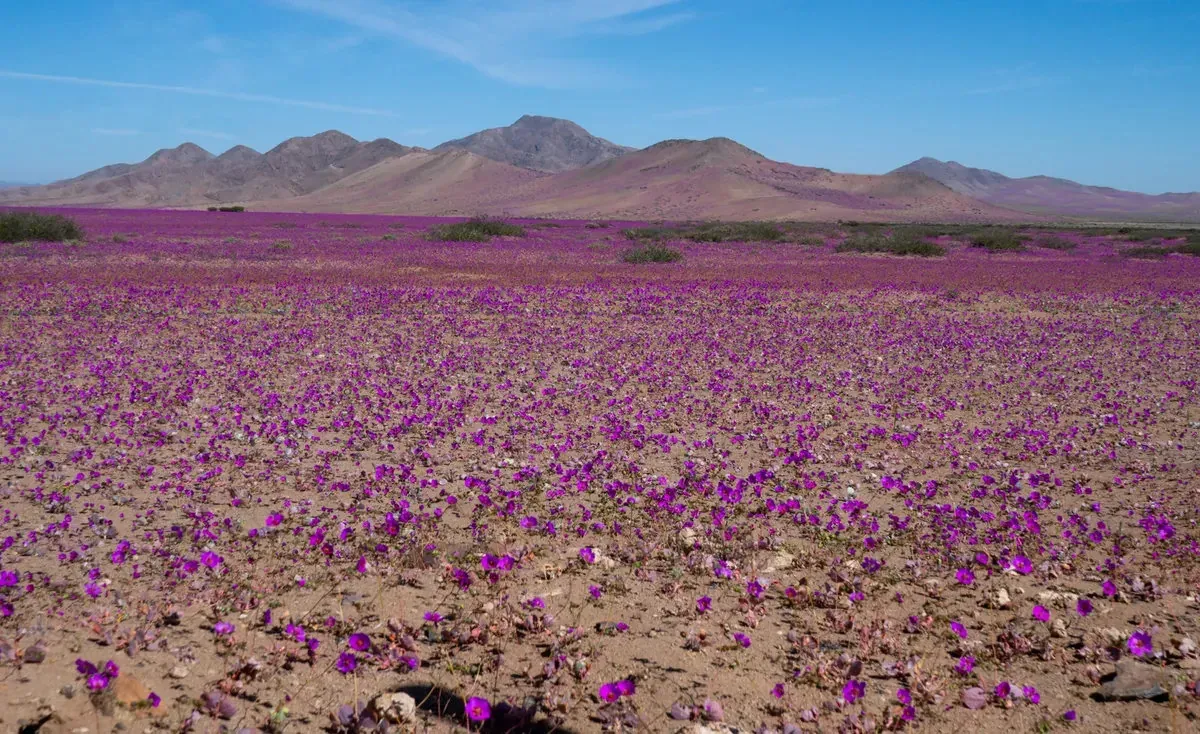
The Atacama Desert in northern Chile is considered one of the driest places on Earth. This autumn its appearance changed: usually parched areas were covered with white and purple flowers. The cause was heavy precipitation brought by the forming record-breaking El Niño.
The blooming is explained simply. Beneath the sandy soil of the Atacama, seeds and bulbs of plants lie for years waiting for suitable conditions. This time moisture penetrated deeper into the ground than usual, and the plants awakened. The blooming was recorded in a reserve approximately 800 kilometers north of the Chilean capital, Santiago. According to experts' estimates, the peak will come in October, when the flowers may cover about 15 thousand hectares.
The cost of the rains for Chile's residents
The beauty of the desert contrasts with the consequences for people. Due to torrential rains in Chile, 13 people died, and about 4 thousand homes were destroyed. This is a typical El Niño scenario: the phenomenon redistributes moisture on the planet, and what in one place becomes a rare natural spectacle in another turns into a natural disaster.
One climate signal and different consequences
The logic of El Niño is that one Pacific anomaly simultaneously creates opposite weather extremes. While Chile received torrential rains, Europe this summer faced heat and shrinking rivers, and this hit nuclear energy. Due to record low water levels and abnormal heating of the water in the Danube, Romania's only nuclear power plant, Cernavodă, was fully or partially shut down, as was Hungary's Paks nuclear power plant. In Switzerland, two reactors at the Beznau nuclear power plant were temporarily shut down due to overheated water. In France, EDF shut down or reduced the capacity of power units in order not to violate environmental standards when discharging heated water: this affected the Golfech nuclear power plant on the Garonne, Bugey on the Rhône, Chooz on the Meuse, and Nogent-sur-Seine on the Seine. The total damage to the European economy from the heat was estimated by Triodos Bank at approximately 180 billion euros, and the abnormal heat in one week led to more than 10 thousand excess deaths in 27 countries of the continent.
The scale of the current season is also confirmed by forecasts. The U.S. National Oceanic and Atmospheric Administration (NOAA) estimates the probability that this El Niño will become the strongest since observations began in 1950 at almost 69%. The expected anomaly in ocean surface temperature in the key region will exceed 2.66°C, whereas the previous record of 1982-1983 was 2.4°C. A recent coral analysis published in the journal Science showed that powerful phases of the phenomenon have become more frequent specifically since the beginning of the Industrial Revolution: the amplitude of temperature fluctuations associated with it in 1990-2010 increased by 36.5% compared with the pre-industrial era.
What this means for Kazakhstan and Central Asia
For the region, the Atacama story is important as a clear example of how excess moisture changes arid ecosystems. Forecasts for Central Asia, including Kazakhstan, link El Niño not to drought, but to an increased risk of precipitation and heat waves. For farmers, this means two sides of the same problem: additional moisture may support pastures and crops in semi-desert zones, but torrential rains and sharp temperature swings increase the risk of floods, soil erosion, and crop losses.
The European experience is also useful for the energy sector. Kazakhstan is considering building its own nuclear power plants, so shutdowns of stations due to heated and shallower water show that water supply and the temperature of the cooling source must be taken into account when choosing sites and designing cooling systems.
Glacier-fed rivers are of particular importance. Climatologists link the current season to the accelerated destruction of Alpine glaciers, and experts draw parallels with the glaciers of the Tien Shan and the Dzungarian Alatau, on which the water balance of rivers in southern Kazakhstan depends. For farms operating on irrigation, this is a matter of planning water use for the coming seasons.
Author's conclusion
A blooming Atacama looks like good news, but in essence it is a symptom of how strongly the climate system is currently skewed. The same precipitation that turned the desert into a flower garden destroyed thousands of homes, and in other parts of the world the same mechanism produces heat, shallower rivers, and shut-down nuclear stations. For Kazakhstan, the main practical conclusion is that the forming record-breaking El Niño should be taken into account when planning the agricultural season, water resources, and energy infrastructure.


Comments ()