El Niño could wipe out a fifth of the Galapagos Islands' vertebrates
A forecast of an unusually strong El Niño this season has alarmed Ecuador's scientific community.
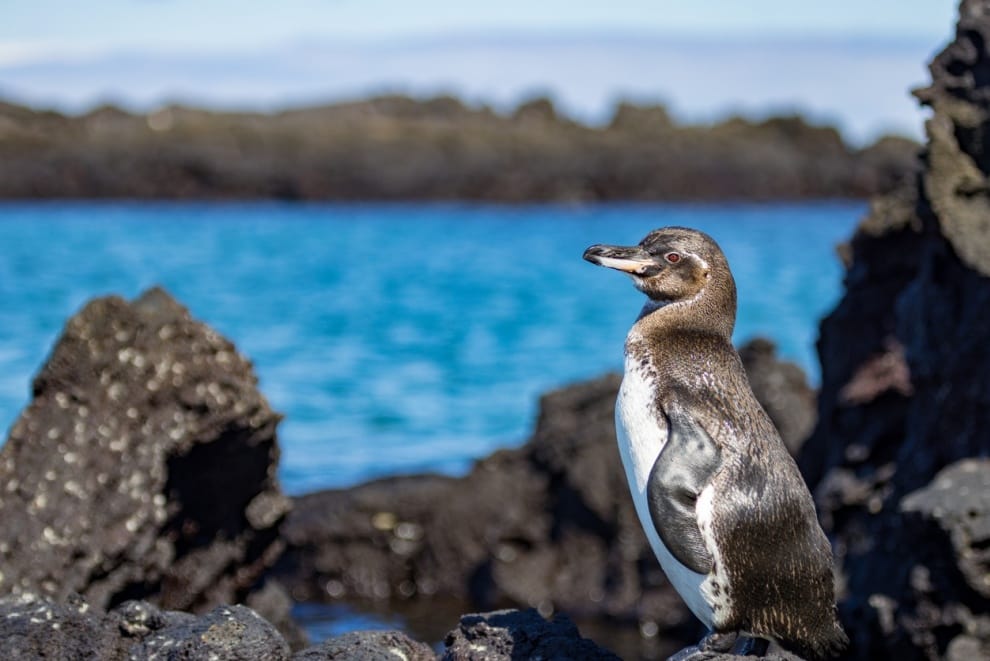
This is not about an abstract climate anomaly — penguins, sea lions, giant trees and cacti that are found nowhere else on Earth are under threat, EuroNews reports.
The gist in brief
- According to the latest NOAA forecast, sea temperatures around the Galapagos Islands will be roughly 2.2°C above normal — at a threshold of 2°C, the phenomenon is already considered "very strong."
- Warming water kills plankton, algae and small fish that large marine animals feed on — Galapagos penguins, blue-footed boobies, petrels, flightless cormorants, albatrosses, sea lions, coral colonies and the tuna fishery are all at risk.
- According to Gustavo Jimenez, a scientist at the Charles Darwin Foundation, if the phenomenon manifests with the expected strength, the archipelago's vertebrate population could decline by at least 20% this year.
- After the powerful El Niño of 1998, of the 1,300 Galapagos penguins that existed, only 400 survived — this species serves as the main indicator of how the phenomenon affects the archipelago's fauna.
The mechanism of hunger in the ocean
Professor at the Higher Polytechnic School of the Coast of Ecuador (ESPOL) Franklin Ormaza warned outright: the impact is expected to be significant. Director of Biodiversa Ecuador Washington Tapia explained the mechanics of the catastrophe — as water temperatures rise, plankton, algae and small fish species that serve as food for larger marine animals practically disappear. Gustavo Jimenez of the Charles Darwin Foundation added: when food is scarce, animal colonies stop reproducing, disperse in search of feeding grounds and ultimately die of hunger. This is exactly the scenario that unfolded in 1998, when one of the most powerful and destructive El Niño cycles reduced the Galapagos penguin population by more than threefold.
Plants are also under threat
The danger threatens not only animals. Scientist at the same foundation Heinke Jäger warned that if the expected scenario materializes, the last three remaining forests of Scalesia — giant daisy trees up to 20 meters tall — will be at risk of extinction, along with prickly pear cacti growing along the coast. These plants are found only in the Galapagos and support entire ecosystems of insects, birds and other small species. The problem is not just the heat itself — the torrential rains that accompany El Niño allow invasive plants like blackberry, with a shorter reproductive cycle, to capture territories faster than native species. That is why Ecuadorian authorities, together with conservation foundations and NGOs, had to develop a plan to eliminate invasive vegetation, collect seeds and create nurseries to preserve threatened species.
A continuation of the series we are following
The fate of the Galapagos is another episode in the climate season we have tracked from beginning to end. We have already written that NOAA raised the probability of a record-strength El Niño to nearly 69%, and a recent analysis of Galapagos corals — the very same ecosystems now under threat — showed that powerful phases of the phenomenon have become more frequent precisely since the start of the Industrial Revolution. It is symbolic that the Galapagos — an archipelago whose unique biodiversity formed the basis of Darwin's theory of evolution — turns out to be both a scientific archive preserving the memory of past climates and one of the first victims of the present climate.
Author's conclusion
The story of the Galapagos shows El Niño with rare, almost laboratory-like clarity: an isolated archipelago with endemic species that have no ability to migrate to more favorable conditions responds to the climate anomaly quickly and predictably, leaving a clear quantitative trace — as in 1998, when the penguin population declined by nearly fourfold. The forecast of 20% vertebrate losses this summer is not an alarmist exaggeration but a calculation based on an already documented historical precedent, and that is precisely why Ecuador is preparing for a possible catastrophe in advance rather than after the fact.


Comments ()