El Niño stokes underground peat fires in Indonesia, reminiscent of the 2015 disaster
Indonesia sees a sharp rise in hazardous peat fires as the El Niño phenomenon intensifies.
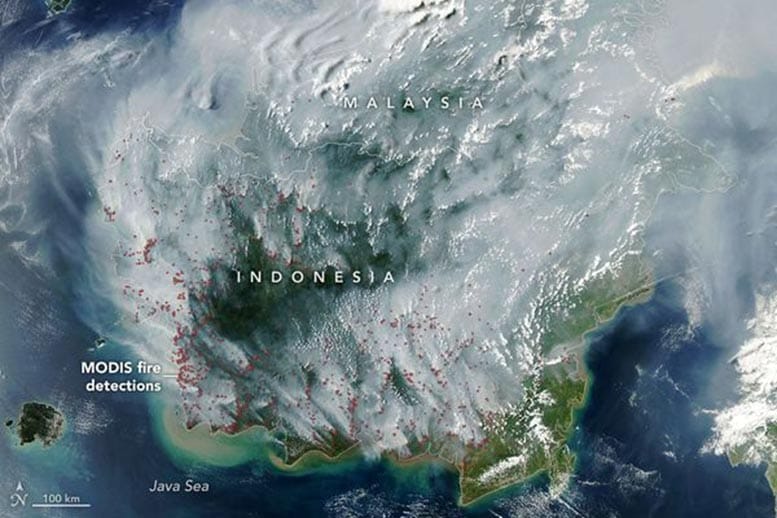
We have already written about how smoke from forest fires in Indonesia threatens the health of millions of people. New NASA data show that the real danger of this season is hidden deeper than it seems — literally beneath the surface of the earth, where peat fires can smolder for months, remaining almost invisible even to satellites.
The gist in brief
- Peat fires emit on average three times more fine particulate matter, five times more sulfur dioxide, three times more organic carbon, and twice as much methane and carbon monoxide as ordinary tropical forest fires.
- Indonesia contains about 36% of all tropical peatlands on the planet; by September 1, 2026, the SiPongi monitoring station had recorded 946 fire hotspots in a single day.
- According to Columbia University researcher Robert Field, fire activity is rising sharply along a trajectory reminiscent of the catastrophic 2015 season — when Indonesian fires released 1.75 billion tons of greenhouse gas equivalent over more than three months, more than Japan produces in an entire year.
- By September 2, 2026, just one month into the season, fires had already released about 10% of the total emissions of the entire catastrophic 2015 season.
Why peat fires are so dangerous
Ordinary fires move across the surface, burning trees and vegetation — peat fires, by contrast, smolder inside dried-out waterlogged soil at relatively low temperatures, making them extremely difficult to extinguish. Under normal conditions, peat deposits in Kalimantan, Sumatra, and Papua are too wet for fire to penetrate underground, but severe drought changes the situation dramatically. University of Maryland ecologist Mark Cochrane, who spent nearly a decade conducting field research on peat fires in Indonesia, noted a paradox: the very worst smoke events are often the hardest to spot from space — the thick smoke itself blocks the view of the MODIS and VIIRS satellite instruments, so the number of detected fires sometimes drops not because there are fewer fires, but because the smoke prevents them from being seen.
The roots of the problem go back to the 1990s
According to Cochrane, the vulnerability of Indonesian peatlands to fire is largely linked to decisions made thirty years ago: large-scale construction of irrigation canals and drainage of peat swamps in the 1990s, partly undertaken to create vast rice plantations, lowered the water table across the region and made the landscape significantly more flammable. Extensive oil palm plantations also play a role. After the catastrophic 2015 season, authorities and organizations attempted to partially reverse this damage — blocking canals to restore swamps, strengthening fire services, and intensifying efforts to prevent accidental human-caused ignitions.
Protective measures put to the test
University of Maryland graduate student Shi Jun Wei, who is involved in developing improved methods for detecting fires beneath the forest canopy in collaboration with NASA and MapBiomas, called this season a true stress test for all measures adopted after 2015. So far, the results of this test look alarming: according to Indonesia's meteorological service, about 90% of the country's territory received minimal or no rainfall in early August. The consequences are already being felt — some schools have switched to remote learning, nine national parks have been closed, and several flights have been delayed due to dense smoke.
Connection to the season we are tracking
The reason for this year's accelerated fire development is the same one we have already discussed — the emerging super El Niño, amplified by the positive phase of the Indian Ocean Dipole, making the dry season in Indonesia's fire-prone regions even drier than usual. NOAA recorded the presence and intensification of El Niño as early as August 2026, and a recent analysis of Galápagos coral data showed that strong phases of this phenomenon have become more frequent precisely since the onset of the Industrial Revolution — meaning underground peat fires are becoming yet another, particularly alarming manifestation of the same long-term climate trend we have been tracking from the Kazakh heatwave to the record sea-level rise off California.
Author's conclusion
Cochrane warns: attention to Indonesian fires usually grows during major El Niño seasons and fades as soon as the situation improves — even though sustained, rather than episodic, attention is what is needed to solve a problem rooted in decades of peatland drainage. As the 2026 season follows a trajectory frighteningly similar to the 2015 disaster, the main question is no longer whether these fires can be fully extinguished before the rains arrive in October-November, but whether the protective measures adopted over the past decade will withstand a real test of strength.



Comments ()