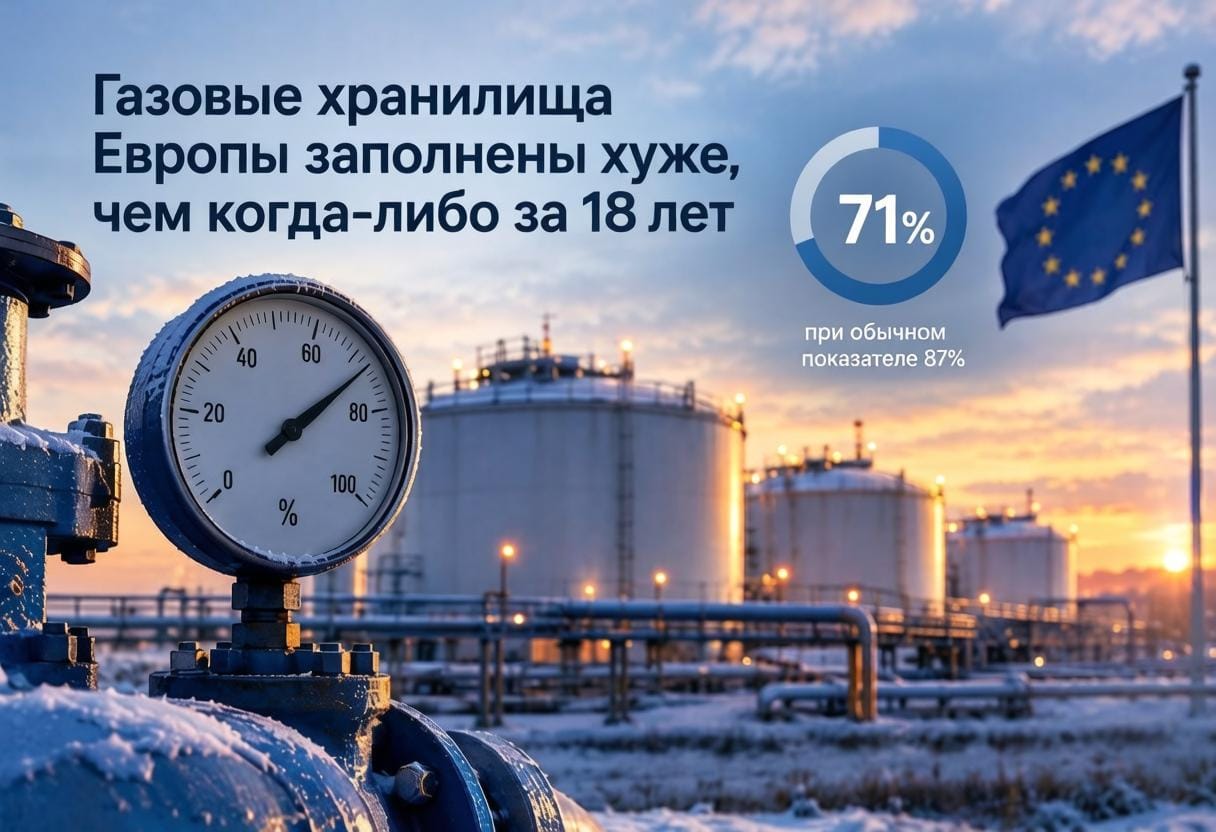
Europe's gas storage is filled worse than ever in 18 years
The model that kept European winters predictable for decades has failed for the second year in a row.
Companies can no longer cheaply buy gas in summer and profitably sell it in winter — which means the incentive to fill storage in advance disappears precisely when it is needed most.
The gist in brief
- European gas storage facilities are about 71% full, compared with the usual level for this time of year of around 87% — the lowest in the entire history of observations since 2009, Bloomberg reports.
- In Germany, the EU's largest economy, the situation is even worse — storage facilities are only 57% full.
- The traditional model — buying cheap gas in summer for storage and selling it in winter at a higher price — has not worked for the second year in a row due to reduced supplies of Russian pipeline gas and Europe's shift to LNG; in 2026, the situation was further complicated by disruptions to Middle Eastern supplies amid the conflict with Iran.
- The head of regulation at Uniper Energy Storage, Michael Schmölzer, said: "It is impossible to reinvest in and sustainably operate storage facilities over the long term if the seasonal price difference remains negative."
Why the model stopped working
The economics of gas storage are built on the price difference between seasons — gas is usually cheaper in summer and more expensive in winter, and it is precisely this difference that covers the costs of injection, storage, and subsequent withdrawal of fuel. When the seasonal spread becomes negative or insufficient, storage operators lose the financial incentive to fill capacity in advance — they can physically do it, but they will lose money on the operation itself. This is precisely what Schmölzer is talking about: selling storage capacity below cost makes long-term sustainable investment in the storage infrastructure itself impossible, not just the current filling of a particular season.
Two independent blows to one system
It is telling that the problem is not made up of a single factor, but of the overlap of a structural and a situational one. The structural part — reduced supplies of Russian pipeline gas and the shift to more expensive and price-volatile LNG — has been at work for the second year already and is changing the very economics of long-term storage. The situational part — disruptions to supplies from the Middle East amid the conflict with Iran — was superimposed on this already weakened system in 2026, exacerbating the deficit precisely at a moment when there were fewer reserve capabilities than usual to compensate for it.
Germany between a long-term plan and an immediate deficit
It is telling that the worst storage fill level in the EU belongs specifically to Germany, a country that last week presented a national roadmap for a complete phase-out of coal, oil, and gas by 2045. The long-term strategy and the immediate reality diverge here: a plan for decades ahead envisages a systematic reduction in dependence on fossil fuels, but this particular winter the country will likely have to rely on expensive LNG precisely because of a shortage of reserves accumulated in advance. This is not a contradiction in the strategy as such — a transition period is rarely smooth — but it is a reminder that declarations about the future do not remove the need to cope with current structural problems of energy supply right now.
What this threatens for consumers
Bloomberg notes: in the event of a cold winter or new supply disruptions, Europe may need to buy LNG at high prices on the spot market — instead of using reserves already accumulated and paid for in advance on more favorable terms. This could increase energy bills and strengthen inflationary pressure in EU countries, while competition for LNG cargoes on the global market will primarily affect less wealthy countries already experiencing difficulties with energy supply — that is, the effect of low storage fill levels will be distributed unevenly across Europe.
Author's conclusion
The situation with European storage facilities shows how quickly a system that worked for years on predictable seasonal logic can break down: the mere existence of physical capacity for gas storage is not enough if the economics of filling it cease to pay off. While the specific outcome of the winter of 2026–2027 depends on the weather and on whether the shortage of reserves can be compensated for by additional LNG purchases, the very fact of record-low fill levels in 18 years of observations is a signal that the European gas market has entered a period of structurally higher vulnerability, rather than experiencing a one-off seasonal failure.

Comments ()