Fertilizer exports fell overall but rose to individual countries
Kazakhstan's fertilizer exports fell over the year. But behind this average lies a surge in supplies to some countries — the very picture Kostanay farmers described as their own problem.
LSM.kz published a new infographic on fertilizers, based on BNS data.
The gist in brief
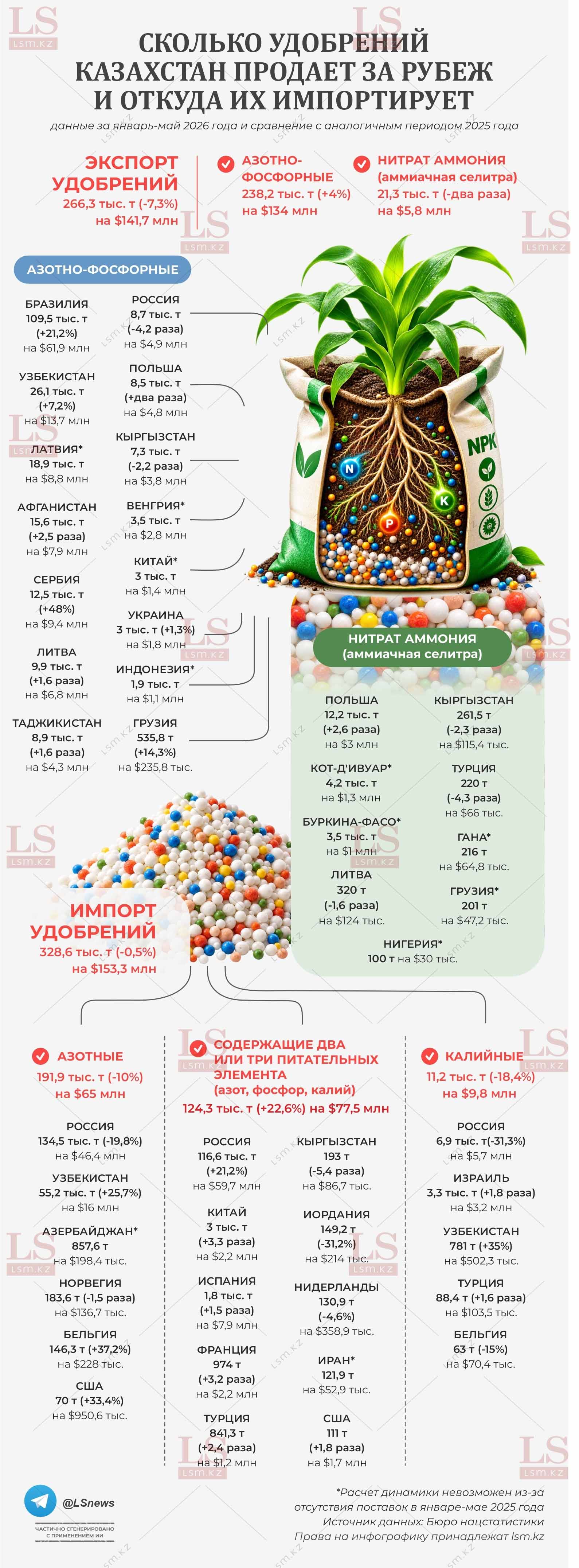
- In January–May 2026, Kazakhstan exported 266,300 tonnes of fertilizers worth $141.7 million — 7.3% less than a year earlier, although supplies to certain countries grew severalfold.
- Exports of nitrogen-phosphorus fertilizers to Brazil rose by 21.2%, to 109,500 tonnes, to Afghanistan — 2.5-fold, to 15,600 tonnes; for the first time in a year, Côte d'Ivoire (4,200 tonnes of ammonium nitrate) and Burkina Faso (3,500 tonnes) appeared among buyers.
- Fertilizer imports into the country remained virtually unchanged — 328,600 tonnes worth $153.3 million; almost 60% of imported nitrogen fertilizers came from Russia.
- Exports of ammonium nitrate, unlike nitrogen-phosphorus fertilizers, halved — to 21,300 tonnes, showing that dynamics across different product types are uneven.
Where supplies are growing
The geography of Kazakh fertilizer exports has expanded noticeably over the year. Besides growth to Brazil and Afghanistan, supplies to Serbia rose by 48%, to 12,500 tonnes, to Lithuania — 1.6-fold, to 9,900 tonnes, to Tajikistan — 1.6-fold, to 8,900 tonnes, to Poland — twofold, to 8,500 tonnes. For the first time in the past year, nitrogen-phosphorus fertilizers began to be supplied to Latvia, Hungary, China, and Indonesia. At the same time, purchases by traditional partners declined — Russia bought 4.2 times less, Kyrgyzstan — 2.2 times less than a year earlier.
Imports remain stable
While export geography is diversifying, the volume of fertilizer imports into the country has remained virtually unchanged — 328,600 tonnes, the same as a year earlier. Russia remains the main supplier of nitrogen fertilizers (134,500 tonnes, though 19.8% less than last year's volume), while supplies from Uzbekistan grew by 25.7%, to 55,200 tonnes. The most noticeable growth was in imports of complex fertilizers containing several nutrients at once — by 22.6%, to 124,300 tonnes, mainly due to Russia.
A vivid confirmation of the problem we have already examined
The export figures provide concrete numerical confirmation of the story we recently told: Kostanay farmers have been unable for months to obtain subsidized domestic fertilizers because the Kazphosphate and KazAzot plants prefer to sell their products abroad at higher prices. At the time, Kairat Ospanov, director of Turar LLP, directly articulated the essence of the problem — a program to increase fertilizer application was created, but the plants focus on exports, leaving the domestic market without products. The latest BNS statistics show this in practice: while Kazakh agrarians wait months for rejections of their applications for subsidized fertilizers, supplies to Brazil grew by 21.2%, and to Afghanistan — 2.5-fold.
Connection with the soil protection law
The problem of fertilizer availability takes on additional significance against the backdrop that in Kazakhstan since September 8, 2026, the Law "On Soil Protection" has been in force, obliging landowners to take measures to preserve fertility and prevent degradation. Fertilizer application is one of the basic tools for maintaining soil fertility, and if farmers physically cannot obtain subsidized domestically produced products due to the plants' export priorities, this also complicates compliance with the new legislative requirements on land protection, which are not directly related to the export policy of fertilizer producers.
Author's conclusion
Trade statistics turn the Kostanay story from a local episode into a pattern confirmed by figures: even with an overall decline in fertilizer exports of 7.3%, domestic producers continue to increase supplies to certain particularly solvent countries — Brazil, Afghanistan, new buyers like Côte d'Ivoire. This means that the overall decline in exports is not related to a shortage of products at the plants or a drop in interest from foreign buyers — rather to a redistribution of priorities between different markets and types of fertilizers. For domestic farmers, this picture remains alarming in any case: while the plants find opportunities to expand supplies to new countries, the shortage of affordable fertilizers within Kazakhstan, judging by all indications, has not gone away.


Comments ()