Five Caspian states agreed on an interstate program to save the Caspian Sea
The initiative Kazakhstan brought to the international level is now officially enshrined in a joint document of the Caspian states.
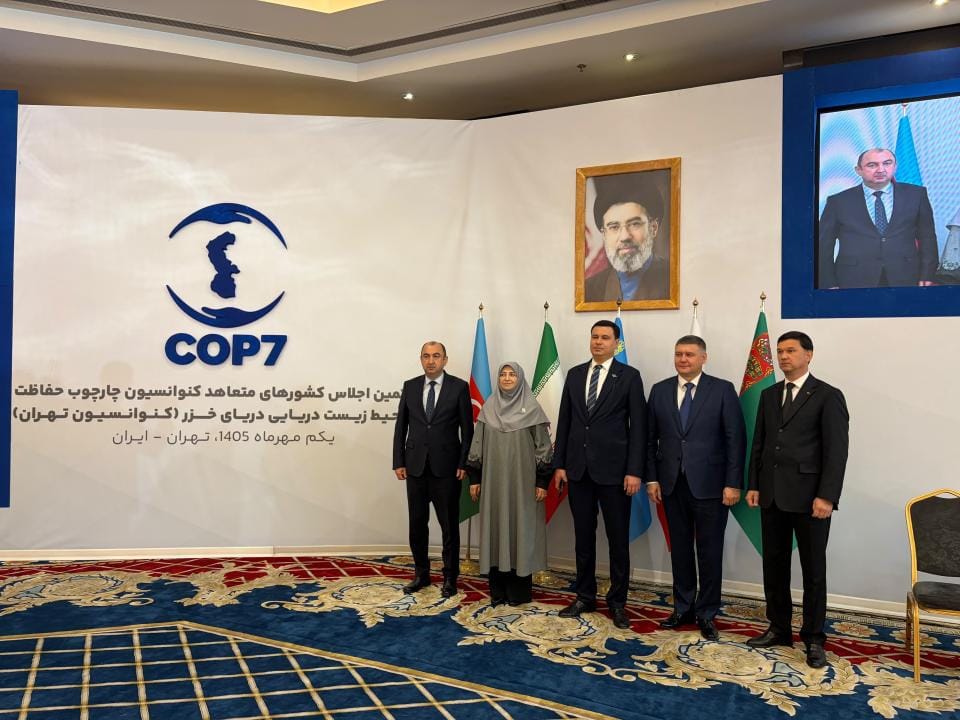
From a national scientific institute to a regional agreement of five states at once — the journey took just over a year.
The gist in brief
- Tehran hosted the 7th session of the Framework Convention for the Protection of the Marine Environment of the Caspian Sea (Tehran Convention) with the participation of Kazakhstan, Azerbaijan, Iran, Russia, and Turkmenistan — the meeting coincided with the 20th anniversary of the convention's entry into force.
- The main topics of the negotiations were the rapid decline in sea level and the threat to its biodiversity; following the talks, the heads of delegations signed a joint Statement of Ministers and adopted a package of official decisions.
- The final statement officially included the initiative of Kazakhstan's President Kassym-Jomart Tokayev to create an Interstate Program for the Conservation of the Caspian's Water Resources, uniting the efforts of all five countries for a comprehensive solution to the shallowing problem.
- The parties also agreed to establish end-to-end data exchange on the state of water, biological resources, and sea level fluctuations — the adopted documents move cooperation from a discussion format into the realm of applied environmental projects.
From a scientific institute to an interstate program
The Tehran agreement is not a one-off diplomatic episode but a logical continuation of a process we have observed over the past year. Back in August 2026, at the premises of the Kazakh Research Institute of the Caspian Sea — an institute that only began operating in September 2025 — a consultation meeting was held on three UNDP environmental projects for the Caspian: integrated management of marine and coastal resources, development of a circular economy, and combating plastic pollution of the sea. At that time, the director of the Department of Environmental Culture and Policy of the Ministry of Ecology, Daulet Yesmagambetov, emphasized the need to more actively involve the institute itself in international projects — meaning the Kazakh side had already been building the scientific and institutional foundation long before the Tehran summit.
Why specifically the interstate format
The logic of moving from national initiatives to a five-party agreement is clear: the Caspian Sea is an enclosed body of water divided among five countries, and shallowing or pollution in one part of the water area inevitably affects the state of the sea as a whole. Unified monitoring of data on the state of water, biological resources, and sea level, as fixed in the Tehran decisions, is a necessary condition for the countries to be able to work with a comparable rather than fragmented picture of what is happening to the sea. Without such coordination, even the most well-designed national programs like Kazakhstan's risk remaining effective only within the borders of one country, without solving the problem at the level of the entire body of water.
Author's conclusion
The official inclusion of the Kazakh initiative in the intergovernmental statement of five countries is a notable diplomatic achievement, but, as with any such framework document, its true value will be determined not by the fact of signing but by how quickly declarations about end-to-end data exchange and joint projects turn into concrete, measurable results on the water. The journey from the creation of a national scientific institute to a five-party agreement took a little over a year — an encouraging pace, but the shallowing of the Caspian remains a problem accumulated over decades, and its solution will inevitably require far longer and more consistent work than a single diplomatic summit.

Comments ()