France to design floating nuclear power plant for desalination and data centers
French startup Newcleo secured state funding to develop a radically new nuclear format: a non-propelled barge carrying several compact reactors.
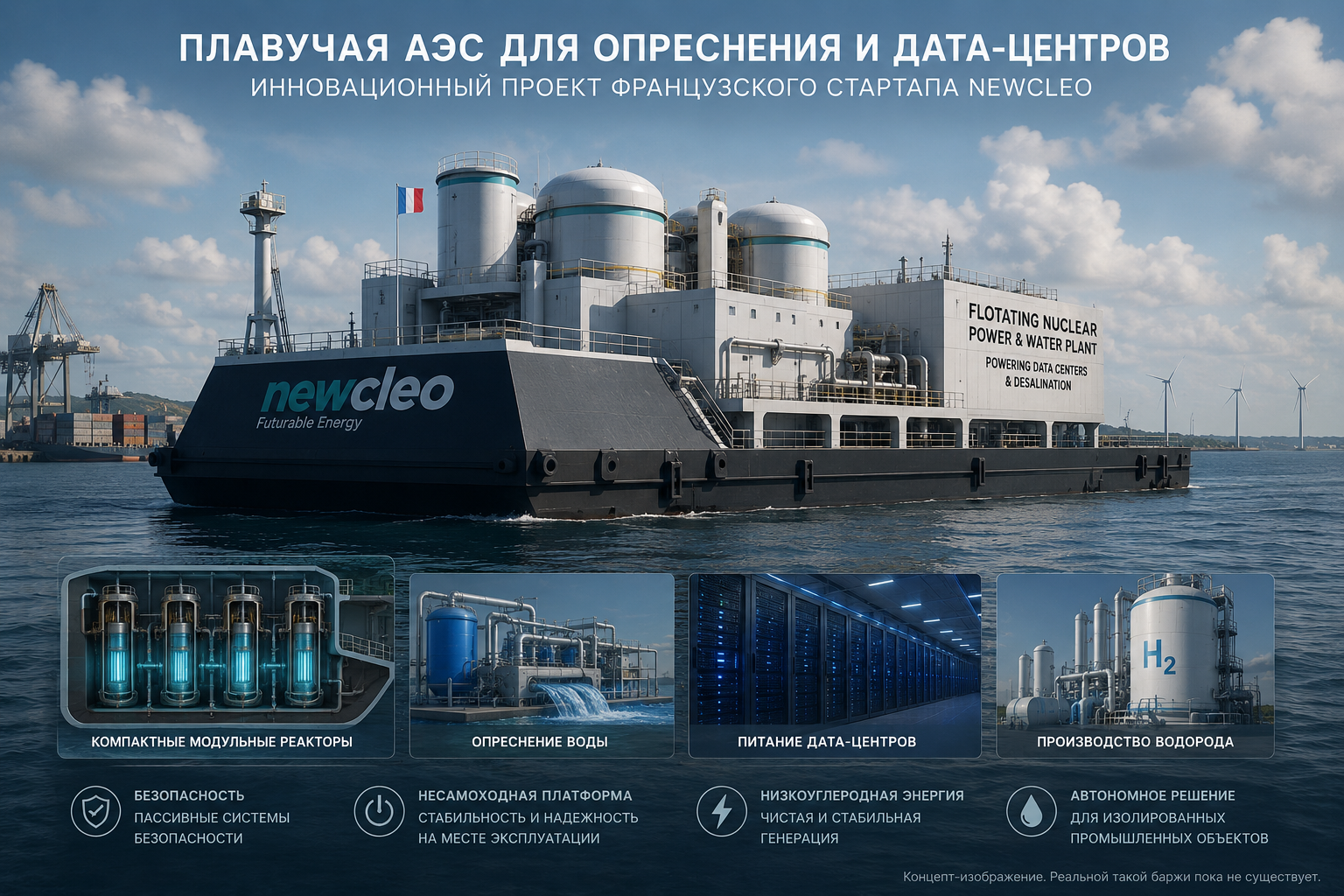
The project is aimed not at classic power supply for cities, but at isolated industrial consumers: ports, data centers, desalination plants, and hydrogen production.
The gist in brief
- A consortium led by France's Newcleo has received about €1 million from the state investment bank Bpifrance to develop a conceptual design for the n-Floating floating nuclear platform, capable of housing several LFR-AS-200 reactors with a capacity of 200 MW(e) each.
- LFR-AS-200 is a fast reactor with lead cooling, designed to generate electricity and industrial heat for data centers, hydrogen production facilities, cement and metallurgical plants.
- The project targets power supply for isolated regions, ports, and coastal industrial hubs, as well as support for energy-intensive processes — water desalination and low-carbon fuel production; the roadmap targets industrial deployment by 2036.
- The conceptual phase is scheduled to last 18 months; in addition to Newcleo, the consortium includes classification society Bureau Veritas Marine & Offshore and engineering company ABMI Groupe.
What is LFR-AS-200 and why a barge
LFR-AS-200 belongs to fast neutron reactors with a liquid metal lead coolant — a technology fundamentally different from classic water-water reactors like VVER. Lead cooling allows achieving higher operating temperatures and, according to the developers, enhances the level of passive safety of the design. The idea of placing several such reactors on a non-self-propelled marine platform is not new in its engineering logic — Newcleo directly borrows approaches honed over decades by the oil and gas industry for designing floating production, storage, liquefaction, and regasification facilities, simply applying them now to nuclear generation.
Why a floating NPP needs desalination and data centers
The list of stated applications for n-Floating is telling in itself: isolated regions, ports, coastal industrial hubs, water desalination, low-carbon fuel production. This is exactly the set of challenges that today requires stable, weather-independent energy in large volumes — the same combination of problems we have already examined using the example of the Israeli desalination project and the growing energy deficit of data center complexes like Kazakhstan's "Data Center Valley" in Ekibastuz. Newcleo CEO Stefano Buono noted that maritime deployment of advanced reactors opens a broader and still largely unexplored market for nuclear energy — essentially an attempt to enter precisely the niche where building a traditional onshore NPP is often excessive or economically unviable.
Another path in the diversity of reactor solutions
The n-Floating project logically fits into the global trend we have been tracking for several months: the nuclear industry is rapidly diversifying in terms of reactor types and application formats. While Kazakhstan is building the Balkhash NPP with large VVER-1200 reactors, Uzbekistan is combining the same VVERs with small modular RITM-200N units, and Armenia is simultaneously negotiating with five countries at once over a new-generation modular station. The French project adds another, more niche option to this palette — compact fast reactors on a floating platform for industrial consumers not tied to traditional onshore infrastructure.
Why this matters for Kazakhstan
There is no direct practical application for Kazakhstan in a floating nuclear barge for now — the country is building an onshore station at Balkhash, not offshore facilities. But the underlying logic of the project resonates with already familiar Kazakhstani challenges: growing energy demand for desalinating Caspian water and powering energy-intensive data centers requires generation sources capable of operating stably and predictably, regardless of weather. Technologies like the LFR-AS-200 show that the nuclear industry is seeking an answer precisely to this demand — compact, replicable generation for a specific industrial facility, not just gigawatt-scale stations for powering entire regions.
Author's conclusion
For now, n-Floating remains at the conceptual design stage with an 18-month horizon and industrial deployment no earlier than 2036 — that is, it is more of a bid for the future than a ready-made technology. But the very attempt to transfer practices honed over decades in the offshore oil and gas industry to nuclear energy shows where the industry is heading: not only toward more powerful and larger stations, but also toward maximally flexible, deployable solutions for a specific industrial task — from a port to a desalination plant.
Comments ()