From 99.8% to zero: how Kazakhstan is divided by access to natural gas
Kazakhstan raised gasification from 43% to 64% in ten years—an impressive absolute result. But behind the figure lies massive regional inequality.
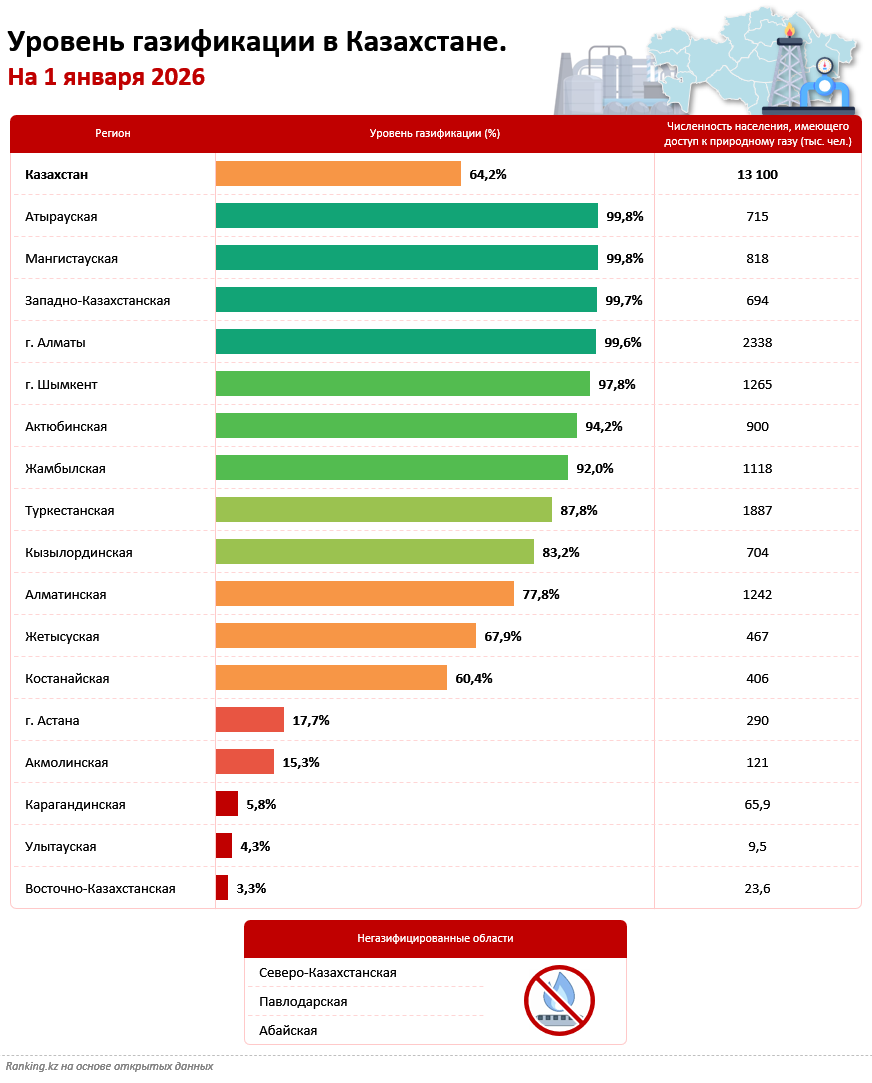
The Atyrau and Mangystau regions are connected to gas at 99.8%, while three regions of the country — North Kazakhstan, Pavlodar, and Abai — are not gasified at all, reports Ranking.kz. President Tokayev has set the task of bringing the figure to 80%. The gap between the two Kazakhstans — the fuel-based and the coal-based — remains one of the main challenges of domestic policy.
In Brief
- The level of gasification in Kazakhstan has grown from 43% in 2016 to over 64% by the beginning of 2026. Natural gas is supplied to more than 13 million out of 20.5 million residents.
- Leaders in gasification: Atyrau and Mangystau regions — 99.8%, West Kazakhstan region — 99.7%, Almaty — 99.6%, Shymkent — 97.8%.
- Outsiders: Karaganda region — 5.8%, Ulytau region — 4.3%, East Kazakhstan region — 3.3%. Three regions — North Kazakhstan, Pavlodar, and Abai regions — are not gasified at all.
- By June 30, 2026, President Tokayev has set the task of accelerating gasification and bringing its level to 80% of the country's population.
- For the development of the gas transportation system in 2026, 27.3 billion tenge has been allocated from the republican budget. Construction of the second line of the "Beineu — Bozoi — Shymkent" main gas pipeline continues with the participation of Qatari investors.
Two Kazakhstans: The West with Gas and the North with Coal
The gap between the regions is explained primarily by geography: the western regions — Atyrau, Mangystau, West Kazakhstan — are located directly near the largest hydrocarbon deposits and were the first to receive gas infrastructure back in Soviet times. Almaty and Shymkent are connected to the gas transportation system via the southern route.
Northern and eastern Kazakhstan have historically been heated by coal. The North Kazakhstan, Pavlodar, and Abai regions are areas with a developed coal industry and coal-based energy. For them, gasification requires building infrastructure from scratch — long-distance main gas pipelines across thousands of kilometers of steppe, which is fundamentally more expensive and technically more complex than connecting regions close to the deposits.
What is Being Built and How Much It Costs
The main infrastructure project to eliminate the "gas gap" is the second line of the "Beineu — Bozoi — Shymkent" main gas pipeline with a capacity of up to 10 billion cubic meters per year (with subsequent expansion to 15 billion cubic meters in the second phase in 2027–2029). The project is being implemented with the participation of Qatari investors and is key to supplying gas to the central and southern regions.
For the northern regions, a main gas pipeline is being built from the KS-14 compressor station in the Aktobe region to Kostanay. By order of the president, this involves not only residential gasification but also infrastructure for new industrial projects. In parallel, the second line of the "Almaty — Taldykorgan" main gas pipeline is being built for the Almaty and Zhetysu regions.
At the end of 2025, as a result of the implementation of 84 projects, more than 354,000 residents of 94 populated areas received gas — 2,000 km of gas distribution networks were laid. In 2026, another 36,000 people are planned to be connected to the system.
Turkestan Region as a Model of Pace
The Turkestan region demonstrates one of the most active rates of gasification: in 2025, gas was received by 102,000 residents of 41 populated areas, and the gasification level reached 88%. In 2026, it is planned to commission another 33 facilities and bring the figure to 89.5% — this is almost 2 million gasified residents in 640 populated areas.
This dynamic is the result of systematic funding: in 2025, 20.7 billion tenge was allocated for the construction of gas infrastructure in the region. The Turkestan model shows that with budgetary resources and political will, the pace of gasification can be high.
Environmental and Social Dimension
Behind the gasification figures lies not only the issue of comfort but also ecology. Coal heating in the outsider regions is the main source of smog-forming emissions in the Karaganda, Pavlodar, East Kazakhstan, and North Kazakhstan regions. Switching to natural gas automatically means a reduction in PM2.5 and other harmful emissions into the atmosphere — a factor directly affecting public health and life expectancy.
At the same time, the cost of heating for households when switching from coal to gas typically decreases — especially since Kazakhstan maintains some of the lowest natural gas tariffs in the world for the population.
Author's Conclusion
64% gasification is significant progress achieved over one decade. But three completely non-gasified regions and several areas with rates below 6% indicate that "gas Kazakhstan" and "coal Kazakhstan" still exist in parallel. Achieving the target of 80% will require not only money but also solving a fundamentally more complex engineering challenge — laying main infrastructure in regions where it has never existed. This is not a matter of a few years of work, but an entire decade.
Comments ()