Germany's hydrogen market to be boosted by subsidies of over €1.5 billion
Germany's Economy Ministry unveiled a package of measures to speed up its hydrogen market, which is lagging behind initial plans.
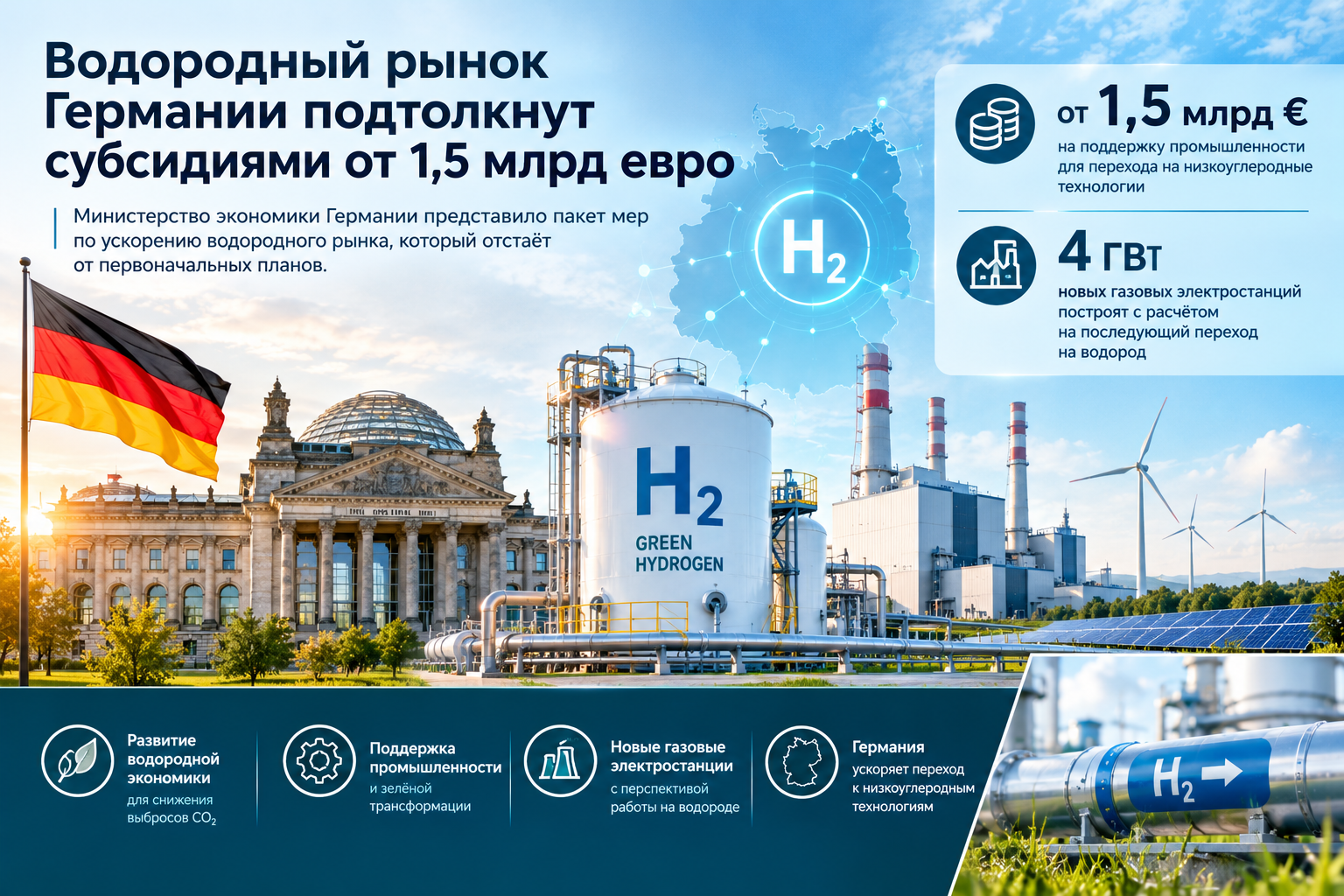
At least €1.5 billion will be allocated to industry for the transition to low-carbon technologies, and another 4 GW of new gas-fired power plants will be built with provisions for a subsequent switch to hydrogen, Reuters reports.
The gist in brief
- At least €1.5 billion is earmarked to support industry through carbon contracts for difference with a term of 15 years.
- A dedicated budget for hydrogen projects will be reserved in the 2027 tender; if demand is high, it may be increased.
- Gas-fired power plants with a total capacity of 4 GW are to switch to hydrogen over time: the first 2 GW will be put out to tender in 2027, and they will be able to run on hydrogen from 2040.
- Last year, more than 500 km of hydrogen pipelines were in operation in Germany, another 2,200 km were under construction, and €4.2 billion is planned for expanding the network.
Money for industry
The subsidies will be provided through Carbon Contracts for Difference (CCfD). Under such a contract, the state compensates a company for the additional costs it incurs when switching to a cleaner production method. Such contracts will have a term of 15 years.
A dedicated budget for hydrogen projects will be reserved as part of the next competitive selection in 2027. If demand proves high, the amount of funding may be increased.
Gas plants for hydrogen
Germany also plans to support the construction of gas-fired power plants with a total capacity of 4 GW, designed for a subsequent switch to hydrogen. The first tender for 2 GW is scheduled for 2027, and these capacities will be able to run on hydrogen from 2040. Another 2 GW will be allocated in tenders in 2030-2032, and their conversion to hydrogen is to begin in 2043.
Gas generation is seen as an interim stage: the new plants will provide electricity now and in the future will switch to a lower-carbon fuel.
Pipelines and the price of hydrogen
The market is developing alongside a dedicated pipeline network. Last year, more than 500 km of hydrogen pipelines were already in operation in Germany, and another 2,200 km were under construction. Federal and regional authorities plan to allocate €4.2 billion to expand the network in the coming years.
The ministry acknowledges that market development is lagging behind expectations, and the cost of producing hydrogen remains significantly higher than that of fossil fuel alternatives. The new package of measures is intended to narrow this gap for industry and create conditions for demand growth.
How production is being built in other countries
While Germany is stimulating demand, other countries are building the plants themselves. Spain's Moeve is constructing the first phase of the "Andalusian Green Hydrogen Valley" in Huelva: a 300 MW electrolyzer, more than €1 billion in investment and about 45,000 tonnes of hydrogen per year. In Saudi Arabia, the NEOM Green Hydrogen complex is moving from construction to commissioning: 2.2 GW electrolyzers are to produce up to 600 tonnes of hydrogen per day, with commercial launch scheduled for 2027.
What this means for Kazakhstan
Kazakhstan is also revisiting its hydrogen policy: at an August meeting of the Public Council on Fuel and Energy at the Ministry of Energy, an update to the Concept for the Development of Hydrogen Energy through 2040 was announced. At the same time, the ministry summarized 24 investment agreements in the energy sector totaling 3.8 GW. In that material, hydrogen was described as a long-term direction affecting both industry and transport.
Author's conclusion
The package acknowledges that Germany's hydrogen market is moving slower than planned and seeks to give it a push with money and long-term contracts. But the main deadlines are pushed far into the future: the plants from the first tender will switch to hydrogen only from 2040, and those from the second from 2043. As long as the price gap with fossil fuels remains, demand will depend on state support.
Comments ()