Gold deposit near Ekibastuz planned to be returned to production after 40 years of inactivity
Dostyk-2023 LLP plans to move from exploration to open-pit gold mining at the Aymanday deposit in Pavlodar Region, 15 km southwest of Ekibastuz.
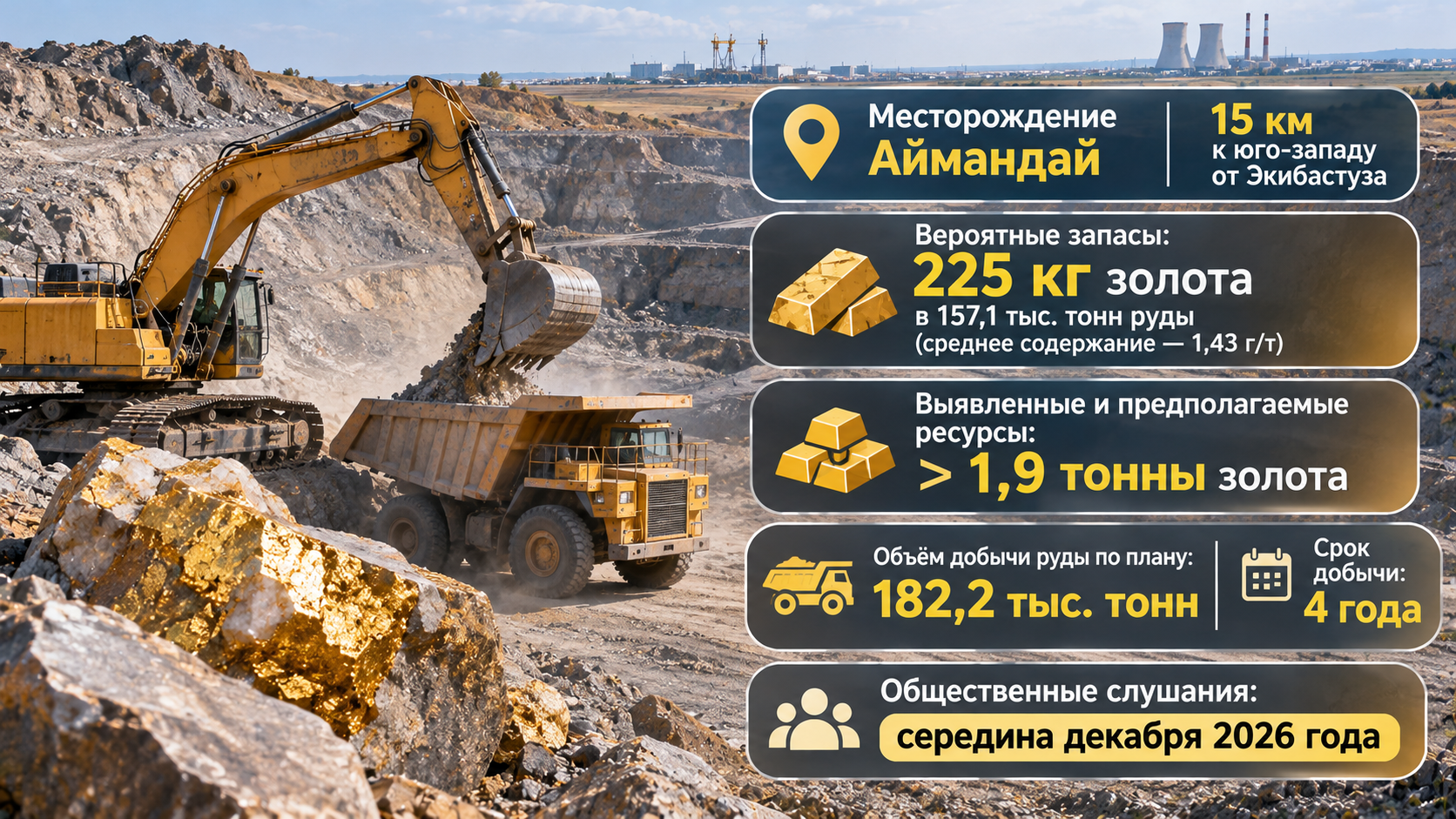
The deposit was developed in 1977-1986; the subsoil user is now preparing a mining plan, with public hearings on it scheduled for mid-December 2026, Forbes Kazakhstan reports.
The essence in brief
- The subsoil user plans to obtain a mining license and move from geological exploration to open-pit gold mining.
- Probable reserves under the mining plan amount to 225 kilograms of gold in 157.1 thousand tonnes of ore at an average grade of 1.43 grams per tonne.
- Indicated and inferred resources together exceed 1.9 tonnes of gold.
- Ore extraction under the plan will take four years and total only 182.2 thousand tonnes; the hearings are scheduled for mid-December.
What is known about the deposit
Aimandai is located in the Pavlodar region, about 15 kilometres south-west of Ekibastuz. It was explored in 1969-1972, and mining was carried out in 1977-1986. In 2023-2025 the company conducted additional exploration of the north-eastern part of the deposit: the resources were estimated according to the Kazakh reporting standard KAZRC. The reserve estimate as of the beginning of 2026 was accepted onto the state balance.
What the company plans
The solid minerals exploration license held by Dostyk-2023 was issued in early 2023 and is valid until 2029. Now the subsoil user intends to exercise its exclusive right and obtain a mining license. To this end, a mining plan is being prepared, and public hearings on it will be held in mid-December 2026 in Ekibastuz.
How much gold is at the deposit
According to the mining plan, probable reserves amount to 225 kilograms of gold in 157.1 thousand tonnes of ore, with an average grade of 1.43 grams per tonne. The resources, that is, the less studied part, are divided into two categories:
- indicated - 325.5 kilograms of gold in 240.2 thousand tonnes of ore, grade 1.35 grams per tonne;
- inferred - 1,581.4 kilograms of gold in 419.8 thousand tonnes of ore, grade 3.77 grams per tonne.
Together, the indicated and inferred resources exceed 1.9 tonnes of gold.
The difference between resources and reserves can be large: at the Kogadyr deposit in the Zhambyl region, resources are estimated at 44.5 tonnes of gold, but the state has approved reserves of only about 12 tonnes.
How they plan to mine
The gold is to be mined by open-pit method. The mining plan provides for the extraction of 177 thousand tonnes of ore: losses will amount to 7.1 thousand tonnes, and dilution, that is, the admixture of waste rock, will be 12.4 thousand tonnes. Ore extraction by year is distributed as follows: 11 thousand tonnes, 94.5 thousand, 55 thousand and 21.7 thousand, for a total of 182.2 thousand tonnes. Extraction first grows and then declines: the peak falls in the second year.
What happens next
The next step is public hearings on the mining plan in mid-December 2026 in Ekibastuz. The company does not yet have a mining license: it only intends to obtain one. The materials do not provide either investments in the project or a forecast of gold output by year, only ore volumes.
What else is happening with gold in Kazakhstan
The editorial team monitors gold mining in the country. In the nine months of 2026, Kazakhstan produced 84.7 tonnes of unrefined and semi-processed gold versus 95.2 tonnes a year earlier: output declined by 11%; refined gold output was 47.7 tonnes versus 53.5 tonnes.
Large projects are designed for different volumes. At the Vasilkovskoye deposit, Kaz Zinc expects output of 2-5 tonnes of gold per year: exploration has shown more than 190 tonnes there, and mining will begin in 2027 and end in 2042. In the same Pavlodar region, about 70 kilometres south-west of Pavlodar, there is another project - the Beskauga copper-gold-silver project: Canada's Mogotes Metals has registered a subsidiary in the Astana International Financial Centre (AIFC) for this project.
Author's conclusion
The project is still at the preparatory stage: the company has not yet obtained a mining license, and the hearings on the mining plan are still ahead. The figures for the deposit are stated according to project documentation, and only part of the gold is classified as probable reserves: 225 kilograms out of more than two tonnes. The project can be judged by two steps: whether the hearings take place in mid-December and whether Dostyk-2023 obtains a mining license.
Comments ()