Hungary has completely shut down its only nuclear power plant for the first time in 44 years.
This summer the Danube already halted one nuclear plant — now it fully stopped a second. Hungary's Paks NPP, supplying up to half its electricity, ceased generation entirely for the first time since 1982.
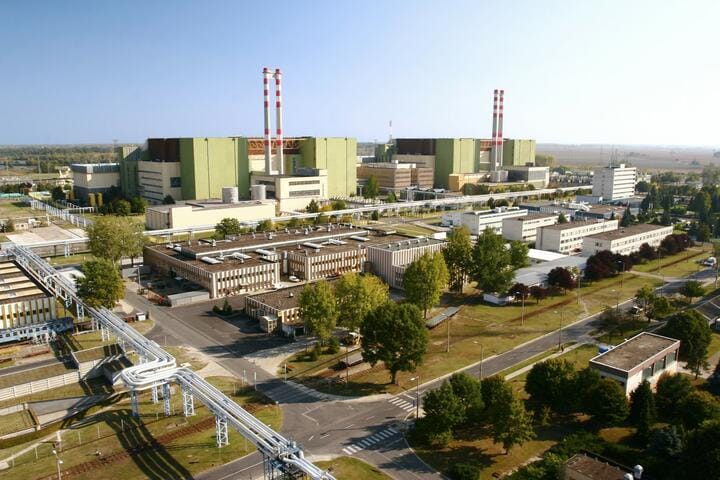
The reason is the same as in neighboring Romania a few days earlier — catastrophic shallowing of the river, only this time the consequences turned out to be far more extensive, writes the publication mixnews.lv.
The gist in brief
- The Paks nuclear power plant — Hungary's only atomic station, supplying about 40–50% of the country's electricity — has for the first time in 44 years completely shut down all four reactors on the night of August 2, 2026.
- The reason is the record shallowing of the Danube, whose waters are used to cool the reactors; in recent weeks the plant gradually reduced the output of its units until it shut down the last one.
- The Hungarian government has called on large enterprises to reduce electricity consumption and introduced energy-saving measures — from switching off decorative lighting on government buildings to restrictions for industry.
- According to authorities' estimates, if the drought persists, the plant's downtime could last several weeks; this is already the third case in one summer when nuclear generation in the Danube basin has suffered from heat and water shortages.
What happened at Paks
The plant, located about 100 km south of Budapest, uses Danube water to cool its four reactors. This summer, Central Europe has been hit by a series of extreme heat waves with almost no precipitation, and the river level has dropped to record lows. In recent weeks, the plant operator had already repeatedly reduced the output of individual power units, but as the water level continued to fall, the reactors had to be taken offline one after another — on the night of August 2, the penultimate unit was shut down, after which electricity generation ceased entirely. The Hungarian regulator emphasizes: the shutdown was carried out in a routine manner precisely to comply with environmental and operational requirements, not because of a nuclear safety threat — the cooling systems continue to operate, but they require significantly less water than during full-power generation.
How serious is this for Hungary
Paks provides between 40 and 50% of the country's total electricity, so its complete shutdown is not an ordinary episode but a blow to the energy balance of an entire nation. Hungary will have to sharply increase electricity imports from neighboring countries while simultaneously conserving its own resources. The government has already called on large enterprises to cut energy consumption and introduced energy-saving measures — from switching off decorative lighting on government buildings to restrictions for individual industrial plants. According to authorities' estimates, if the drought drags on, the plant's downtime could last several weeks.
Third case this summer, second on the Danube
Hungary has become the third country whose nuclear energy sector has suffered from abnormal heat and drought this summer — and the second where the Danube was the cause. A week earlier, due to the critical shallowing of the same river, Romania was forced to shut down a reactor unit at the Cernavodă nuclear power plant, and when the water still did not return, the country's authorities moved to a military operation to alter the riverbed — blasting works on the Danube floor carried out by more than 100 military personnel. Earlier in the same season, France's reactors were shut down not because of a lack of water in the Seine and Rhône, but because the river water had become too warm for safe discharge. In addition to nuclear generation, low water levels in the Danube and Rhine have already disrupted navigation, reduced hydroelectric output, and complicated cargo transportation along Europe's major rivers.
Why this matters for Kazakhstan
Three countries, two different failure mechanisms — water too warm in France and its volume too small in Romania and Hungary — but the same outcome: nuclear generation ends up hostage to the condition of the river or lake from which it draws cooling water. For Kazakhstan, which last week signed intergovernmental agreements with Russia on building a nuclear power plant on Lake Balkhash, this European season is not a distant chronicle but a series of direct precedents. Balkhash differs from the Danube in that it is a closed body of water rather than a flowing river: the Danube in theory has a chance to recover its level with the return of precipitation, whereas Balkhash's level depends entirely on the balance between inflow and evaporation — and that balance is already showing signs of mounting stress. Three European plants this summer have demonstrated three different scenarios of the same vulnerability — and all three are worth considering when designing the cooling systems for future Kazakhstani power units, not just the classic choice between wet and dry cooling towers.
Author's conclusion
Just a month ago, the French episode could have been written off as a one-off coincidence of weather conditions. After Romania and now Hungary, the pattern is harder to deny: Europe's nuclear energy sector is facing for the third time in a single season the reality that water is not an infinite resource that can be factored into a project by default. For Kazakhstan, where the discussion of a future plant on Balkhash is unfolding in parallel with these European news stories, three illustrative cases in one summer are a weighty argument in favor of resolving the issue of water resilience at the design stage rather than after the plant is commissioned.

Comments ()