In Astana, the temperature difference between buildings reaches 16°C on the same day — data from 49.5 thousand buildings
Pavlov Analytics analyzed perceived air temperature for all 49,538 buildings in Astana in June 2026. Temperature differences reached 16°C.
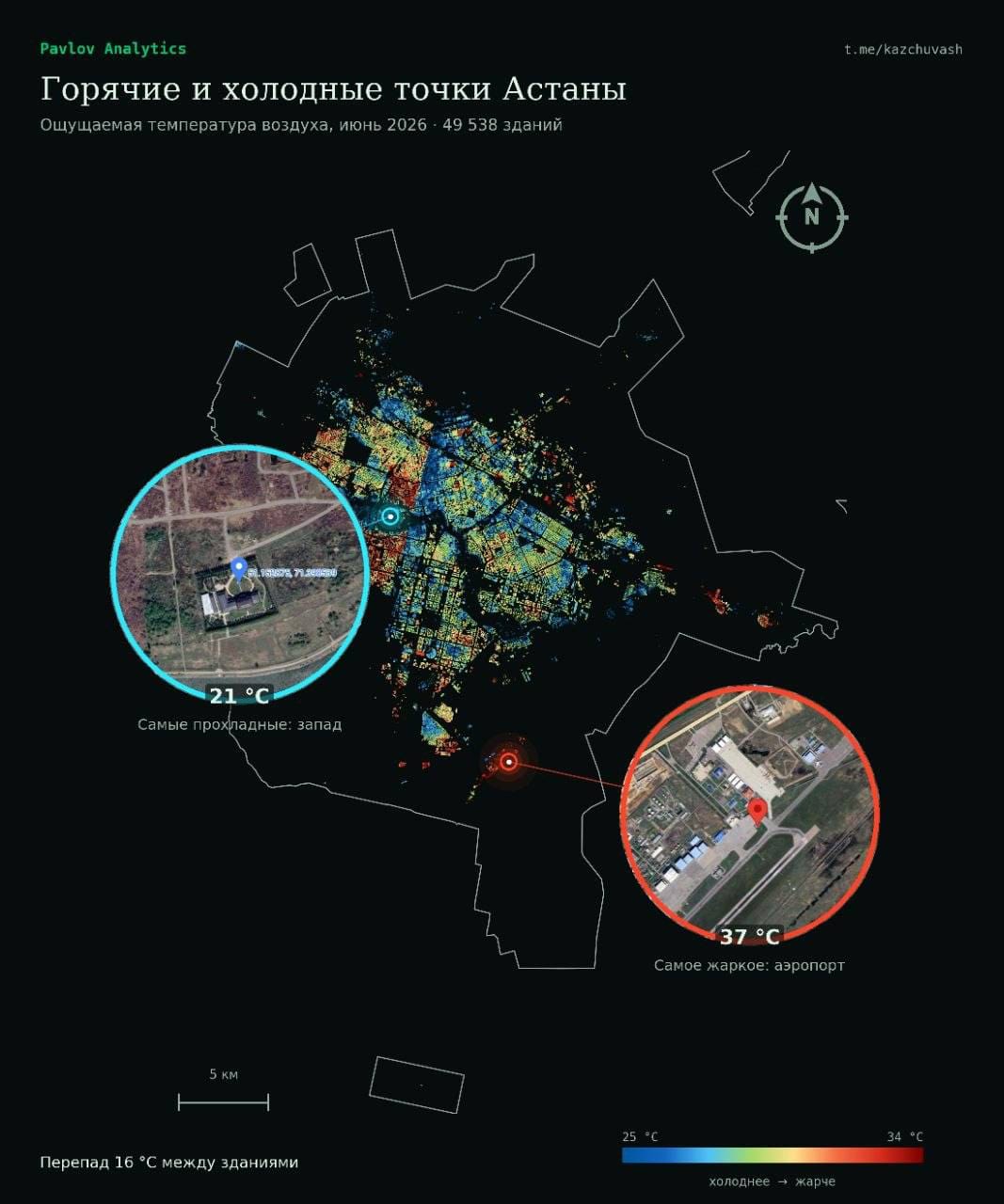
The analytical center Pavlov Analytics conducted a unique study: scientists calculated the perceived air temperature in Astana for each of the 49,538 buildings in the city for June 2026. The result showed that the urban environment creates its own, highly uneven microclimate — the difference between the hottest and coolest building in the capital on the same day reaches 16°C.
The Gist
- Pavlov Analytics analyzed the perceived air temperature for all 49,538 buildings in Astana for June 2026.
- The difference between the hottest and coolest building in the city was 16 degrees on the same day.
- Hottest area — near the airport: concrete aprons, metal roofs, and a lack of trees create temperatures around 37°C.
- Coolest area — on the western outskirts of the city, near the Yesil River, where green spaces and water keep the temperature at around 21°C.
The City as a Mosaic of Microclimates
The study clearly demonstrates a phenomenon known in climatology as the urban heat island effect — but with unprecedented detail for Kazakhstan: not averaged indicators by district, but data for each individual building. This allows us to see that urban heat is not a uniform phenomenon, but the result of specific architectural and landscape decisions.
The airport zone is a classic example of a heat island in its extreme form: extensive concrete and asphalt surfaces, metal roof structures, and a complete absence of tree vegetation create a local microclimate that does not cool down even at night, as artificial materials accumulate and release heat slowly.
Water and Greenery as a Natural Air Conditioner
The opposite pole is the western outskirts of Astana along the Yesil River. The difference of 16 degrees between two points in the same city at the same moment is not a coincidence, but a direct consequence of the presence of water and green spaces, which act as a natural cooling system: moisture evaporation and shade from trees reduce the temperature of the surface air layer by several degrees without any technical intervention.
This study is especially telling against the backdrop of the ongoing heatwave in the Northern Hemisphere in 2026 — from Europe to Central Asia. While city authorities cannot change global climate trends, they can certainly influence the local urban microclimate.
Author's Conclusion
Pavlov Analytics' data turns the abstract concept of an "urban heat island" into a concrete, measurable, and mappable phenomenon. 16 degrees of difference between two points in the same city is not a statistical error, but a direct indication that urban planning can either exacerbate heat or mitigate it. For Astana, where climatic anomalies are becoming the norm, such data is not just an interesting figure, but a practical guide for greening and urban planning policy.

Comments ()