Indonesian wildfire smoke threatens health of 3.4 million people
Dense smog blanketed several major Indonesian cities, forcing authorities to close schools and distribute hundreds of thousands of protective masks.
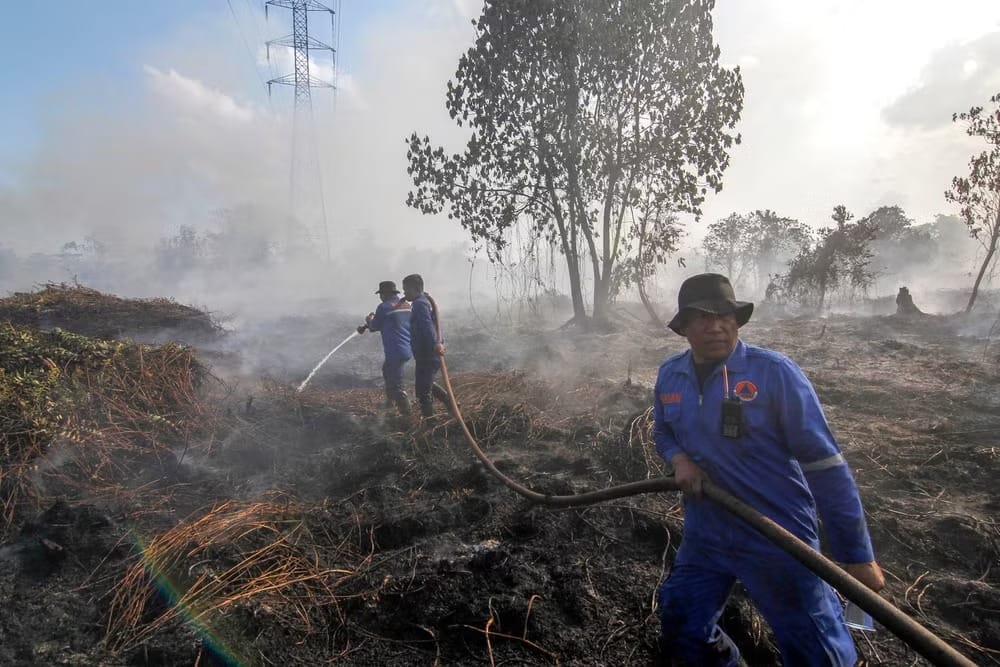
Forest fires on Borneo and Sumatra, partly linked to the emerging El Niño, have already destroyed more land than in all previous seasons of this climate phenomenon, Euronews reports.
The gist
- From January to July, fires on Borneo and Sumatra destroyed more than 200,000 hectares — an area three times the size of Jakarta — and more than in the previous El Niño seasons of 2019 and 2023.
- Indonesia's Ministry of Health has warned that 3.4 million people in seven provinces are at risk of respiratory infections; authorities have closed dozens of schools and distributed more than 260,000 protective masks.
- The haze has spread far beyond Indonesia: on Tuesday, Kuala Lumpur ranked second in the world for air pollution levels, and Malaysian authorities closed nearly 600 schools in the state of Sarawak.
- President Prabowo Subianto has deployed dozens of helicopters, aircraft, and thousands of personnel to fight the fires; police have already detained 72 people on suspicion of arson.
What life under the haze looks like
Residents of affected cities describe the situation as suffocating daily life.
Abdullah, an entrepreneur from Pekanbaru, told AFP: "At night the haze gets denser, Pekanbaru literally turns into a dead city. Many are afraid to go outside."
In Jambi, Farida, a 31-year-old homemaker, said the haze has already affected the health of her four-year-old child — both began coughing heavily after prolonged time outdoors, and local authorities have switched kindergartens and primary schools to home-based learning until the end of the week.
The cause of the fires — agricultural practices
Most forest fires in Indonesia are traditionally linked to slash-and-burn land clearing for agriculture — a cheap but extremely risky method of preparing plots for planting during an abnormally dry season. It is the combination of this practice with the prolonged drought caused by El Niño that turns controlled burns, manageable in normal years, into large-scale, poorly controlled fires covering hundreds of thousands of hectares of peatlands and forests.
The international dimension
The smoke from Indonesian fires does not recognize state borders. Malaysia has already offered assistance in fighting the fires, but at the same time is itself suffering the consequences — in addition to closed schools in Sarawak, air quality in Kuala Lumpur, according to the IQ Air monitoring service, ranked second worst in the world. The haze has also affected Singapore, showing how transboundary the consequences of local agricultural practices can be under unfavorable weather conditions.
Connection to the climate series we have already covered
The Indonesian fires are another manifestation of the same emerging super El Niño we have been tracking all season. We have already reported that NOAA has raised the probability of this phenomenon reaching record strength to nearly 69%, and its effects are appearing in various corners of the planet — from the heatwave in Kazakhstan to the crisis in European agriculture. In terms of the scale of destruction, the Indonesian fire season also resembles the severe European fire season that claimed dozens of lives this summer and even reached Germany — except there the fire was fueled by direct heat and drought, while in Southeast Asia El Niño traditionally intensifies drought indirectly, creating ideal conditions for catastrophic forest fires amid slash-and-burn farming.
Author's conclusion
The fact that the current fire season in Indonesia has surpassed in scale the previous El Niño episodes of 2019 and 2023 is a worrying sign for the future: if the phenomenon indeed proves to be record-breaking in strength, as NOAA predicts, the consequences could exceed even current figures. While President Prabowo expresses cautious optimism about the timeline for bringing the situation under control, millions of residents of Borneo and Sumatra continue, quite literally, to breathe the consequences of a climate phenomenon born in the waters of the Pacific Ocean thousands of kilometers from their homes.

Comments ()