Jellyfish halt France's largest nuclear plant for second straight year
French nuclear reactors have a new summer shutdown cause: not just heat, but jellyfish clogging cooling systems.
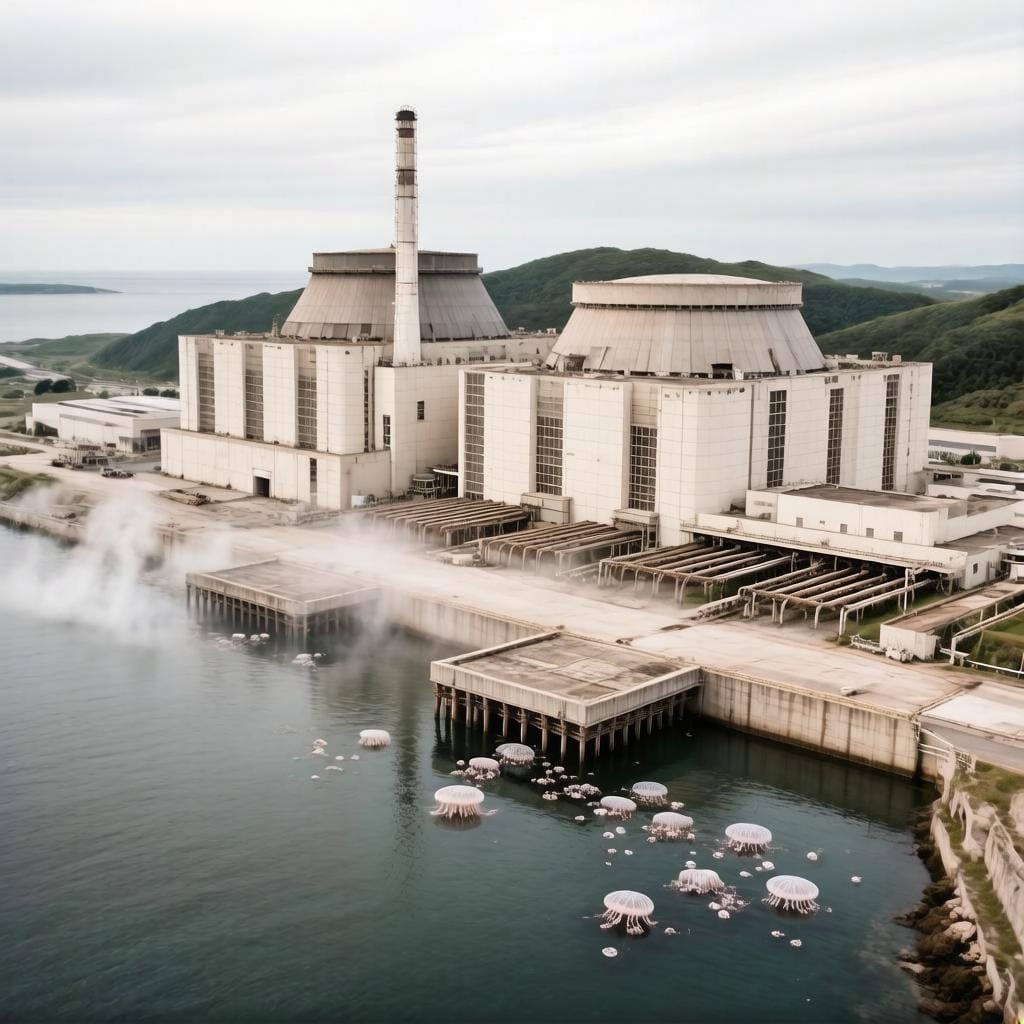
As European Pravda reports, on August 10, 2026, a massive jellyfish invasion clogged the seawater intake stations of the Gravelines nuclear power plant, the largest nuclear power station in Western Europe — and this happened exactly one year after a nearly identical incident.
The gist
- On August 10, 2026, a massive jellyfish invasion clogged the seawater intake stations of the Gravelines NPP (six reactors of 900 MW each), which automatically shut down three reactors; a fourth is operating at half power.
- The incident occurred exactly one year after a similar case — on August 11, 2025, jellyfish took four reactors of the same plant offline at once.
- The shutdown coincided with record unavailability of the entire French nuclear fleet — 15.6% as of August 8, the highest since 2015, caused by drought and heat that limit cooling of other reactors with river water.
- EDF states there is no threat to personnel safety or the environment, but the simultaneous drop in electricity supply and rise in demand due to air conditioners is putting pressure on wholesale prices, which risks affecting consumer bills.
How jellyfish stop a nuclear reactor
Gravelines is a coastal plant that, unlike reactors on the Seine and Rhône, is cooled not by river water but by seawater: its intake stations pump hundreds of thousands of cubic meters of water from the North Sea daily to cool the secondary circuit. The reactors are equipped with protection systems that monitor any thermal anomalies, and as soon as the temperature of the secondary circuit exceeds a critical threshold, the automation triggers an emergency shutdown — boron control rods are instantly inserted into the core, stopping the chain reaction. The procedure is safe but requires a prolonged cooling period before restart, so a massive accumulation of jellyfish clogging the intake filters reliably takes a power unit offline for days, if not weeks.
EDF was preparing, but didn't make it in time
After last year's incident, the plant operator strengthened control measures: surveillance cameras were installed at the facility to monitor the filter drums and the water supply channel with live feeds to the control room, and at sea, a partnership was established with the fishermen's association France Pêche Durable et Responsable and SNSM rescuers for daily visual monitoring and, if necessary, targeted jellyfish harvesting. The enhanced surveillance allowed them to detect "several dozen kilograms" of jellyfish near the plant as early as Saturday, but by Sunday the situation had deteriorated so much that a large-scale catch had to be organized — preventive measures could not keep up with the speed at which the accumulation grew.
Another example of vulnerability — and again France
Gravelines adds to the list of French energy problems this summer with a new, third vulnerability mechanism. Earlier, France's reactors were shut down because the water in the Seine and Rhône became too warm for safe cooling, and then the country introduced water use restrictions across nearly 70% of its territory due to the driest and hottest summer on record. The jellyfish at Gravelines represent a mechanism of a different nature than direct overheating or water scarcity: here, a biological factor comes to the forefront, although it too is linked to climate — warming seawater creates more favorable conditions for jellyfish reproduction and population growth. Three different failures in one summer — thermal, water-deficit, and biological — show that the vulnerability of nuclear power to climatic and environmental factors cannot be reduced to a single cause.
Author's conclusion
The repetition of last year's incident on the exact same day is not merely a curious coincidence of dates, but an indication that the problem is seasonal and structural in nature, not random. EDF strengthened monitoring after the first case, but the scale of the invasion proved sufficient that even with cameras and the partnership with fishermen, the shutdown could not be avoided. For an energy industry designed for the climatic conditions of the last century, such episodes serve as a reminder that the list of risk factors for nuclear plants continues to expand, and not all of them are amenable to simple engineering solutions.


Comments ()