Kazakhstan again reports unknown livestock disease — this time in sheep in West Kazakhstan Region
New reports of livestock deaths with an unidentified diagnosis have appeared on social media — this time involving sheep in the West Kazakhstan region.
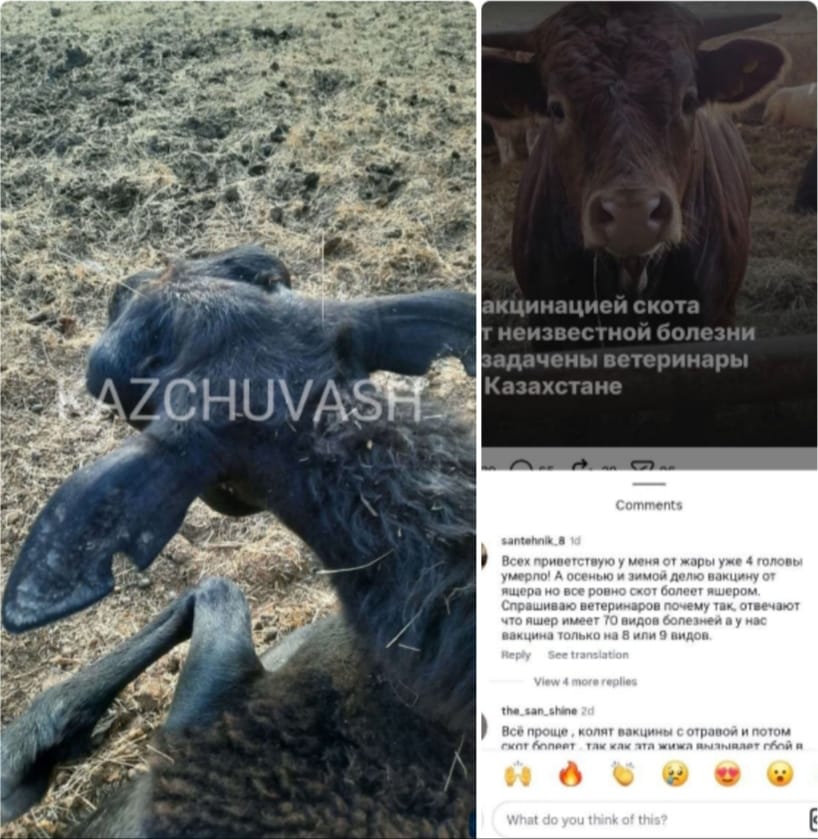
The information did not come from official sources, but from the farmers themselves, but the case is not isolated: similar reports of unexplained livestock diseases in the country have been recorded since the beginning of the year.
The gist in brief
- A new case of livestock death with an undetermined diagnosis has been recorded in the West Kazakhstan Region — the information spread through videos filmed by farmers.
- The term "Tashimov's disease," under which this case is being discussed on social media, was first heard several months ago in connection with a similar situation in the Atyrau Region — it was jokingly proposed by a veterinary expert commenting on the absence of an official diagnosis.
- In May 2026, Kazakhstan received status as a foot-and-mouth disease-free zone from the World Organisation for Animal Health. Cases of livestock death with an undetermined diagnosis, meanwhile, continue to be recorded in several regions.
- The Ministry of Agriculture has previously acknowledged systemic problems with veterinary infrastructure: the construction of veterinary stations is lagging in eight regions, and of animal burial sites in five, while livestock registration in the digital system Tort Tulik remains incomplete in six regions.
- According to FBRK, the head of the department of veterinary control at the border and transport, Yeris Nuraliyev, sent official memos to the committee's leadership about the risks of infection spread as early as January 2026; after his proposals went unanswered and he himself began complaining to government agencies, his position was slated for elimination.
What happened this time
The Telegram channel "Kazakh Chuvash" published a post about a new case of sheep death in the West Kazakhstan Region.
The text is short and contains a direct reference to previous episodes: "An unknown disease has been detected in sheep in the West Kazakhstan Region. Of course, this is in no way connected to the sudden outbreak of an unknown disease in neighboring Russia. Just as it was at the end of winter with another unknown disease, presumably 'Tashimov's disease.'
Saigas, of course, are not in the risk zone and are not carriers of unknown diseases (Tashimov's disease or Berdalin's disease).
But none of this is certain — trust only official sources, cook meat thoroughly and wash your hands before eating."
The channel usually publishes materials sent directly by farmers and eyewitnesses rather than retelling news from the media — meaning the source of the report, in all likelihood, was a video from the scene rather than an official bulletin.
Where the name "Tashimov's disease" came from
The term did not appear in this post but earlier — in connection with a similar case in the Atyrau Region, which FBRK wrote about. At that time, entrepreneur Raya Mukhanbetova lost 13 head of livestock, and farmer Yerkin Sharipov lost 20–30 head, and in neither case was a diagnosis officially established. Commenting on the situation, Doctor of Veterinary Sciences Gaisa Absatirov drew attention to a contradiction: there is no diagnosis, but the animals are already being vaccinated — and it is unclear against what exactly. In another FBRK article, Absatirov explained in detail why the official diagnosis of "pasteurellosis" given to saigas raises doubts for him: the symptoms of this disease do not include lesions of the oral and nasal mucosa, salivation, lameness, and lesions in the interdigital cleft area — whereas it is precisely these signs that are recorded in photo and video materials from the field, and the sick saigas are in close contact with domestic livestock. As a historical analogy, he cites the epizootic of 1957–1958, when about 45,000 adult saigas and two-thirds of newborns died, and the disease spread over long distances, introducing foot-and-mouth disease into domestic livestock herds in areas that were disease-free at the time. Having received no clear explanation from the agencies, Absatirov ironically proposed naming undiagnosed diseases after the surname of the chairman of the Committee for Veterinary Control and Supervision of the Ministry of Agriculture, Kazbek Tashimov — thus was born the name that is now used on social media as a common noun.
Internal warnings that went unanswered
According to FBRK, the head of the department of veterinary control at the border and transport of the Committee for Veterinary Control and Supervision, Yeris Nuraliyev, sent official memos to the agency's leadership about the risks of infection spread as early as January and April 2026 — several months before the topic became a subject of public discussion. In a memo dated January 23, addressed to committee chairman Kazbek Tashimov, Nuraliyev pointed to the unstable epizootic situation in neighboring countries and proposed organizing disinfection of incoming vehicles at the border, citing the fact that similar practices are already in place in Russia, Kyrgyzstan, and Uzbekistan. A separate memo concerned saigas — Nuraliyev described the migration routes of the Volga-Ural population, noted the absence of boundaries along their movement paths, and pointed out that the carcasses of dead animals are not collected or disposed of on site, remaining a source of infection. He proposed a specific set of preventive measures and warned that inaction on developing vaccines for wildlife could lead to an environmental catastrophe with unpredictable consequences.
According to Nuraliyev, these proposals went unanswered. After he began appealing to the Agency for Civil Service Affairs and other bodies with complaints about violations of his rights, a reorganization began in the committee, during which his position was slated for elimination, and an internal review is now being conducted against him — Nuraliyev himself links it to these appeals.
Official status and parallel reports of diseases
In May 2026, the World Organisation for Animal Health granted Kazakhstan the status of a foot-and-mouth disease-free zone. This is an international recognition with direct significance for meat exports. The same channel "Kazakh Chuvash" responded to this with a separate post, ironically describing the logic behind obtaining such statuses and mentioning that "unknown diseases" continue to be recorded in parallel with the official recognition of disease-free status. Whether the specific cases of livestock death reported by farmers are linked to foot-and-mouth disease or to some other disease cannot be determined from open sources — official laboratory conclusions for most such cases are not published.
Veterinary control infrastructure is not yet complete
The problem of diagnosing individual cases is layered on top of a broader picture. We have already written that the Ministry of Agriculture in August 2026 publicly criticized several regions for missing deadlines on veterinary infrastructure construction. For 2026–2027, nearly four times as many facilities are planned as were built over the previous two years, but the construction of veterinary stations is lagging in eight regions, including Kostanay, Akmola, and Atyrau regions, and of animal burial sites in five. Livestock registration in the Tort Tulik app, on which the speed of detecting and localizing disease outbreaks directly depends, remains incomplete in the Mangystau, Karaganda, East Kazakhstan, Aktobe, Pavlodar, and North Kazakhstan regions. In other words, the system that should quickly record and explain such cases of livestock death is itself still in the process of being created.
The economic backdrop
The diagnostic problem is also layered on top of the broader economic situation in the sector. In July 2026, livestock farmer from the Abai Region Kuanysh Suleimenov warned of the risk of mass livestock slaughter due to rising costs and problems with providing farms with feed. His warning concerned primarily economic factors rather than epizootic ones, but both types of risk affect farms simultaneously: a farmer losing livestock for an unclear reason finds himself in a more vulnerable position than one who at least understands the source of the losses and can influence it.
What is known and what is not
Based on the totality of available data, the following can be stated: cases of livestock death with an undetermined diagnosis have been recorded in several regions of Kazakhstan for at least several months of 2026. Within the relevant committee itself, according to FBRK, warnings about such risks were voiced as early as January — that is, before the situation became public. In parallel, the country confirmed its international foot-and-mouth disease-free status. Whether specific cases of livestock death are linked to foot-and-mouth disease or to some other disease cannot be determined on the basis of open sources; official laboratory conclusions for most cases are not published. The version put forward by Nuraliyev himself about the connection between his appeals to government agencies and the subsequent elimination of his position has also not been independently confirmed — it is his own interpretation of events, not an established fact. But the coincidence in time between the ignored official memos and the subsequent public discussion of "unknown diseases" in itself raises a question that goes beyond one region or one case: does the relevant agency receive signals from its own specialists, and what happens to those signals afterward.



Comments ()