Kazakhstan commissioned seven of the ten renewable energy facilities planned for 2026.
Kazakhstan's renewable energy sector accelerated notably this summer.
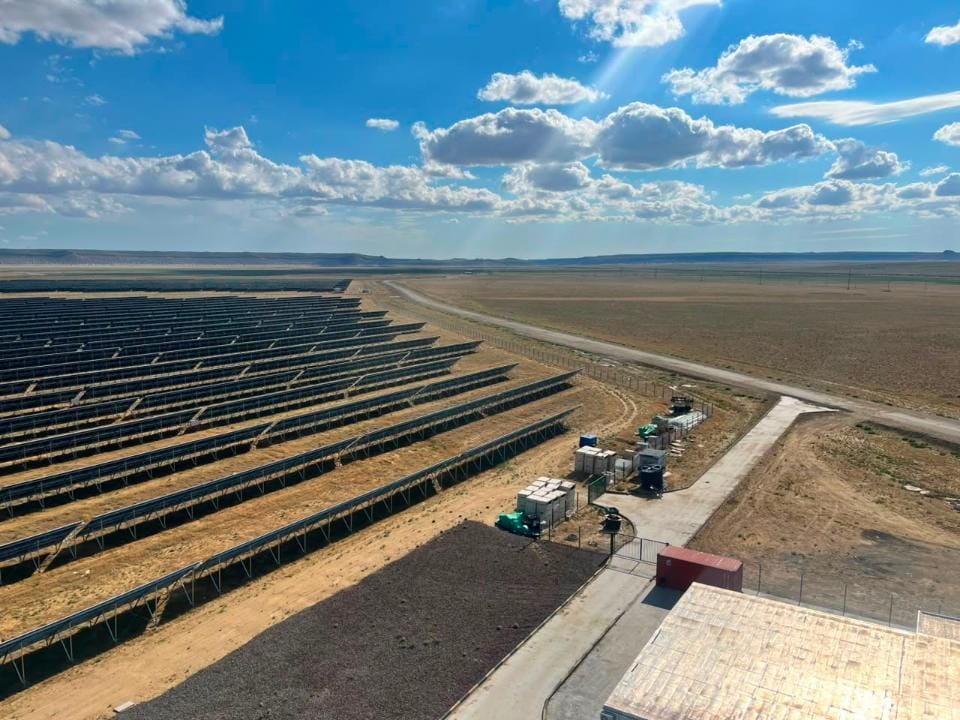
Of the ten renewable energy facilities planned for launch in 2026, seven are already operational, providing the country's power system with an additional 212 MW of capacity — and this is not yet the end of the year, Inbusiness.kz reports.
The gist in brief
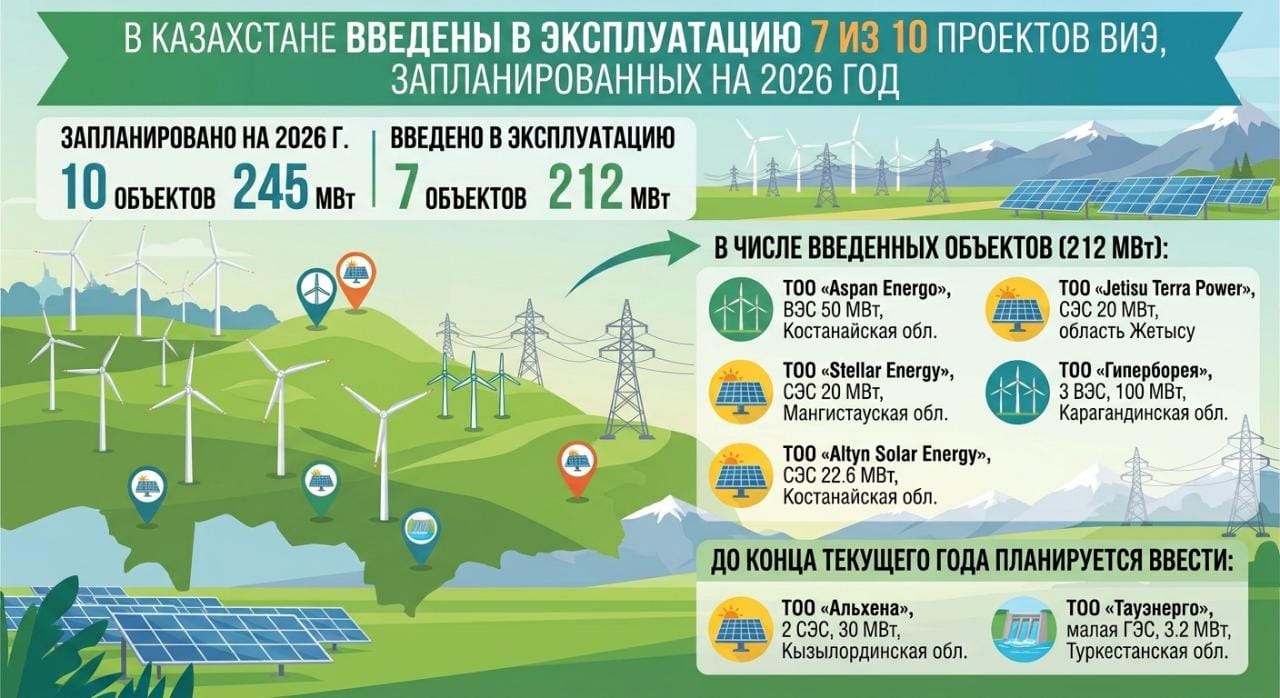
- Of the 10 renewable energy facilities planned for 2026, 7 have already been commissioned, providing the country's power system with 212 MW of additional capacity out of the planned 245 MW.
- Wind generation leads in contribution — four already operational wind projects, including three stations of Giperboreya LLP and the wind farm of Aspan Energo LLP, together provide 150 MW.
- The new facilities are distributed across six regions of the country: Kostanay, Mangystau, Karaganda, Zhetysu, Kyzylorda and Turkistan regions.
- Two more facilities are planned to be commissioned by the end of the year — a 30 MW solar power plant in the Kyzylorda region and a small hydropower plant of 3.2 MW in the Turkistan region, which will bring the total number of new renewable energy facilities in 2026 to nine.
Where exactly they are building
The Kostanay region has this year become the site of two renewable generation directions at once — a wind power plant of Aspan Energo LLP with a capacity of 50 MW and a solar plant of Altyn Solar Energy LLP with a capacity of 22.6 MW have started operating there. In the Mangystau region, a solar power plant of Stellar Energy LLP with a capacity of 20 MW was commissioned, and in the Zhetysu region — a plant of Jetisu Terra Power LLP of the same capacity.
The Ministry of Energy noted: "In total, the commissioning of 10 renewable energy facilities with a total installed capacity of 245 MW was planned for 2026. To date, seven of them have already been put into operation, providing the country's power system with an additional 212 MW of capacity."
Wind leads
The bulk of the already commissioned capacity was provided by three wind power plants of Giperboreya LLP in the Karaganda region with a combined capacity of 100 MW.
The ministry emphasized the importance of this direction: "It is wind generation that currently occupies a prominent place among the facilities commissioned in 2026: just four already operational wind projects, including three stations of Giperboreya LLP and the wind farm of Aspan Energo LLP, together provide 150 MW of installed capacity."
This is more than two-thirds of all renewable energy capacity already commissioned this year — solar and small hydropower generation are still noticeably lagging in contribution.
Part of a broader picture
The commissioning of new renewable energy facilities is not an isolated achievement but part of a broader program. We have already written that the country is simultaneously implementing 24 investment agreements on the modernization of energy facilities with a total capacity of 3.8 GW, and by 2035 Kazakhstan plans to commission more than 8 GW of additional renewable energy capacity. Against this backdrop, the current 212 MW is only a small part of the stated goal, but it is a concrete, already realized confirmation of it: not an abstract promise, but operating stations that are already feeding energy into the grid.
Large-scale generation exists, household generation does not yet
All seven commissioned facilities are industrial generation built by companies to sell electricity to the grid. Meanwhile, neighboring Uzbekistan is gaining momentum with a fundamentally different model — the "Solar House" program has paid residents subsidies for electricity from home solar panels, with payments growing 9-fold in a year, already covering 68.6 thousand households. Kazakhstan is so far relying exclusively on large projects like those being commissioned in 2026 — a mechanism for purchasing surplus energy from private households formally exists in the country but remains extremely limited in coverage. Given the high level of insolation in the southern regions of the country — the same Kyzylorda and Turkistan regions where large projects are already being implemented — distributed generation could become a logical complement to the pace already achieved.
Author's conclusion
The difference between "planned" and "already commissioned" does not always favor the plans, but in the case of the 2026 renewable energy program, Kazakhstan is demonstrating an unusually high execution rate: seven of the ten facilities are already operational, and the commissioning of the remaining ones is announced by the end of the year. For a power system that is simultaneously expanding coal, nuclear and hydro generation, every new megawatt of renewable capacity is also a gradual diversification of energy sources, reducing the risks typical of any system dependent on one or two types of generation.

Comments ()