Kazakhstan increased its reserves of gold, copper, and rare earth metals.
Kazakhstan's subsoil expanded across multiple fronts—from precious metals to rare-earth materials critical for modern high-tech industry.
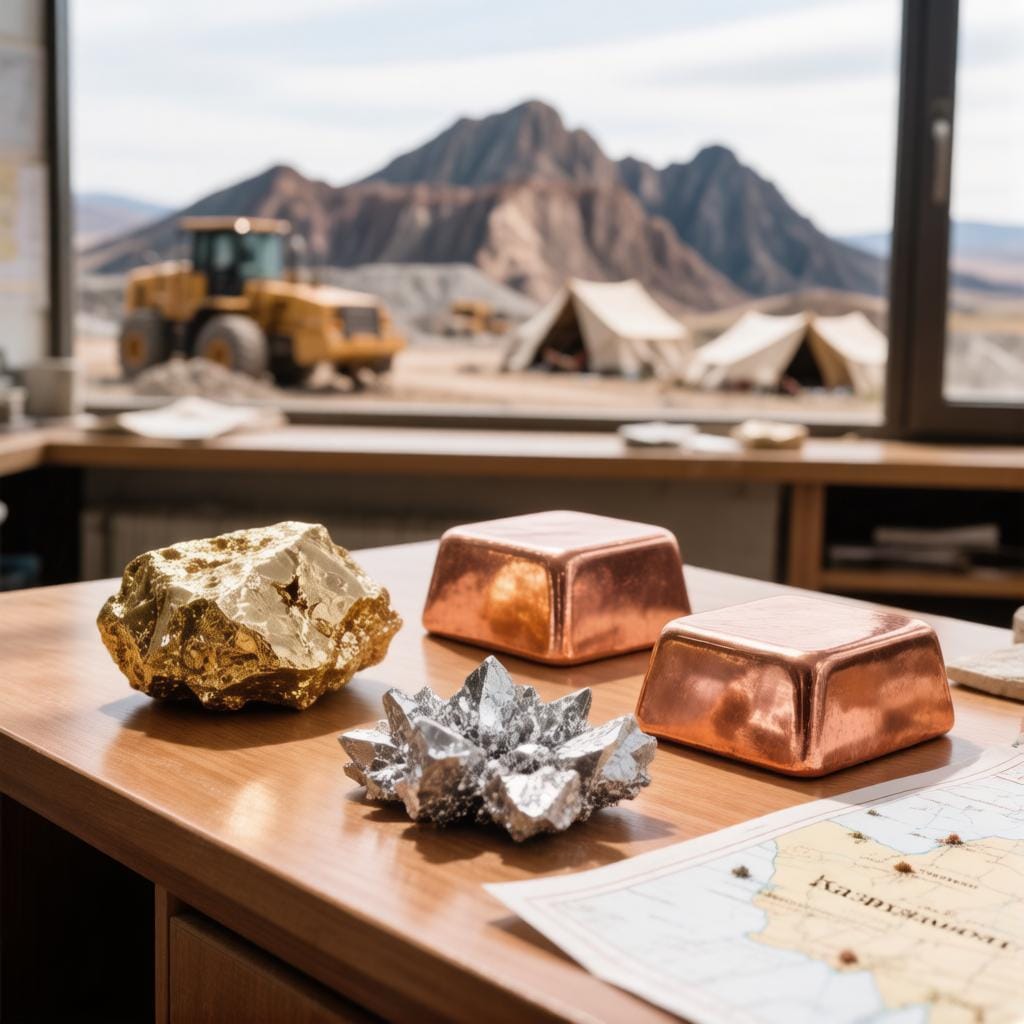
The government has reported on the results of geological exploration over the past two years, and the picture is impressive: dozens of new deposits and a notable increase in reserves across key categories, lsm.kz reports.
The gist
- In 2024–2025, 54 new deposits were placed on the state register — 40 of solid minerals, 7 of hydrocarbon raw materials, and 7 of underground water; in total, the country has about 10,000 deposits of various mineral types on record.
- The most significant growth was seen in reserves of gold (+157,210.6 kg), silver (+9,432 tonnes), copper (+122.7 thousand tonnes), and iron ore (+262.2 million tonnes), as well as oil (+199 million tonnes) and gas (+22 billion cubic meters).
- A separate category is rare and rare-earth metals: 935.4 thousand tonnes of estimated resources were identified at promising sites, of which Kuirektykol in the Karaganda region is considered the most promising.
- The geography of new discoveries covers virtually the entire range of critical minerals — from lithium (Karagailyaktas, Akhmetkino, Akhmirovskoye) and tungsten (Karaobinskoye) to molybdenum (Koktenkol, Verkhne-Kairaktinskoye, Aidarly).
What lies behind the reserve growth figures
It is important to understand the methodological feature of such reporting: placing a deposit "on the state register" does not always mean the literal discovery of a new subsoil area from scratch — more often it is the result of geological exploration work that has confirmed and refined the reserves of already known or presumed deposits to a level sufficient for official inclusion on the balance sheet. This is precisely why, over two years, reserves have been increased across such a wide range of minerals — from precious and base metals to hydrocarbons and underground water: the country is systematically investing in geological exploration across all areas simultaneously, rather than focusing pointwise on one specific type of raw material.
Rare-earth metals — the most promising category
Among all exploration areas, rare and rare-earth metals stand out in particular — not by absolute weight in tonnes, but by their strategic significance for the global high-tech industry, where these elements are used in the production of magnets, batteries, electronics, and defense equipment. Work on 11 promising sites has already been completed, and Kuirektykol in the Karaganda region is considered the leader in terms of potential. Separately, for the Irgiz area, C2 category reserves have been calculated at 795.8 thousand tonnes — a relatively high degree of geological knowledge that brings the site closer to possible industrial development. The potential for rare and rare-earth metals has also been confirmed at the Kenkuduk, Rzhavaya Sopka, Mirolyubovsky, Bokai, and Kuneoy sites — meaning this is not about a single isolated discovery, but an entire belt of potential deposits.
Lithium, tungsten, and molybdenum — minerals for the new economy
The list of specific metals mentioned in the report reads like a catalog of raw materials for future technologies. Lithium — a key component of batteries for electric vehicles and energy storage — is concentrated at the Karagailyaktas, Akhmetkino, and Akhmirovskoye deposits. The Karaobinskoye deposit is rich in tungsten, used in the production of hard alloys and high-temperature materials. Molybdenum, used in steel alloying and catalyst production, has been found at several major sites — Koktenkol, Verkhne-Kairaktinskoye, and Severny Katpar in the Karaganda region, as well as Aidarly in the Abai region. Kazakhstan, already a global leader in uranium production — a significance the country has also cemented at the international level, being the first in Central Asia to join the global technology alliance Pax Silica, which unites countries around issues of AI, critical minerals, semiconductors, and data centers.
Author's conclusion
The report on reserve growth is a good starting point for a new topic that we will track on a regular basis: geological exploration, deposits, and critical minerals form the foundation on which a significant part of Kazakhstan's economy is built, from the uranium industry to future projects in electric transport and high technology. The gap between "placed on the register" and "brought into industrial production" can be years, sometimes decades, so the current figures should be seen as a declaration of intent for the future rather than an already realized economic effect — and it is precisely this gap that makes sense to follow in subsequent articles.
Comments ()