Kazakhstan ranks fourth in the world in horse population.
Kazakhstan firmly holds its status as one of the world's top horse-breeding powers—and the gap with Central Asian neighbors is not just wide, but multiples wider.
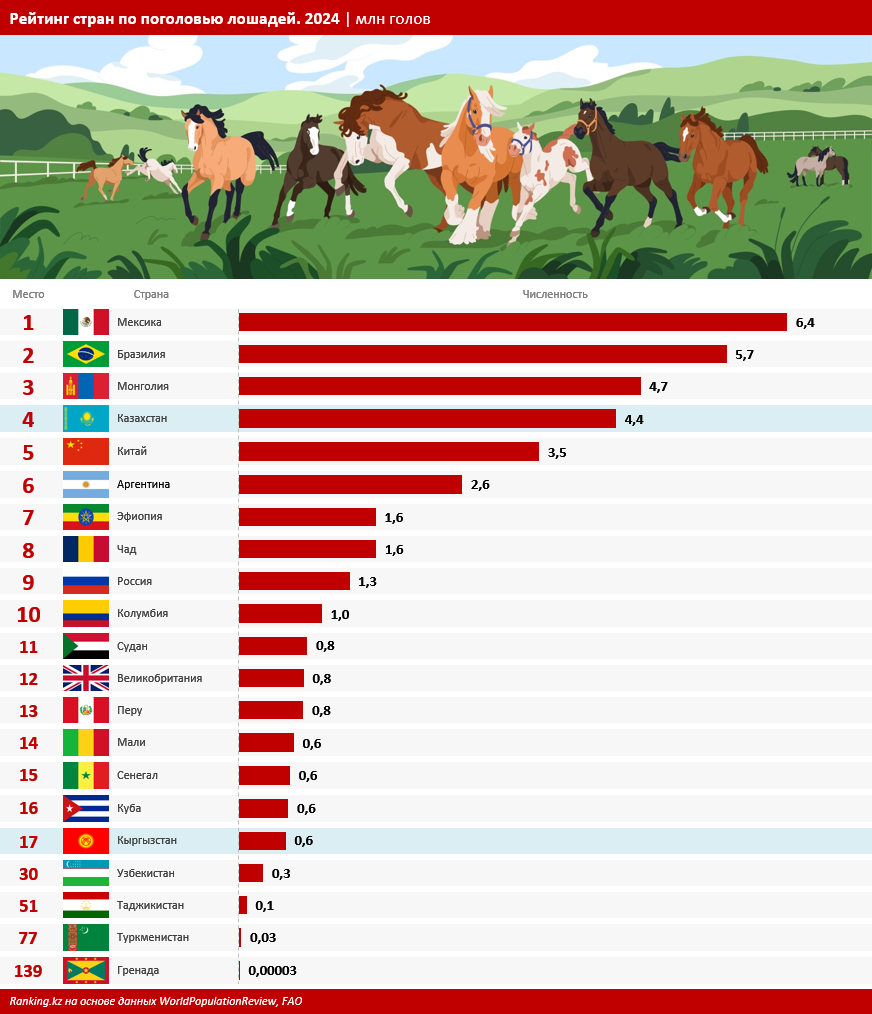
According to FAO data, the country ranks fourth in the world in horse population, writes Ranking.kz.
The gist in brief
- According to the Food and Agriculture Organization of the United Nations (FAO), as of the end of 2024, Kazakhstan ranks fourth in the world in horse population — 4.4 million head, trailing only Mexico (6.4 million), Brazil (5.7 million), and Mongolia (4.7 million), while ahead of China (3.5 million).
- Kazakhstan is the undisputed leader in horse population in Central Asia: Kyrgyzstan ranks only 17th in the world (553.5 thousand head), Uzbekistan — 30th (283 thousand), Tajikistan — 51st (92 thousand), and Turkmenistan closes the list among the region's countries (27.6 thousand).
- Over 2020–2025, the horse population in Kazakhstan grew from 3.1 to 4.6 million head — by nearly 48%, while in Kyrgyzstan over the same period the growth was only 4.9%.
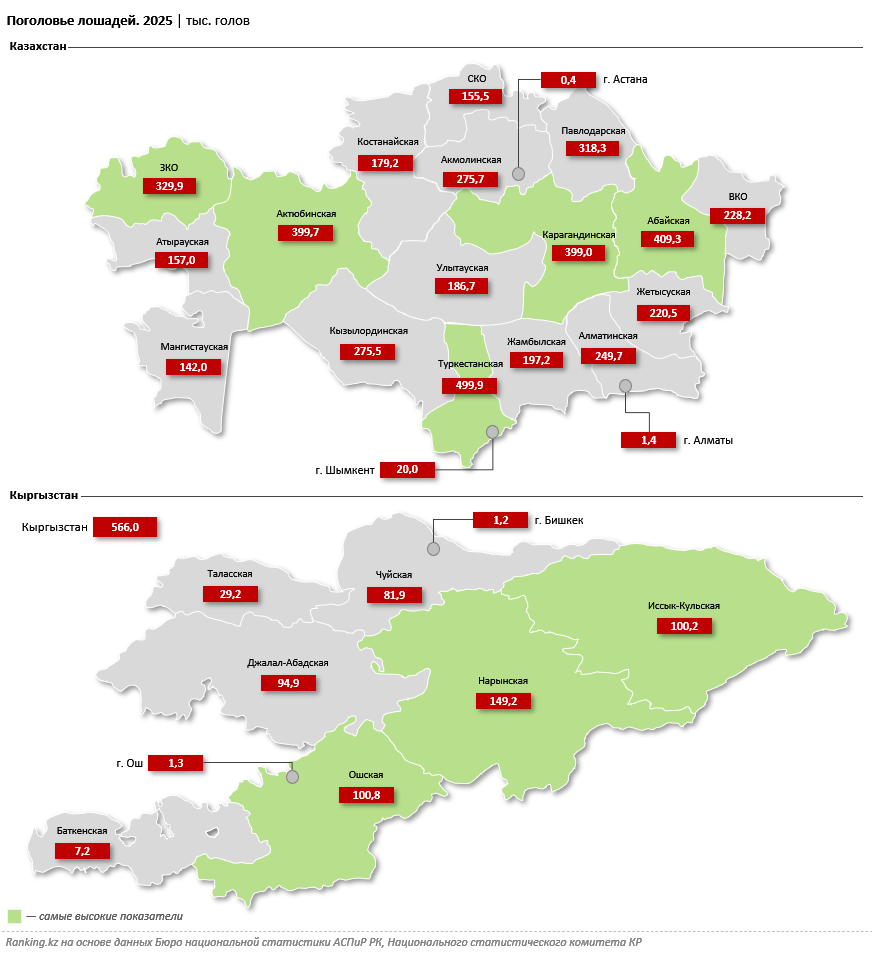
- The leaders in population among Kazakhstan's regions were Turkistan (499.9 thousand), Abai (409.3 thousand), Aktobe (399.7 thousand), and Karaganda (399 thousand) regions.
The gap with regional neighbors
Since 2020, the horse population in Kazakhstan has been 5–8 times larger than in Kyrgyzstan, and this gap has only widened over the years: the annual growth in Kazakhstan reached 11%, while in Kyrgyzstan it was no more than 2%. One of the obvious reasons is territorial: Kazakhstan's area exceeds 2.7 million sq. km versus approximately 200 thousand sq. km in Kyrgyzstan. But territory alone does not fully explain the difference — the structure of population distribution within the countries themselves also matters.
Why territory is not the only factor
In Kyrgyzstan, the largest number of horses is concentrated in the regions with the biggest area — Naryn, Osh, and Issyk-Kul. In Kazakhstan, however, the picture is fundamentally different: herds numbering in the thousands are found in virtually all regions of the country, including major industrial regions where peasant farms continue to actively engage in horse breeding. The only exceptions are the megacities, where the economic structure does not allow for large areas of pasture. Such an even distribution of the industry across the entire country is in itself an indicator of how deeply horse breeding is rooted in Kazakhstan's agriculture, rather than being concentrated in a few traditional hubs.
Investment as a growth driver
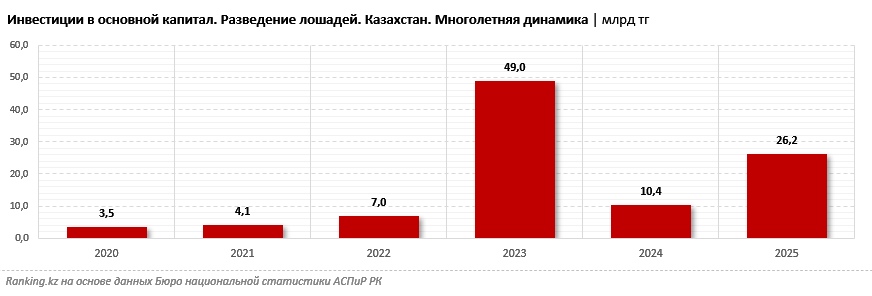
The population growth is also backed by concrete capital investments in the industry — in the construction, reconstruction, and modernization of facilities, and the purchase of machinery and equipment. The dynamics of investment are extremely uneven due to the very nature of capital expenditures: farms make large one-time injections when building or purchasing batches of animals. In 2020, fixed capital investment in horse breeding amounted to 3.5 billion tenge, and by 2023 it had grown to a peak value of 49 billion. After a sharp decline in 2024 — to 10.4 billion — investment activity picked up again in 2025, reaching 26.2 billion tenge.
The link with the export trend
The steady growth in population logically fuels foreign trade as well: we have already written that Kazakhstan has significantly increased exports of live cattle, including horses, to China and Afghanistan. The growing population within the country and growing demand beyond its borders are two sides of the same process: without a sustainable base for reproduction, scaling up exports would simply have been impossible.
Author's conclusion
FAO statistics confirm what has long been part of Kazakhstan's national identity — horse breeding here is not a local tradition of individual regions, but an industry evenly developed across the entire country and backed by real growth rates that far outpace those of its closest regional neighbors. Moreover, this is not a static legacy of the past: a population increase of nearly half over five years and volatile yet substantial capital investments show that the industry continues to actively develop rather than merely maintain an already achieved level.
Comments ()