Kazakhstan signed a contract for the construction of its first nuclear power plant.
The project, discussed and prepared for years, has moved into its practical phase.
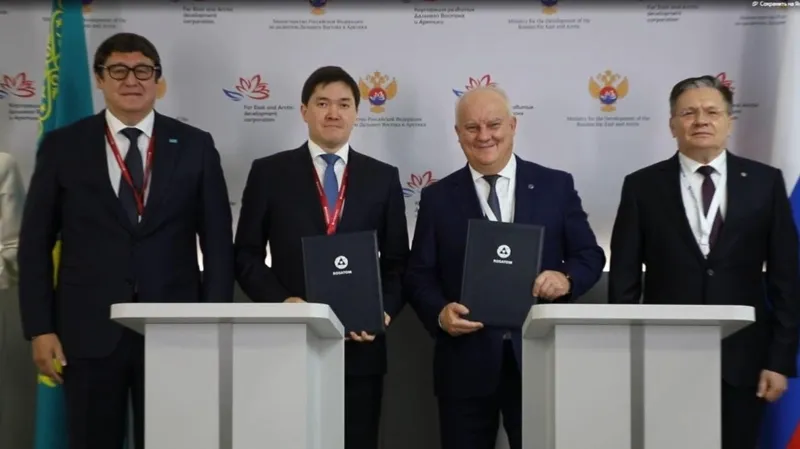
A contract for the design, supply, and construction of Kazakhstan's first nuclear power plant was signed on the sidelines of the Eastern Economic Forum in Vladivostok — a document that definitively cements the project's status as a real construction endeavor, rather than mere intergovernmental agreements, Inform.kz reports.
The gist in brief
- Within the framework of the XI Eastern Economic Forum in Vladivostok, a contract for the design, supply, and construction of Kazakhstan's first NPP was signed — between Kazakhstan Nuclear Power Plants LLP and Atomstroyexport JSC (a subsidiary of Rosatom).
- The signing took place in the presence of the Chairman of the RK Agency for Atomic Energy Almasadam Satkaliyev and the Director General of Rosatom Alexey Likhachev; the document moves the project to a "new, practical stage."
- In accordance with the intergovernmental agreement of May 28, 2026, the parties will continue the stipulated procedures, including the necessary coordination with the Government of the Republic of Kazakhstan.
- Special attention during project implementation will be paid to localization — the maximum involvement of Kazakhstani enterprises, specialists, goods, works, and services.
From negotiations to contract
The signing in Vladivostok is a logical continuation of the process we have been following all year. Back in the summer, Tokayev confirmed that field work at the site near Balkhash was being completed, and that Russia would build the plant — at that time, the talk was of intergovernmental agreements and site preparation. Now the parties have moved to the next, far more concrete stage — the actual contract for design and construction, which the ministry describes as a transition to a "new, practical stage" of the project. Formally, the parties still must undergo the necessary coordination with the Government of the Republic of Kazakhstan under the intergovernmental agreement of May 28, 2026, but the very fact of signing the EPC contract is a milestone after which the project is harder to reverse than at the stage of negotiations alone.
Why Kazakhstan needs nuclear power right now
The Agency for Atomic Energy links the project's strategic significance to the economy's growing need for reliable generation — amid industrial growth, infrastructure development, digitalization, and the advancement of artificial intelligence. This wording echoes a theme we have already examined in another context: Kazakhstani projects like the "Data Center Valley" in Ekibastuz are already facing energy shortages today, meeting the growing demand of computing infrastructure with coal simply because there are not yet enough alternative stable sources of baseload generation. Nuclear power is positioned precisely as the solution to this problem — stable baseload generation for decades to come, independent of weather conditions, unlike solar and wind generation.
Focus on localization
Special emphasis in the agency's statement is placed on localization — the maximum involvement of Kazakhstani enterprises, specialists, and services in project implementation. This is not merely a formal caveat: the construction of an NPP of this scale spans years and creates demand for a wide range of goods and services — from building materials and equipment to workforce training, part of which could theoretically be supplied by domestic industry with proper coordination. The agency directly calls the plant's construction a stimulus for developing new industries and technologies and building national competencies for the further development of the nuclear sector — that is, the project is viewed not only as a source of electricity but also as an instrument of industrial policy. This logically complements the country's already established status in the global nuclear infrastructure: the international IAEA Low-Enriched Uranium Bank is already located in Ust-Kamenogorsk — a trusted reserve of fuel material for all member states of the agency in case of disruptions to regular supply chains.
Kazakhstan in the regional context
The contract signing takes place against the backdrop of an active nuclear agenda across the entire region. Armenia continues negotiations with five countries at once on building a new plant and, in parallel, is considering extending the operating life of its existing NPP until 2046, while Uzbekistan has already announced preparations for a second nuclear plant without having completed construction of the first. Against this backdrop, Kazakhstan has chosen a different model — not multi-vector negotiations with several potential partners, but consistent progress with a single technology supplier from an intergovernmental agreement to a concrete EPC contract. Different countries in the region are testing different strategies almost simultaneously, and the results of this natural experiment will become visible within the next decade.
Author's conclusion
The contract signed in Vladivostok is the most concrete step in Kazakhstan's nuclear program since its discussion began: from referendum to intergovernmental agreement, from agreement to a confirmed partner choice, and now to a contract for design and construction. Each of these stages has narrowed the room for reversing the project, and now Kazakhstan has far less room for maneuver than it did a year ago. How successful this choice will prove — in terms of timeline, cost, and the real level of localization — will only become clear over the years, but the point of no return on this long path, by all appearances, has already been passed.
Comments ()