Kazakhstan's nuclear power can go far beyond electricity alone
Lead energy engineer at KAES LLP Madi Azbergenov spoke about the wide range of applications of nuclear reactors.
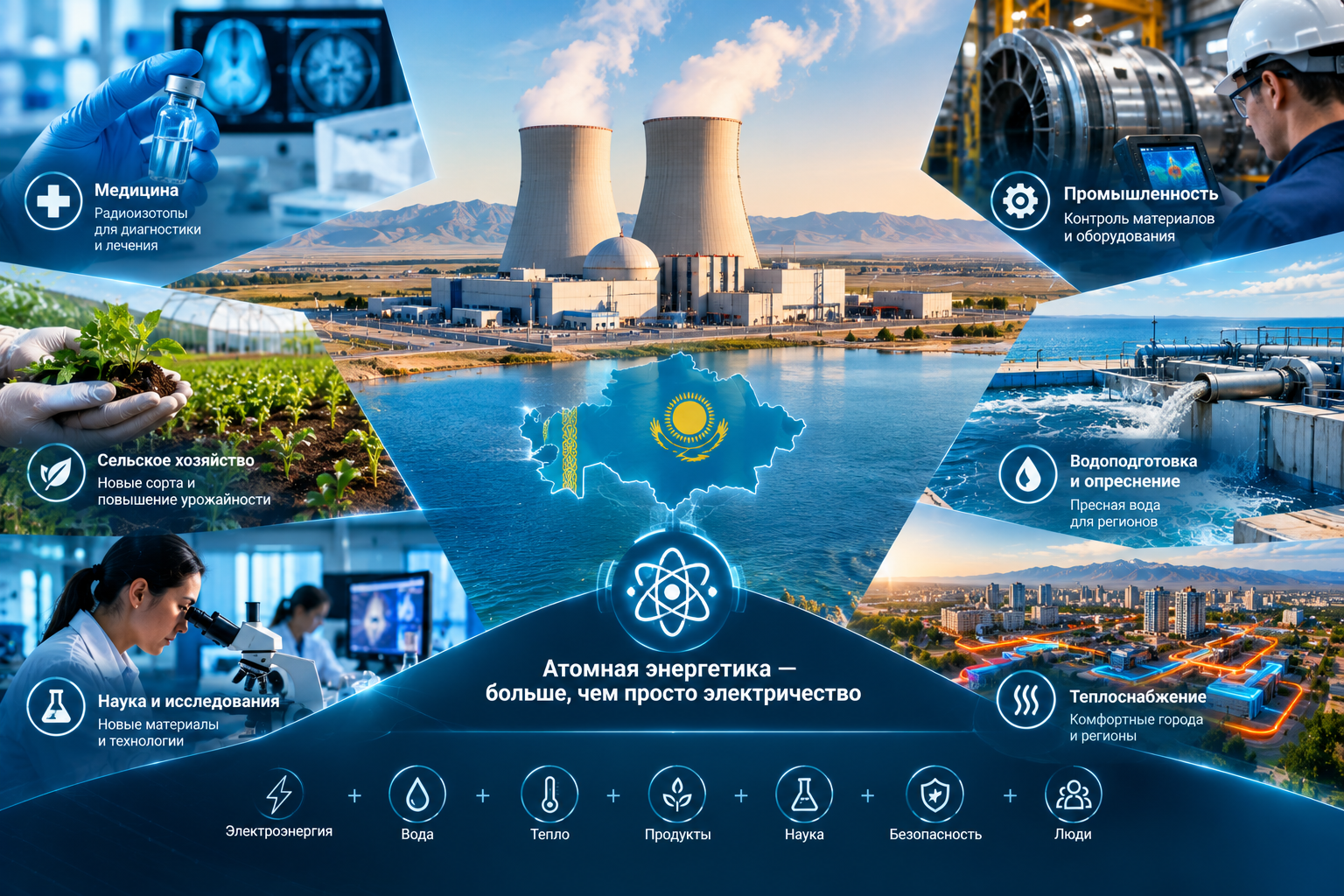
While the country is preparing for the construction of its first station at Balkhash, the conversation is mostly about megawatts and kilowatt-hours. But, according to a specialist from the company building this station, the future of Kazakhstan's nuclear industry may turn out to be considerably broader than just electricity generation.
The essence in brief
- Lead engineer of the energy group at KAES LLP Madi Azbergenov, in an authored piece for Kazinform, argues that the potential of a nuclear reactor is not exhausted by stable electricity generation — neutron fluxes and the materials obtained with their help are applicable in medicine, industry, agriculture, science, heat supply and water treatment.
- According to IAEA data, the heat of a nuclear reactor can be used for district heating, water desalination, hydrogen production and providing industrial processes with process steam — the combined production of electrical and thermal energy allows for a fuller use of the station's energy potential.
- For Kazakhstan, the expert names practical interest in water treatment and desalination, heating of settlements and providing industrial enterprises with process steam — but emphasizes that the feasibility of each solution is individual and depends on the location of consumers, infrastructure, regulation, economics and safety requirements.
- Separate potential is seen in research reactors: they create neutron fluxes for studying the properties of materials, testing the resilience of equipment, producing radioisotopes for medical diagnostics and treatment, as well as for industrial monitoring of technological processes without destroying samples.
Not just theory — already existing Kazakhstani practice
Azbergenov summarizes his position as follows: for Kazakhstan, the development of such areas could mean the formation of an entire technological ecosystem around the nuclear industry — from training engineering and scientific personnel to medical technologies, industrial diagnostics, materials production and solutions for water and heat supply. It is telling that this is not only about a hypothetical future: part of this ecosystem is already operating in practice in Kazakhstan. The Institute of Nuclear Physics near Almaty, using its own VVR-K reactor, already produces radiopharmaceuticals covering 85–90% of the domestic market, exports high-purity cobalt-57 to European and Russian buyers, and uses industrial radioisotopes for inspecting welded joints — that is, precisely those areas that Azbergenov describes as promising are, in some form, already bringing the institute growing commercial revenue.
Desalination — not a new idea for Kazakhstan
The mention of water desalination using nuclear energy deserves special attention: for Kazakhstan, this is not an abstract concept but part of its own historical practice. Back in 1973, the BN-350 reactor was commissioned in Aktau — one of the world's first examples of industrial seawater desalination using nuclear energy, which operated for several decades and provided the city with fresh water. The fact that such a technology is now being discussed again in relation to the country's future nuclear program shows that some of the "new high-tech industries" that Azbergenov speaks of are, for Kazakhstan, more accurately called a revival of something already tried and tested rather than an invention from scratch.
Personnel infrastructure for the future ecosystem
Realizing such ambitions requires not only reactors but also specialists capable of working with them. Kurchatov, where the National Nuclear Center and the KTM experimental thermonuclear tokamak are located, is already getting its own power plant to supply the growing scientific infrastructure — a city whose economy is built around precisely the kind of technological ecosystem that Azbergenov writes about. In parallel, the same Institute of Nuclear Physics is training specialists in non-destructive testing — a field whose importance will only grow as the construction of power units at Balkhash approaches, where the quality of welded joints and equipment will become a direct safety issue.
But here the expert's optimistic vision encounters a far less certain reality. We have already written that in response to an official request about the personnel program for the station at Balkhash itself, the Atomic Energy Agency gave an evasive answer: over 25 years, Kazakhstani universities have trained about 4,500 nuclear specialists, but where exactly they currently work is not specified in the agency's response, and a comprehensive personnel training plan for 2027–2031 is still only being developed. Funding for practical training of personnel is included in the EPC contract — that is, it is borne by the station's general contractor itself, and a separate state budget for this program has not been disclosed. For comparison, the national operator of the Barakah station in the UAE, long before the launch of the first power unit, publicly disclosed detailed, year-by-year plans for hiring and training personnel. The contrast within Kazakhstan itself is also telling: the Ministry of Water Resources and Irrigation, by contrast, publishes detailed and transparent statistics on its own personnel program — nearly 500 specialists who have completed foreign internships over three years, broken down by country, year and specific partner programs. The broad technological ecosystem that Azbergenov speaks of is possible only with a sufficient number of trained specialists — and the transparency of precisely this element at the nuclear agency still lags noticeably behind the standard already set by another Kazakhstani industry.
Author's conclusion
Azbergenov's argument is important not so much as a revelation — industry specialists have long known about the non-medical and non-energy applications of nuclear technologies — but as a signal that the company directly building Kazakhstan's nuclear power plant is publicly formulating a broader vision of the project than simply another source of electricity in the country's power system. The already operating practice of the Institute of Nuclear Physics and the historical experience of desalination in Aktau show that the ground for such a technological ecosystem in Kazakhstan is not being laid from scratch. But this ecosystem itself can only grow around a sufficient number of trained specialists — and it is precisely the personnel planning for the station at Balkhash that, judging by the official responses of the relevant agency, remains the least specific and least transparent part of the entire project. Until this gap is closed, the conversation about new high-tech industries around nuclear energy remains a prospect rather than a guaranteed outcome.

Comments ()