Korean scientists created a ruthenium-based catalyst instead of platinum for hydrogen production
Scientists at KAIST have created a ruthenium-based catalyst for producing hydrogen from water.
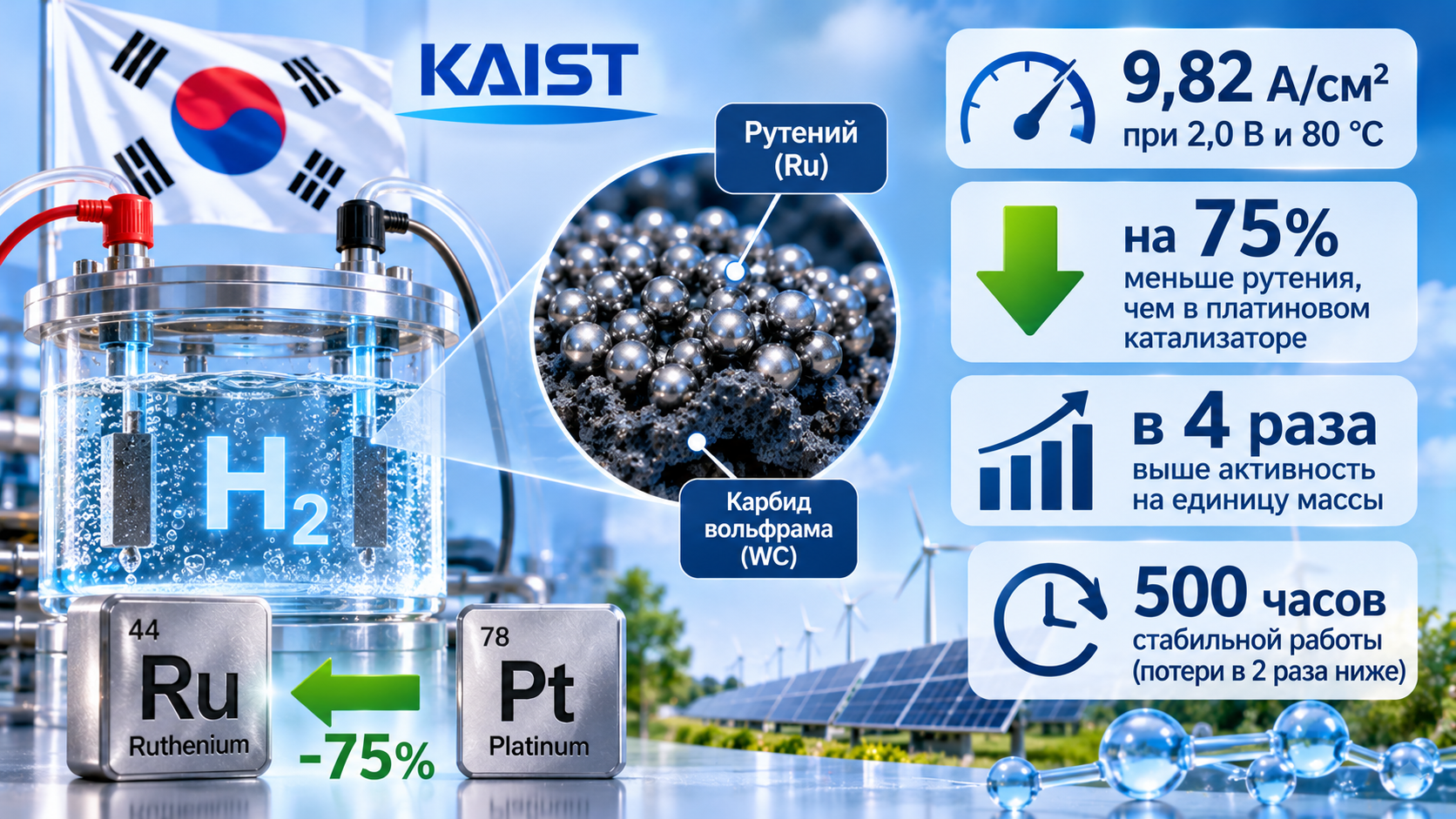
In a laboratory electrolyzer, it delivered performance on par with a commercial platinum catalyst, but used 75% less of the precious metal. The study was published in the journal Nature Communications.
The gist in brief
- The catalyst consists of clusters of three to four ruthenium atoms on a tungsten carbide support.
- In a laboratory cell, it achieved a current density of 9.82 A/cm² at a voltage of 2.0 V and a temperature of 80 °C.
- It requires 75% less precious metal than a commercial platinum catalyst, while activity per unit mass is roughly four times higher.
- Over 500 hours of continuous operation, performance losses were about half those of the platinum sample.
- The result was obtained only in the laboratory; the catalyst still needs to be tested at larger scale and over longer periods.
How the catalyst is structured
The catalyst accelerates the reaction in which water electrolysis produces hydrogen. Commercial catalysts use platinum for this, while the new development is based on ruthenium. Here, the ruthenium is assembled neither into large particles nor into individual atoms: it lies on the support as a one-atom-thick layer, in clusters of three to four atoms. The authors call this structure "atomic-layer neighbors."
The support is tungsten carbide. Hydroxyl groups on its surface help water molecules arrange into a hydrogen-bond network, and this accelerates proton transfer. To find the best structure, the researchers varied the number of atoms in each cluster.
What the tests showed
The catalyst was tested in a laboratory water electrolysis cell with an anion exchange membrane. According to KAIST, at the same performance it requires only a quarter of the precious metal by mass compared with a platinum catalyst. The work was led by Professor Jinwoo Lee and supported by the National Research Foundation of Korea.
One of the lead authors, research professor Sonbin Kim, noted that the team assembled small clusters of precious metal atoms and selected a suitable environment for them, and this enables efficient hydrogen production with low metal consumption. According to him, the authors hope the results will help reduce the consumption of precious metals in hydrogen production equipment.
What has not yet been proven
The test lasted 500 hours, which is not enough to judge long-term operation. The results were obtained in a laboratory cell; there is no data on industrial scale. Ruthenium is also a precious metal, so the technology only reduces consumption rather than eliminating the need for expensive raw materials. The exact platinum content in the reference sample and all test conditions are not provided in the release.
What is happening with hydrogen worldwide
Hydrogen still costs noticeably more than fossil alternatives, and authorities are trying to narrow this gap. Germany is preparing support for the hydrogen market: at least €1.5 billion for industrial transitions to low-carbon technologies and a separate quota for hydrogen projects in the 2027 tender. In Spain, the company Moeve is building the first phase of the "Andalusian Green Hydrogen Valley": electrolyzers with a capacity of 300 MW and more than €1 billion in investment, with electricity accounting for about 70% of the cost of such hydrogen.
In Saudi Arabia, construction of the NEOM complex has been completed with electrolyzers of about 2.2 GW; commercial launch is planned for 2027. And in the Yamalo-Nenets Autonomous Okrug, the Arctic station "Snezhinka" is being built, where surplus solar and wind energy will go to electrolysis, and the hydrogen will then be converted into electricity in fuel cells.
Author's conclusion
The 75% savings in precious metal have so far been measured only in the laboratory, which means it is too early to talk about cheaper hydrogen. If the catalyst withstands testing at larger scale and over longer periods, hydrogen production equipment will need less precious metal. But for now this is only a step toward reducing its consumption, not a ready replacement for platinum.
Comments ()