Nvidia and Germany's PreussenElektra to assess former nuclear plants as sites for AI centers
Nvidia and German utility PreussenElektra will jointly study whether sites of Germany's closed nuclear plants can host AI data centers.
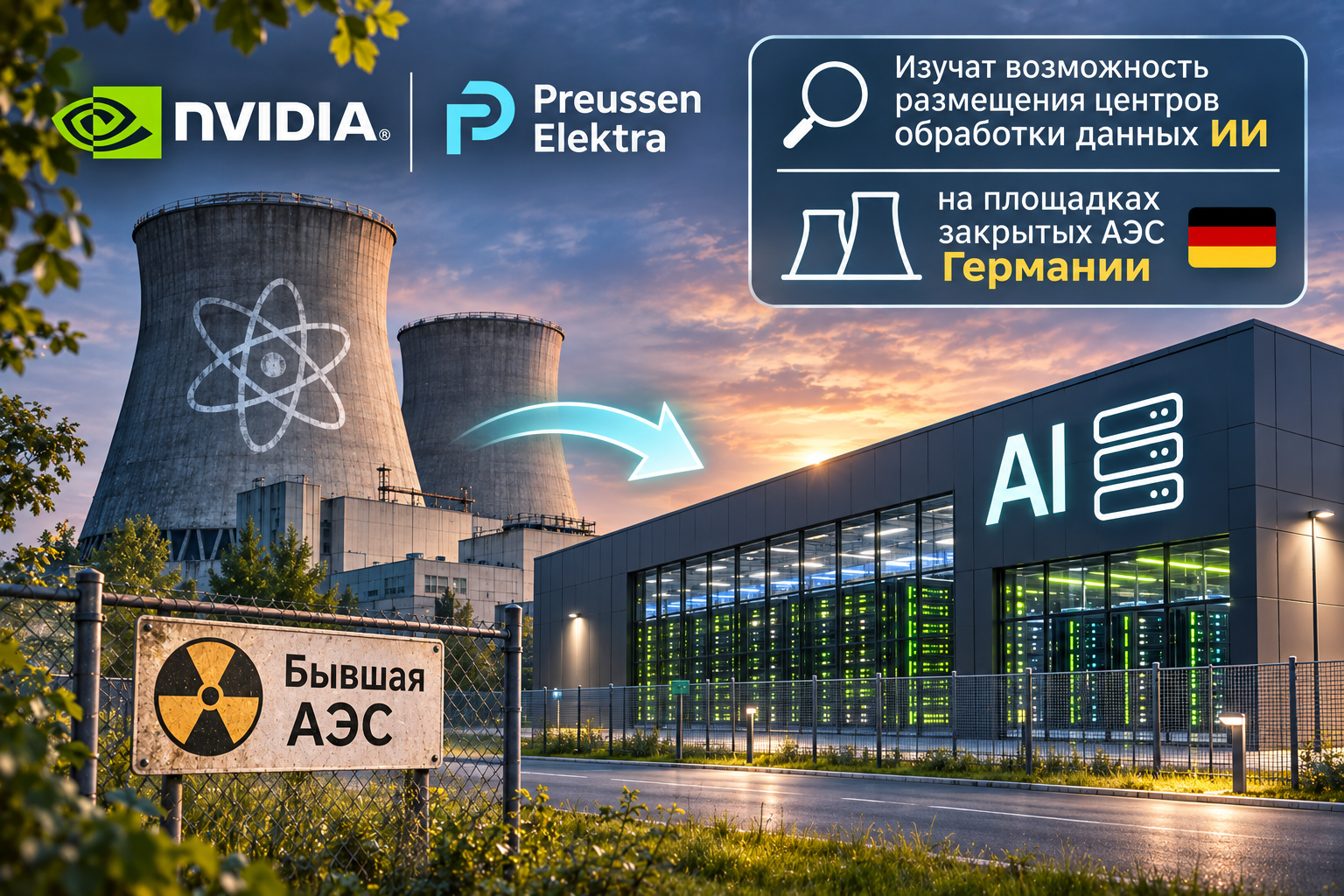
There are no specific decisions on investments or locations yet.
The gist in brief
- The planned cooperation was announced on October 21 by the chairman of the board of PreussenElektra: the companies will assess whether former nuclear power plant sites are suitable for "AI factories."
- PreussenElektra, a subsidiary of E.ON, is decommissioning eight German nuclear power plants, all of which have already been shut down.
- They will assess the energy and site infrastructure, available land, as well as the technical, economic and regulatory conditions.
- The statements do not include the names of the sites, capacities, amounts or timelines.
What they decided to examine
PreussenElektra is responsible for the decommissioning and dismantling of eight nuclear power plants in Germany. According to World Nuclear News, all of them have been shut down and are at various stages of dismantling. The company provides information about the sites and their infrastructure, while Nvidia assesses the requirements for "AI factories," that is, large data processing centers for training and operating neural networks, and possible placement options.
The goal is to bring the existing energy and site infrastructure and available land into line with the requirements of powerful data centers for AI. According to the company, such sites generally have good prerequisites: large industrial zones, powerful grid connections and developed infrastructure. Both parties then want to determine where and under what conditions further development is possible. German outlet PC Games Hardware adds that access to water for cooling is also being taken into account.
What the companies say
PreussenElektra chairman Guido Knott said that together with Nvidia the company wants to thoroughly examine whether and how such conditions can be used for "AI factories." He called the former sites possessors of "valuable industrial infrastructure" and the project a combination of responsible reuse of the sites with a new economic impulse for the regions.
Nvidia senior regional director Markus Hacker noted:
"AI production plants depend on reliable power supply, suitable sites and high-performance infrastructure."
The assessment at PreussenElektra is described as open-ended and a first step: it does not yet presuppose any specific investment decisions or selection of sites.
What is not there yet
Which stations exactly are being considered is not stated. Capacities, amounts and timelines are not named either.
How nuclear power plant dismantling is proceeding in Europe
Dismantling shut-down stations is a long process, and this is evident from the example of Lithuania's Ignalina Nuclear Power Plant. As was noted in September, its dismantling is costing more than planned. Initially the work was to be completed by 2029; in 2016 the deadline was pushed to 2038, and the current long-term contracts run until 2050. The most difficult stage, dismantling the reactor core, is scheduled to begin at the end of 2026.
What is happening with AI centers in Europe
In August the European Union launched a tender for the construction of seven AI "gigafactories." The total budget is estimated at around 30 billion euros, of which about 20 billion are to be invested by private investors. Construction is planned to begin in early 2027, with launch scheduled for mid-2028. But so far only 1 billion euros comes from EU budget guarantees; the rest depends on the future multiannual financial framework, which is still being agreed.
What is happening with data centers and nuclear power plants in Kazakhstan
In Kazakhstan, Kazakhtelecom is seeking capital for the "Data Center Valley" through three channels at once: bonds on the AIFC platform, funds from the Development Bank of Kazakhstan, and negotiations with international financial institutions. The project is being built in Ekibastuz. Its cost is estimated at $10 billion, capacity at no less than 300 MW with possible growth to 1 GW, and Nvidia is named among the participants. The first facilities are planned to be launched in early 2027. The stated amount so far remains a target rather than funds raised.
As for nuclear power, in October in Astana IAEA experts reviewed the country's report on readiness for its first nuclear power plant. The main mission is to assess 19 areas of nuclear infrastructure, and the date for its conduct has not yet been announced. The contract for two VVER-1200 units with a total capacity of about 2.4 GW was signed on September 3.
Author's conclusion
This news is not about nuclear power, but about how difficult it is to find a place for AI data centers with a ready-made powerful grid connection. Shut-down nuclear power plants have one: the stations were built to feed large capacity into the grid, and that infrastructure has not disappeared. It is for its sake that Nvidia is looking at the sites. But for now the companies themselves speak only of an assessment, and it remains unclear whether retrofitting sites where dismantling is underway will prove expensive and slow, and whether regulators will approve it.



Comments ()