Kazakhtelecom seeks capital for Data Center Valley through three channels at once
Kazakhtelecom's sale of half its stake in Central Asia's largest AI hub operator was not its only move to raise funds for the project.
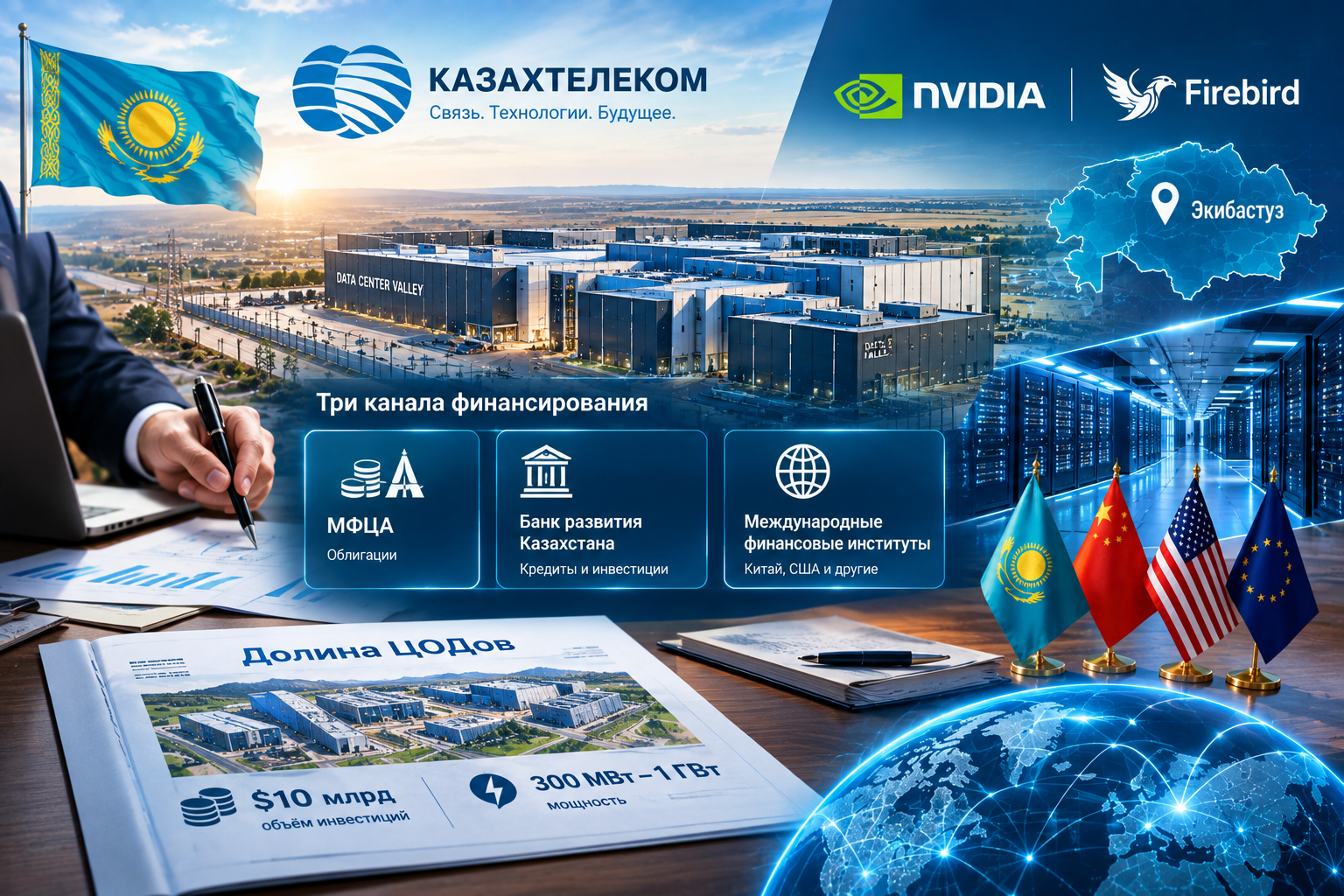
Now the company openly speaks about seeking financing through several channels simultaneously — and for a significantly larger sum than one might have assumed, reports Kursiv.media.
The essence in brief
- Chairman of the Management Board of Kazakhtelecom Bagdat Mussin told Reuters that the company is seeking financing for the Data Center Valley project in Ekibastuz — the sum in question is measured in more than one billion dollars.
- The funds are planned to be raised through several channels at once: bonds on the AIFC platform, funds from the Development Bank of Kazakhstan, as well as financing from international institutions — negotiations are underway with both Chinese and American organizations.
- The exact volumes of the funds being raised and the timelines for receiving them have not yet been determined.
- The total investment in the Future Data Center Valley project with the participation of NVIDIA and Firebird Inc. is estimated at $10 billion, and the facility's capacity should be at least 300 MW with the possibility of growth to 1 GW.
A continuation of an already familiar story
The search for financing logically ties in with what we recently wrote about: Kazakhtelecom sold a 50% stake in the operator of the KT-Telecom project to the structure Samruk-Kazyna Invest, giving up sole control. At the time, this looked like a redistribution of ownership within a single state holding; now the financial logic of this step is becoming clearer as well — the company openly acknowledges that a project of such scale requires attracting external resources, and, judging by everything, the ownership restructuring was merely one element of a broader financing strategy.
Diversification of sources — from several sides at once
It is telling that Mussin did not name a single source of financing, but listed three parallel channels at once: bonds placed on the platform of the Astana International Financial Centre, funds from the Development Bank of Kazakhstan, and negotiations with international financial institutions. The geography of these negotiations deserves special attention — simultaneously with Chinese and American organizations, meaning the company is not betting on one large foreign partner, but is trying to diversify its sources of capital between different geopolitical poles. The bond component of this strategy is no longer just plans: KT-Telecom has placed at least three tranches under a total bond program worth $1.207 billion — at 6% per annum for 10 years and later another tranche worth 594.1 million yuan (about $87.8 million) at 4.5% for 5 years. In parallel with the search for money, the company is negotiating with more than 20 technology companies about placing capacity in the Data Center Valley itself, and the first confirmed partner was the Emirati company Aleria — the first facilities are planned to be launched as early as the beginning of 2027.
The scale of the project in figures
The data cited by Mussin give a sense of the real scope of the Data Center Valley: the declared investment volume of $10 billion places the project on par with the largest industrial construction projects in Kazakhstan in recent years, while the planned capacity of 300 MW to 1 GW is comparable to the energy consumption of a small city. It is precisely this scale that explains why implementing the project required not only the participation of the country's largest telecommunications operator, but also the attraction of several financing instruments in parallel — no single source of capital within Kazakhstan is capable of covering such a need on its own.
Author's conclusion
The open acknowledgment by the head of Kazakhtelecom of the need for multibillion-dollar financing is practical confirmation that the Data Center Valley has moved from the stage of declarations about partnership with NVIDIA and Firebird to a stage where the real limiting factor is not technology or land for construction, but the availability of capital. While the company is negotiating in several directions at once without announced timelines or exact sums, it is premature to judge whether it will actually manage to raise the stated billions of dollars and in what volume — but the very fact of publicly acknowledging the scale of the task speaks to the company's readiness to be transparent about the project's financial challenges, rather than hiding them behind general formulations about "active work."


Comments ()