Clean industry worldwide is increasingly being built in China and the countries of the solar belt
In the past 12 months, a record 36 major clean industry projects secured financing worldwide, with 23 of them going to China.
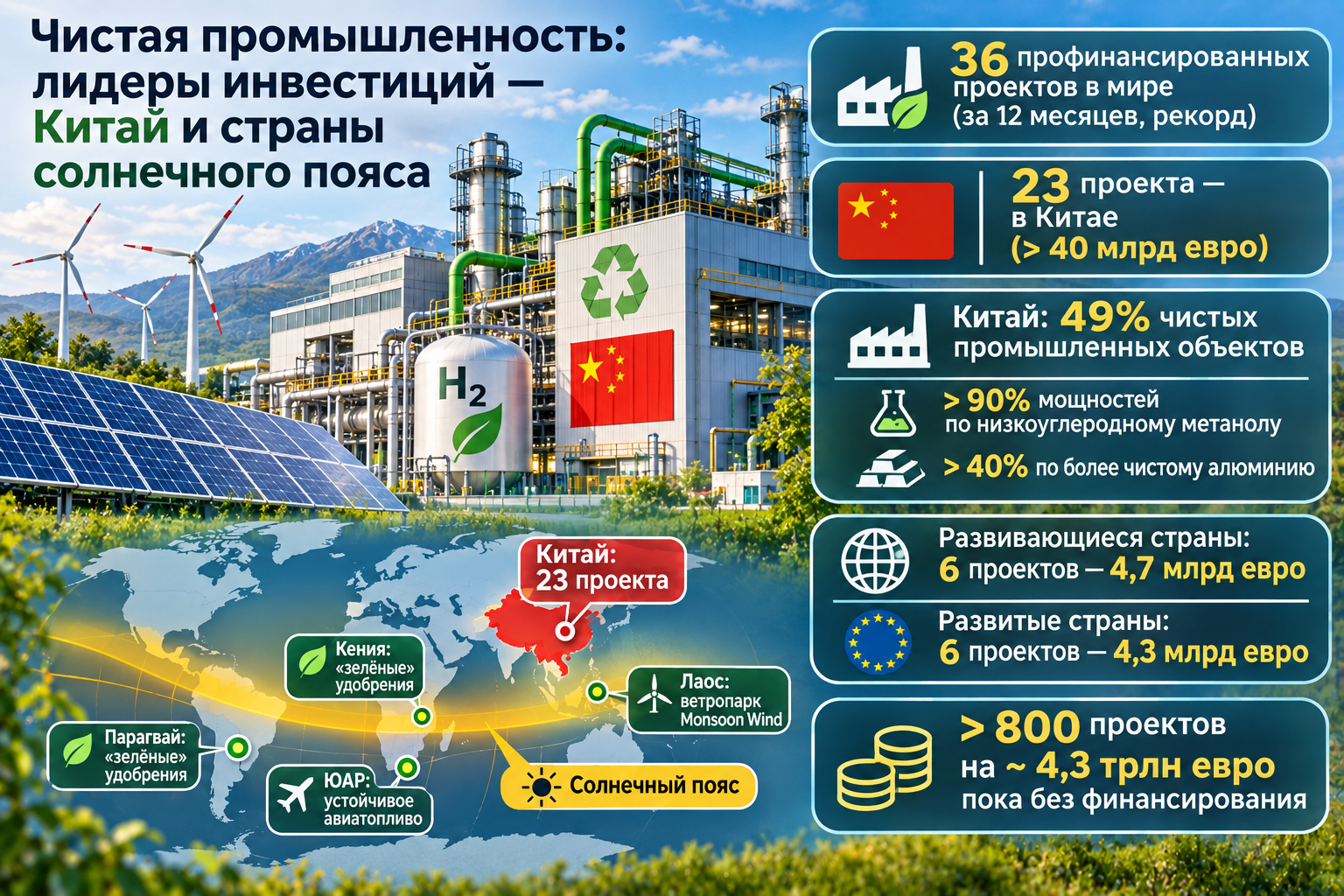
Developing countries with rich renewable resources have attracted more money than developed ones, and Europe is lagging behind in this race. This is stated in data from the international organization Mission Possible Partnership (MPP), as reported by Euronews.
The gist in brief
- Of 36 financed clean industry projects, 23 were in China, with a value exceeding EUR 40 billion.
- China accounts for 49% of the world's operating or under-construction clean industrial facilities, more than 90% of global low-carbon methanol capacity, and more than 40% of cleaner aluminum capacity.
- In developing countries, six projects were financed for EUR 4.7 billion; in developed countries, also six projects, but for EUR 4.3 billion.
- MPP tracks more than 800 proposed projects with potential investments of about EUR 4.3 trillion that remain unfunded.
What the data showed
Mission Possible Partnership tracks clean industry projects, that is, plants that produce low-emission materials, chemicals, and fuels. According to its data, last year 36 large projects received financing, a record. China received 23 of them. In addition, it has nearly half of the world's operating or under-construction clean industrial facilities.
In developing countries, over the same period, six projects were financed for EUR 4.7 billion; in developed states, six projects received EUR 4.3 billion. Another 281 projects in developing countries are in development. MPP head Faustine Delasalle believes the goal now is to move from dozens to hundreds of financed plants per year.
What is being built outside China
Among the examples in the material is the Monsoon Wind wind farm in Laos, which came online in August 2025. It has 133 Chinese-made turbines, and the electricity goes to Vietnam's industry. The farm is owned by a consortium led by Thailand.
In Kenya, Africa's first green fertilizer plant powered by geothermal energy is being built in the Rift Valley, with planned capacity of 200-300 thousand tonnes per year. Paraguay also received financing for a greener fertilizer plant. In South Africa, investors supported the world's second commercial plant for synthetic aviation fuel from captured carbon dioxide and renewable electricity. One in three financed projects worldwide last year was for sustainable aviation fuel.
What about Europe
The European Union launched the Clean Industrial Deal in February 2025 and promised to mobilize more than EUR 100 billion. Since 2025, fuel suppliers at EU airports are required to provide at least 2% sustainable aviation fuel.
According to Belinda Schäpe of the Centre for Research on Energy and Clean Air (CREA), Europe and the US still have notable industrial and technological advantages. She cites a report by the think tank Ember: Europe can already produce roughly twice as many electric vehicles and wind turbines as it needs per year, and nearly three times as many heat pumps.
Why projects remain unfunded
More than 800 projects tracked by MPP have not received financing. As stated in the material, the reasons are often unclear government policies and buyers' reluctance to sign long-term purchase contracts.
What is happening with energy and industry in Kazakhstan
In Kazakhstan, renewable energy is being built according to the annual plan: as of August 19, the country commissioned seven of the ten planned facilities, which is 212 MW out of 245 MW of target capacity. Solar projects are attracting borrowed funds and storage: the Development Bank of Kazakhstan approved a loan of about KZT 54.5 billion for the first phase of solar projects with a capacity of 1 GW, and in Kyzylorda construction has begun on the region's first station with an energy storage system. The law on storage systems is still under consideration.
Industry is undergoing its own restructuring. From January 1, 2027, the country will introduce a national standard for organic fertilizers, and by 2030 the KazAzot Prime chemical complex should become operational in the Mangystau region. From 2027, a five-year plan to reduce water consumption will be required for a special water use permit, with the goal of bringing the share of reused water in industry to 28%. And farmers, as a seminar in Kostanay showed, can receive from USD 15 to 40 per tonne of CO₂ equivalent for switching to technologies that keep carbon in the soil, but real income remains potential for now.
Author's conclusion
China received 23 of 36 financed projects, and EUR 4.7 billion in developing countries turned out to be more than EUR 4.3 billion in developed ones. This indicates a shift in the center of clean industry. But so far only a small share has received money: projects worth a potential EUR 4.3 trillion are still awaiting financing, and whether the trend becomes mass-scale depends on clear rules and long-term contracts.
Comments ()