Kazakhtelecom sold part of its stake in the operator of the Data Center Valley
Central Asia's largest AI hub changed its ownership structure before construction was even complete.
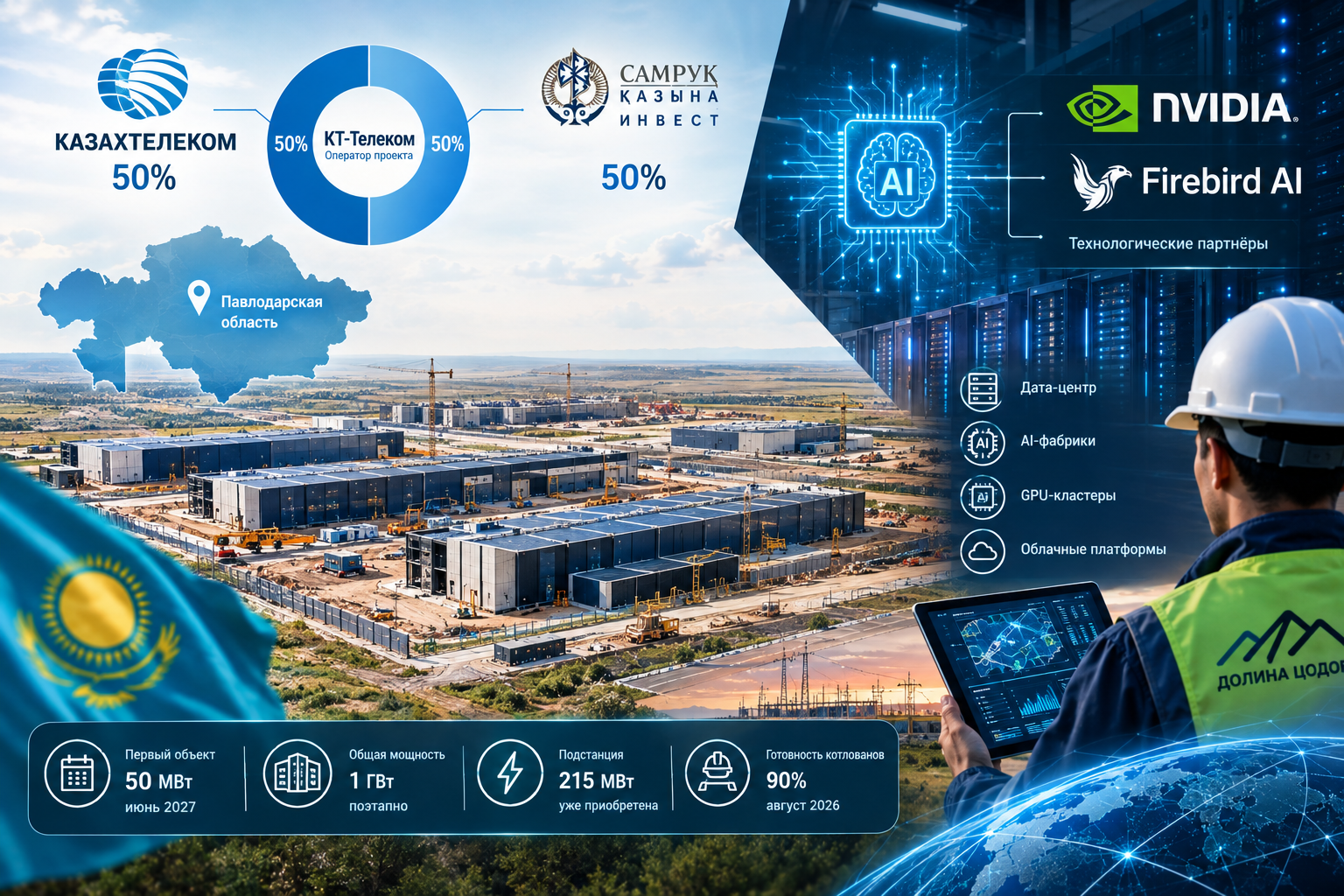
Kazakhtelecom has given up sole control over the project operator in favor of joint ownership with another structure of the same state holding company, Excluzive.kz reports.
The gist in brief
- Kazakhtelecom sold a 50% stake in KT-Telecom, the company managing the Data Center Valley project in Pavlodar Region; Samruk-Kazyna Invest became the second co-owner on an equal basis.
- Before the deal, KT-Telecom was 100% owned by Kazakhtelecom — now the asset has come under the joint control of two structures of the same Samruk-Kazyna holding company; the value of the stake is not disclosed.
- Cooperation with NVIDIA and Firebird AI has been announced for the construction of the site's AI infrastructure, while negotiations are underway in parallel with other foreign investors and potential clients.
- The first facility with a capacity of 50 MW is planned to be launched in June 2027, and the capacity of the entire site will be gradually brought up to 1 GW; a 215 MW substation has already been purchased for power supply.
What changed in the ownership structure
Formally, the deal looks like an internal redistribution of assets within a single state holding company — both parties, Kazakhtelecom and Samruk-Kazyna Invest, are part of the Samruk-Kazyna group. But the very fact of giving up full control over the project operator, which Kazakhtelecom publicly calls an object of the country's critical digital infrastructure, is telling: to implement such scale, it appears that a broader ownership base is required and, probably, additional sources of financing than a single telecommunications operator can provide on its own.
Construction progress
According to government data, by August 2026, excavation of pits for the energy center and AI factory buildings was 90% complete — foundation work and construction of administrative and utility infrastructure are currently underway. By the end of 2026, it is planned to erect the main buildings of the data center and power units, and commissioning work should be completed as early as May 2027. The site is envisioned to host not only data centers in the conventional sense, but also AI factories, GPU clusters, and cloud platforms — infrastructure focused specifically on training and running artificial intelligence models, and not just on data storage.
Connection to an already familiar project
Central Asia's largest AI hub, Data Center Valley, is being built against the backdrop of Kazakhstan's own energy deficit — we examined this story earlier. The appearance of NVIDIA and Firebird AI among the technology partners adds specifics to earlier, more general statements about attracting international technology companies. A similar question — who actually owns Kazakhstan's energy and digital infrastructure and on what terms foreign capital enters it — has already been raised with regard to the country's renewable energy sector, where a significant portion of projects ended up under the control of Chinese state energy holdings. The change in the ownership structure of Data Center Valley — albeit in favor of another Kazakh state entity rather than a foreign player — shows that such large infrastructure projects rarely remain in their original, simple ownership configuration right up to launch.
Author's conclusion
The sale of half the stake in the project operator is not an alarming signal in itself, since control remains within the state group, but it is a reminder that even flagship infrastructure projects undergo adjustments to their initial financing and management structure during implementation. While Data Center Valley is moving along the stated schedule — 90% readiness of the pits, the substation already purchased, the partnership with NVIDIA announced — more important than the deal itself will remain the question of whether the first facility can be launched in 2027 without further delays and whether it will actually attract the foreign clients for whose sake the entire infrastructure is being built.

Comments ()