Kazatomprom received a license for uranium exploration with resources of 10 thousand tons
While Kazakhstan's uranium industry boosts output at existing deposits, the national company is also expanding its portfolio for the future.
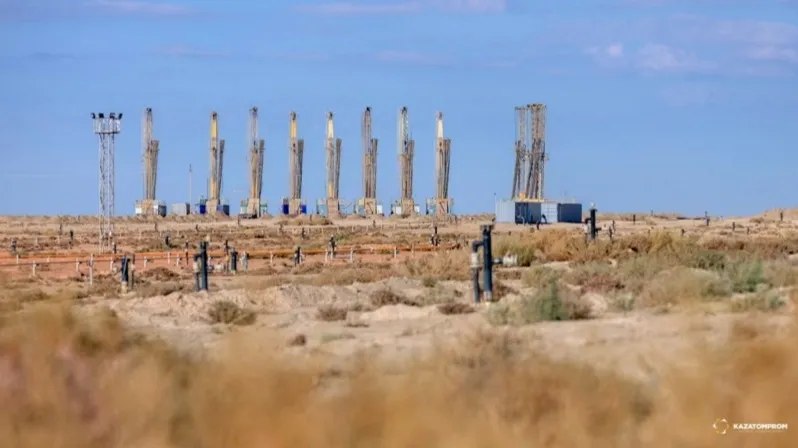
The new license is just one element of a far broader strategy that also carries notable financial risks.
The essence in brief
- Kazatomprom has received an exclusive license to explore for uranium at the Kyzyltu site in the Kyzylorda region for a period of 6 years; according to preliminary estimates, the site's resources could reach 10 thousand tonnes.
- At the same time, the company commented on the risks associated with supplies of sulfuric acid from Russia — a critical reagent for uranium extraction by in-situ leaching: the new Russian export rules do not ban the export of the raw material, but merely introduce volume coordination until the end of 2026, and Russian suppliers have confirmed their readiness to fulfill contracts in full.
- Based on the results of the first half of 2026, the company's consolidated revenue grew by 9%, to 717.8 billion tenge, mainly due to an increase in the average selling price amid a rise in the spot price of uranium — while net profit declined by 9%, to 240.4 billion tenge, due to foreign exchange losses and higher financial expenses.
- According to the strategy for 2025–2034, the company has formed a portfolio of six new promising uranium sites with a total area of more than 1 thousand square kilometers, and investments in geological exploration until 2030 are planned at the level of 75–85 billion tenge.
The new site and its potential
Kazatomprom CEO Meirzhan Yusupov called the receipt of the license "a consistent step in implementing our strategy to expand our mineral resource base." He added that the study of promising sites will continue in compliance with regulatory and environmental requirements. In the near future, geological exploration work is planned at Kyzyltu to refine the preliminary resource estimate — that is, the stated 10 thousand tonnes remains an indicative rather than a fully confirmed figure for now.
The vulnerable link in the chain — sulfuric acid
The company's clarification regarding supplies of sulfuric acid deserves special attention — a reagent without which Kazakhstan's in-situ leaching method of uranium extraction simply does not work. The new Russian export rules do not introduce a direct ban, but require coordination of supply volumes at the level of the Chairman of the Government of the Russian Federation or his deputies until the end of 2026, which in itself creates an additional administrative link in a critically important supply chain. The fact that Kazatomprom considered it necessary to separately and promptly comment on this situation for investors shows how sensitive the issue of raw material dependence remains even for the world leader in uranium mining.
Revenue growth amid profit decline
The financial indicators for the first half of the year present an ambiguous picture: revenue grew amid favorable pricing conditions on the global uranium market, but net profit declined due to foreign exchange losses and increased financial expenses. Operating profit, meanwhile, remained almost at last year's level — 252.6 billion tenge versus 253.7 billion. Such a divergence between operating and bottom-line indicators is typical for export-oriented commodity companies, whose profit in tenge terms depends not only on sales volumes and prices, but also on exchange rate dynamics.
Part of the already familiar picture of uranium leadership
The new license logically continues what we have already examined: Kazakhstan remains the undisputed world leader in uranium mining, and demand for Kazakh raw material continues to grow — in 2025, contracts were signed with Switzerland's Axpo Power, the Czech Republic's ČEZ Group, and Japan's Kansai Electric Power, as well as an agreement on supplies to India. Against the backdrop of what we wrote about new competitors in the uranium market — Canada's Rook I and Mongolia's Orano project with the same in-situ leaching technology — expanding its own resource base is becoming no less important a task for Kazatomprom than maintaining current production volumes.
Author's conclusion
The Kyzyltu license is, by and large, a routine step for a company that has been systematically expanding its portfolio of promising sites for several years now. But the context in which it appeared — parallel clarifications about the risks of sulfuric acid supplies and mixed financial results for the half-year — serves as a reminder that even the world leader in the industry still has vulnerable links in its supply chain and factors beyond the company's own control. Expanding the mineral resource base is important precisely because it provides long-term insurance in case such vulnerabilities — whether raw materials for extraction or exchange rate fluctuations — one day prove more serious than they are now.
Comments ()