Kindergartens in Astana are hotter than the streets, while in Almaty it’s the opposite: Pavlov Analytics studied schools, courtyards, and streets of two cities
Pavlov Analytics continues its urban microclimate study — new data on schools, kindergartens, and streets reveals more than the citywide average.
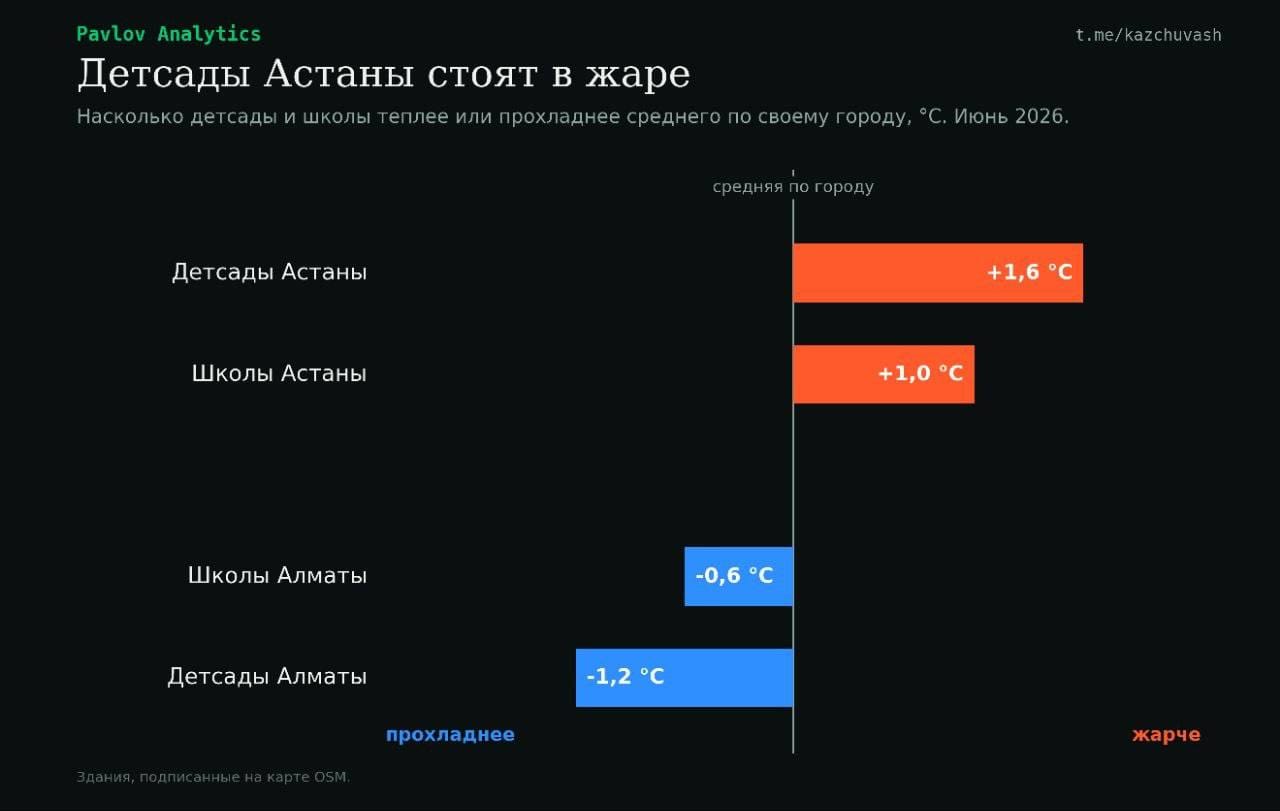
In Astana, a kindergarten is on average 1.6°C hotter than the surrounding city. In Almaty, it is 1.2°C cooler. One indicator, two opposite figures — and behind each lies a specific urban planning decision: whether there are trees in the yard, whether the ground is covered with asphalt, and when the building was constructed.
The Gist Briefly
- In Astana, kindergartens are warmer than the urban background by 1.6°C, and schools by 1°C. The hottest kindergarten records around 34°C — the level of the city's most overheated buildings.
- In Almaty, the picture is reversed: kindergartens are cooler than the city by 1.2°C, and schools by 0.6°C. The old trees of Soviet-era courtyards function as a natural air conditioner.
- The spread between the hottest and coolest streets in Almaty is 18°C. The hottest are Narkesken, Balkurai, Serpukhovskaya. The coolest are the foothill streets with a tree cover of 40–90%.
- In Almaty, 16% of buildings are noticeably hotter than average, 18% are noticeably cooler, and the rest cluster around the average.
- Pavlov Analytics previously established: the difference in perceived temperature between the hottest and coolest building is 16°C in Astana and 19°C in Almaty.
Why a Kindergarten in Astana is Hotter than the Street
New Astana was built quickly. Kindergartens and schools were commissioned alongside residential neighborhoods — surrounded by freshly laid asphalt, young saplings, and open areas without shade. The trees that will one day grow and provide coolness have not grown yet. And children are coming here now.
The result is predictable: the grounds of children's institutions accumulate heat faster than the surrounding built-up area. The hottest kindergarten in Astana records a perceived temperature of around 34°C — the level of the city's most overheated industrial and transport zones.
As Pavlov Analytics puts it directly: "Perhaps it's worth thinking about where to start greening Astana."
Why a Kindergarten in Almaty is Cooler than the Street
Almaty was built differently. The Soviet urban planning standard mandated the greening of courtyards and institutional grounds. 40–60 years have passed, and these trees have grown into a full-fledged tree canopy over playgrounds, schoolyards, and residential blocks. They were built inside the blocks, deep within the courtyards, and the old trees still shelter them.
This is why kindergartens in Almaty are on average cooler than the surrounding city by 1.2°C, and schools by 0.6°C. Not because they were designed with climate norms in mind — but because trees planted half a century ago now work as a free cooling system.
The Hottest and Coolest Streets of Almaty
A new study by Pavlov Analytics on the streets of Almaty adds specifics. The spread between the hottest and coolest streets in the city is 18°C on the same day in June.
The top five hottest: Narkesken, Balkurai, Serpukhovskaya, Lugovskogo, Khangeldi Batyr. They share one thing: tree cover is close to zero. Warehouses, depots, bare ground, scorched roofs — not a single patch of shade.
The top five coolest are in the foothills: Almalykskaya, Gornaya, Montazhnik, Naimanbaeva, Kaisenova. Tree cover here is 40–90%. Buildings stand under the canopies, and the surface around them is 10–14 degrees cooler than the city. The coordinates have been published — each street can be opened in Google Maps to verify: the hot ones look exactly as expected, and the cool ones do too.
A Third of the City Lives in a Different Climate
Comparing each of the 181,966 buildings in Almaty with the city's average temperature yields a surprisingly clear picture: 16% of buildings are noticeably hotter than average, 18% are noticeably cooler, and the rest cluster around the average. In total, more than a third of the city lives in a microclimate noticeably different from the urban norm.
"In one city, on the same day, neighboring houses live in different climates. And this is decided not by the weather, but by what was built on and what was cleared from the land around them," summarizes Pavlov Analytics.
Author's Conclusion
The series of studies by Pavlov Analytics turns the abstract concept of the "urban heat island" into a measurable, mappable, and, most importantly, manageable reality. A kindergarten in Astana is hotter than the street — not because it was designed that way, but because no one planted trees. A kindergarten in Almaty is cooler — not because it was designed more intelligently, but because in the 1970s, someone fulfilled the greening requirement. The difference in approaches is half a century. The difference in temperature is almost 3 degrees. 18 degrees between a hot street without trees and a cool foothill street with canopies — this is not climatology, it's a choice. And Astana has to make this choice right now, while new neighborhoods are still being built.

Comments ()