Marathon Fusion startup claims gold from mercury but doesn't state quantity
Marathon Fusion, a US company developing fuel systems for future fusion power plants, says it has turned mercury into stable gold using neutrons from a fusion reaction.
According to the company, the result is 10 times the CERN record, Euronews writes. But the company did not disclose how much gold was produced, and there is no independent verification of the result. We break down what was claimed and what is known from scientific papers.
The gist in brief
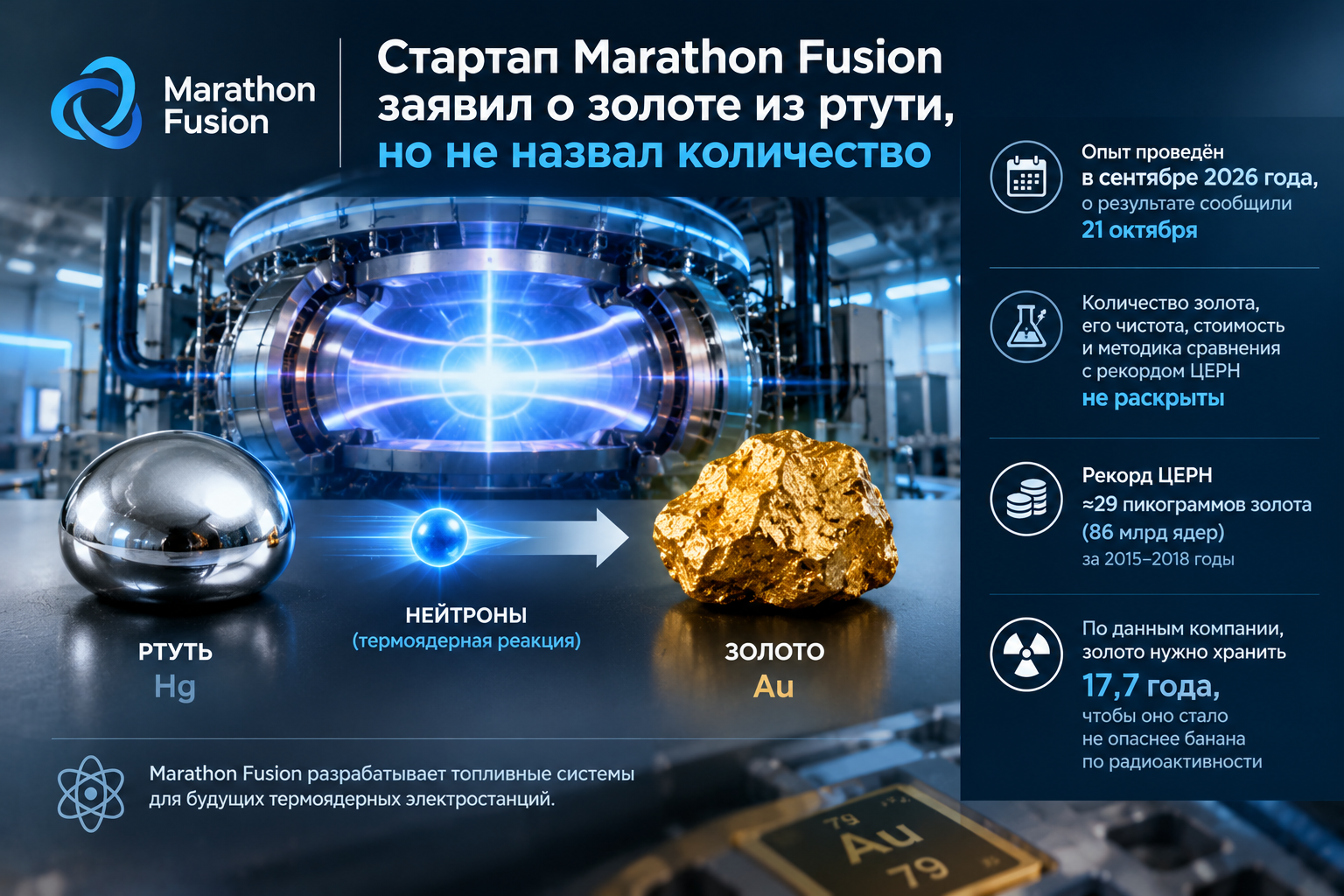
- Marathon Fusion claimed to have turned mercury into stable gold using fusion neutrons. According to the company, the experiment was conducted in September 2026, and the result was announced on October 21.
- The company did not disclose the amount of gold, its purity, the cost, or the methodology behind the comparison "10 times the CERN record."
- The CERN record is about 29 picograms of gold (86 billion nuclei) over 2015-2018; this is a result published in a journal.
- In the company's own paper, the gold after production must be stored for about 17.7 years for it to become no more radioactive than a banana.
What the company claimed
Marathon Fusion from San Francisco announced this on October 21 in a post on social network X: the company writes that it turns mercury into real stable gold and "beat the CERN record by 10 times." As publications note, the only data there are gamma spectra, which, according to the company, show signs of mercury-197 and gold-197. They were taken 8-44 hours after irradiation. Such a spectrum shows that the reaction occurred, but it cannot determine the amount and purity of the metal.
The post does not say what device produced the neutrons for the experiment. According to one publication, the company's current reactor operates at a fusion power of about 1 kW, which is one millionth of a gigawatt. For comparison, power plants are measured in hundreds of megawatts and gigawatts.
How it works
Gold-197 is the only stable isotope of gold. The idea is to irradiate mercury with neutrons with an energy of 14 MeV, which are produced by the fusion of deuterium and tritium. A mercury-198 nucleus loses two neutrons and turns into mercury-197, which decays into gold-197 with a half-life of about 64 hours. Natural mercury contains only about 10% mercury-198, so in the company's calculations it must be enriched to 90%.
These calculations are in a 2025 preprint on arXiv. Its authors work at Marathon Fusion, meaning they have a stake in the result, and the work has not undergone peer review. According to the model, a power plant with a thermal power of 1500 MW could produce about 2.95 t of gold per year, which is about 2 t per gigawatt of thermal power. In public statements in 2025, the company cited a different figure: about 5 t per year per gigawatt. But the preprint stipulates: the geometry is simplified, and the extraction and enrichment of mercury at the required scale remain unresolved tasks. The requirements of the Minamata Convention on Mercury also need to be taken into account.
Radioactivity and storage period
Along with stable gold, radioactive isotopes are produced; the longest-lived of them is gold-195 with a half-life of about 186 days. According to the preprint authors' calculations, for the gold to become no more dangerous than a banana, it must be stored for about 17.7 years. For it to fall into the low-hazard waste class, about 6.8 years are needed. Therefore, the gold produced cannot be sold quickly.
What CERN obtained
For comparison: in the ALICE experiment at the Large Hadron Collider, lead nuclei flew past each other, and the electromagnetic field knocked three protons out of the lead nucleus. In 2015-2018, about 86 billion gold nuclei, or roughly 29 picograms, were produced this way. A picogram is one trillionth of a gram. The result was published by the journal Physical Review C. The gold exists for a fraction of a second and scatters in the beam pipe, meaning no ingot is produced. In the collider's third run, nearly twice as much gold was produced.
What remains unknown
The company did not disclose:
- how much gold was produced, its purity and yield;
- how much it cost to produce;
- how exactly "10 times higher than CERN" was measured: by mass, number of nuclei, or production rate;
- what device produced the neutrons and how much mercury was irradiated;
- what confirms the result besides gamma spectra: there is no independent verification.
The company also stated that it had obtained medical copper isotopes from zinc and enriched isotopes in "the world's most powerful plasma centrifuge." No confirmation of this was found in public sources. The publications do not name any independent scientists who have verified Marathon Fusion's data.
Will this affect the price of gold
Not for now. Global gold production in 2025 was about 3,670 t. The preprint's calculations relate to power plants that do not exist: no fusion plant sells electricity yet, and commercial ones will not appear soon. The preprint authors themselves allow that as supply grows, the price of gold could decline, but they speak of this in relation to the future.
Similar cases here
Loud claims without data also occur here. For example: the Ministry of Agriculture and an institute announced a technology for "marbled" lamb, but in the press release, as our breakdown notes, there is no sample size, control group, or method for measuring fat. And in the material about drones for dispersing beneficial insects, there is a lack of data on replications, statistical significance, and the economics of implementation.
Author's conclusion
At CERN, the result is expressed in a number of nuclei and mass, 86 billion nuclei and 29 picograms; Marathon Fusion has neither mass nor number of nuclei. Therefore, the "10 times" comparison cannot be verified or refuted without disclosed data.
Comments ()