Kyrgyzstan has lost 90% of its forest cover in 50 years
A mountainous country, where forests held slopes against erosion and softened floods for centuries, lost nearly all its tree cover in just fifty years.
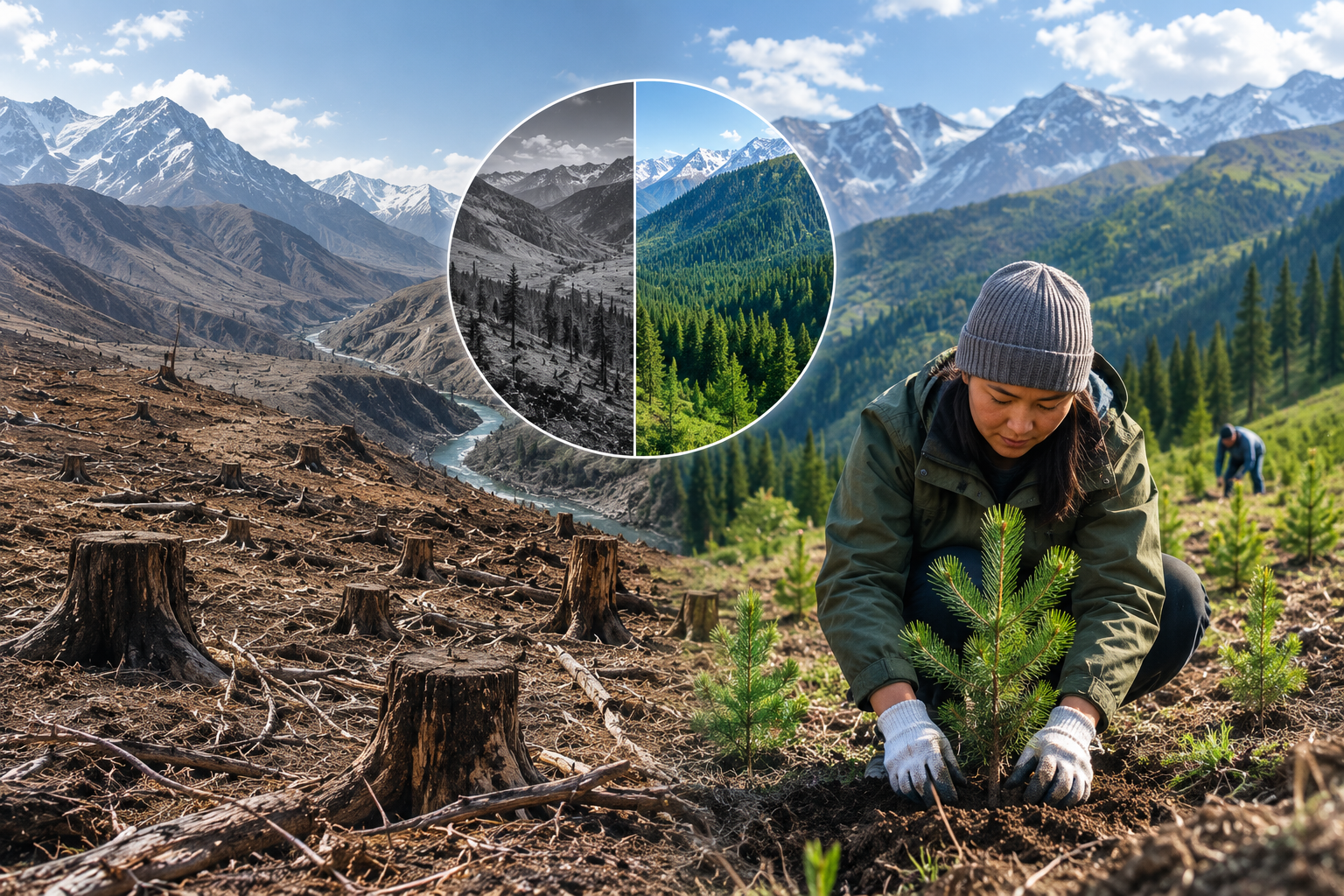
The Cabinet of Ministers of Kyrgyzstan has submitted a plan for public discussion that aims to reverse this trend by 2035.
The gist in brief
- Kyrgyzstan has lost about 90% of its forest cover over the past 50 years, and around 70% of the remaining forests are in a state of degradation — according to data from the country's draft National Adaptation Plan up to 2035.
- By 2035, the authorities intend to restore and stabilize at least 150,000 hectares of degraded forests, slopes, and watersheds, covering at least 60% of the country's priority watersheds with nature-based measures.
- The plan includes 676 measures across six areas — from water security and sustainable agriculture to infrastructure protection and disaster risk management; implementation will require 74.5 billion soms, with more than half expected to be attracted from international sources.
- Without adaptation measures, economic losses from climate change could reach 2–3% of GDP annually by 2040 and 4.2% by 2050, and around 170,000 people could additionally fall below the poverty line.
Forests as "natural infrastructure"
The plan's authors use an illustrative formulation: forests and mountain ecosystems are described in the document as the state's "natural infrastructure" — on par with roads, bridges, and utility networks. Their function is literally engineering-like: holding slopes against erosion, regulating the runoff of meltwater and rainwater, and mitigating the impacts of extreme precipitation. The loss of this function directly increases the risks of mudflows and landslides threatening roads, bridges, and farmland — in other words, deforestation in a mountainous country triggers a chain of risks that extends far beyond ecology itself.
The scale of climate vulnerability
Kyrgyzstan is one of the most climate-vulnerable countries in the region due to its very geography: more than 90% of the country's territory lies above one thousand meters above sea level, and almost 40% — above three thousand. The average annual temperature rose by 0.28°C per decade between 1981 and 2020, with the strongest warming in spring, disrupting the usual patterns of snow accumulation and melting timing, and with them the entire agricultural calendar. The area of glaciation in the country has shrunk by 16–17% since the beginning of the century, and scientists predict further reductions in glacier volume even without additional warming.
Specific measures in the plan
The document is not limited to general declarations. When constructing new facilities in mudflow- and landslide-prone areas, it is proposed to mandatorily assess the condition of surrounding ecosystems and take into account the so-called ecosystem buffer — meaning construction projects in mountain regions will have to consider how their implementation will affect the already weakened natural protective mechanisms of the territory. Monitoring is planned to cover at least 80% of vulnerable mountain and forest ecosystems, and in priority areas at least 40 demonstration sites are to be created to test nature restoration methods in practice — before scaling the approach to all 150,000 hectares.
Part of a regional land restoration trend
Kyrgyzstan's plan logically fits into the broader regional picture we have been following recently. We have already written about how tree species resistant to the local climate are being tested near Astana together with Chinese scientists, and China is sharing with Central Asia its experience in creating protective green belts around the Taklamakan Desert. In parallel, at the international level, the very topic of land and forest degradation was discussed this summer at the COP17 summit in Ulaanbaatar, where 197 countries sought common approaches to restoring depleted territories. The Kyrgyz plan is a concrete, nationally adapted embodiment of the same logic: restoring natural ecosystems as a tool for managing climate risks, not merely an environmental goal in itself.
A similar shift toward systematic accounting of land condition is underway in Kazakhstan as well — in the summer of 2026, the Senate adopted the Law "On Soil Protection," introducing a mandatory land passport and a unified soil monitoring system — meaning both neighbors in the region are almost simultaneously moving from fragmented environmental measures to continuous monitoring of land condition as a basis for further decisions.
Author's conclusion
The acknowledgment that the country has lost 90% of its forest cover over half a century is a rare moment of candor for a government document, and it sets a high bar for assessing the plan's success: 150,000 hectares of restored territory by 2035 is only a small fraction of what has been lost, but it is precisely this portion that, according to the document's authors, can cover the most critical watersheds and slopes that determine the level of risk for roads, settlements, and farmland. For Kyrgyzstan's neighbors in the region, including Kazakhstan, the fate of this plan is a practical test of whether Central Asian countries can turn climate declarations into measurable results on specific hectares of land.


Comments ()