Lamb and beef require the most land of all food products.
Fresh infographic from Visual Capitalist ranks 15 foods by land area needed to produce every half kilo of finished product.
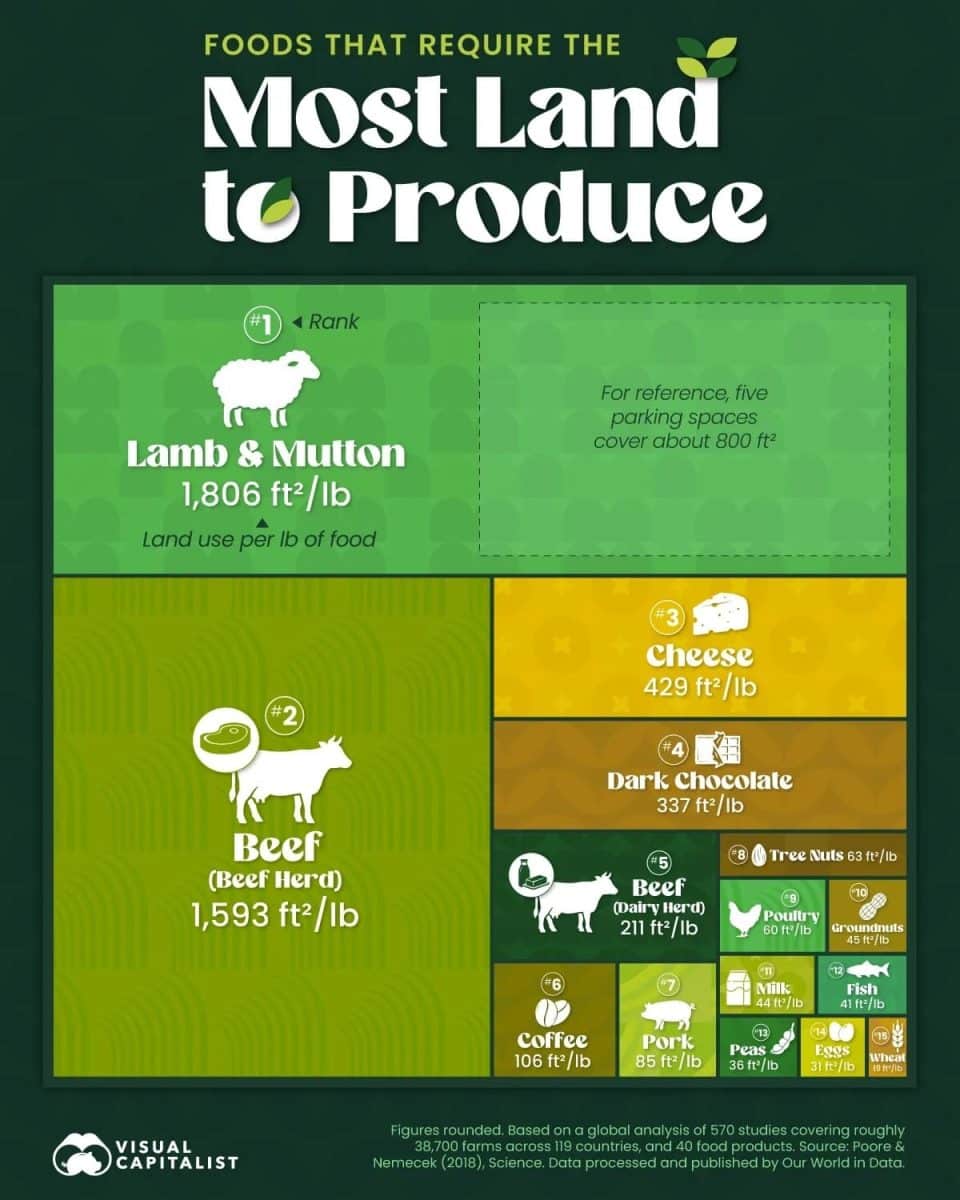
The first two places in the ranking are unexpectedly confidently occupied by precisely those products around which Kazakhstan's own discussion about production efficiency is unfolding — lamb and beef.
The gist in brief
- According to data from the study by Poore & Nemecek, processed by Our World in Data, lamb ranks first among 15 products in land use — about 168 m² per half-kilogram of product.
- Beef from specialized beef cattle breeds ranks second — nearly 148 m², which is more than four times the figure for cheese (39.8 m², third place).
- Dark chocolate (31.3 m²) and coffee (9.8 m²) also require significant land areas — due to the relatively low yield of cocoa and coffee crops per hectare.
- The lowest land requirements are for wheat and rye (1.75 m² per half-kilogram), peas (3.38 m²), and peanuts (4.13 m²).
Why ruminants require the most land
The gap between lamb and beef on the one hand and the rest of the products in the ranking on the other is explained by the very physiology of ruminants. Keeping them requires not only extensive pastures for grazing, but also separate land areas for growing feed crops — a double burden on land that most other products do not have. Added to this is a longer production cycle compared to poultry or pork: the longer an animal grows, the more total land is required per unit of final output.
Plant-based products vs. animal products
The overall pattern of the ranking is predictable — animal products require more land than plant-based products in almost all cases, but the scale of the gap is still impressive. Poultry meat and pork, although inferior to beef and lamb, still remain significantly more land-intensive than most of the plant-based products in the ranking. Meanwhile, cheese — also an animal product — occupies an intermediate position: the land costs of milk production and the volume of milk needed to produce a kilogram of cheese place it more in line with dark chocolate than with beef or lamb.
The Kazakhstani context
For Kazakhstan, this is not abstract global statistics. We have already written that more than 70 million hectares of the country's pastureland are subject to varying degrees of degradation — an area comparable to the territory of France. Lamb and beef as the products with the highest land footprint in the world directly explain why the pressure on Kazakhstani pastures is so great: the country remains one of the major producers and exporters of precisely these types of meat. Also telling in this light is the recent Kazakhstani experiment with switching lambs to intensive grain feeding for "marbled" lamb: from the standpoint of the land footprint, such a transition to grain feeding does not reduce but rather increases the total burden on land — feed grain areas are added to pastures, whereas the only real competitive advantage of Kazakhstani lamb is cheap weight gain precisely on pasture, without additional sown area for compound feed. It is against the backdrop of such a high land burden from livestock farming that in the summer of 2026, the Law "On Soil Protection" was adopted, introducing a mandatory land passport and a unified soil monitoring system — a tool designed to help track the condition of lands before degradation becomes irreversible.
Author's conclusion
The Visual Capitalist ranking translates the abstract discussion about the environmental friendliness of different diets into concrete, comparable figures: lamb and beef are not just "more resource-intensive" products in general terms, but literally require an order of magnitude more land than the vast majority of alternatives. For a country like Kazakhstan, where livestock farming remains a backbone industry and pasture degradation has already been officially recognized as a problem of national scale, these figures are not a reason to abandon its own agricultural profile, but rather an argument for using the land already available as efficiently as possible, rather than increasing the burden on it with new, not fully calculated technological solutions.


Comments ()