Less raw materials, more recycling — the agrarian rate "Ädilet
The agrarian bloc of the Adilet party's election program centers on one core idea: stop exporting raw materials and sell finished products instead. Grain, livestock, and oilseed exports would be replaced by flour, deep-processed meat, and vegetable oils.
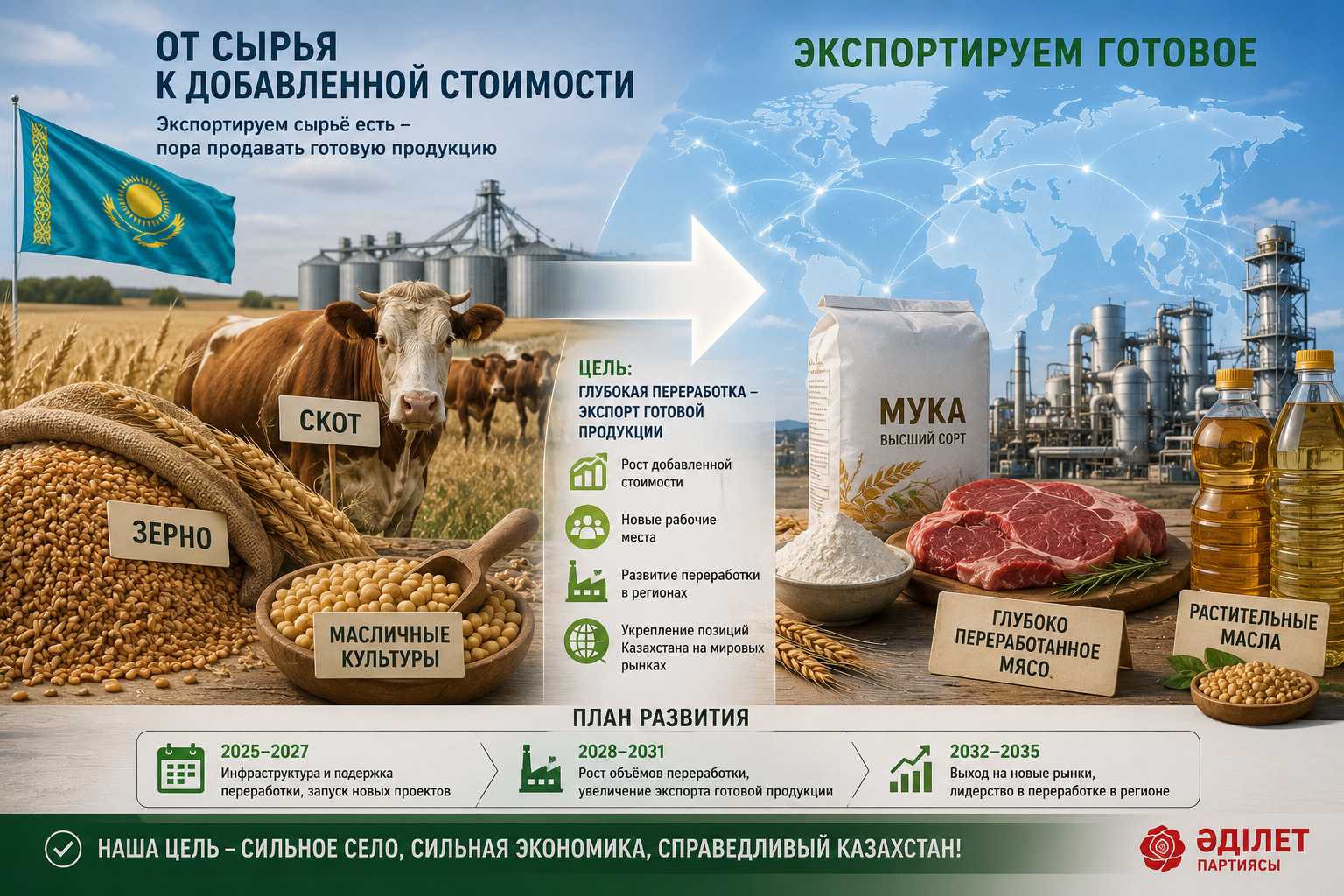
The idea is not new — Kazakhstan has been talking about the need for such a shift for years — but in the program it is backed by specific figures and deadlines that are worth examining in detail.
The gist in brief
- The party promises to increase agricultural exports by 3.5 times by 2030 compared to 2020, raising the share of processed products in the export structure to 70%.
- Domestic milk and meat processing is proposed to be brought up to 70% — currently, according to the program data, about 65% of milk and only 50% of meat is processed.
- A particular emphasis is placed on scaling modern dairy farms following the model of the North Kazakhstan Region.
- The program also envisages expanding concessional financing for livestock farming and developing agricultural cooperation.
Export ambition — 3.5-fold growth
The desire to shift the export structure from raw materials to processing is logical in itself and aligns with what is already happening in individual sectors. Industrial hemp cultivation in Kazakhstan was permitted back in 2025 precisely for the production of cellulose, textile fiber, and other high-value-added products — a pool of 8 projects worth $398.4 million with a combined processing capacity of 50 thousand tons of raw material per year has already been formed for this purpose, although no sown areas actually exist yet. A similar logic can be seen in the meat sector: Kazakhstan increased live cattle exports by 1.7 times in January–May 2026 — that is, it is exporting raw materials rather than finished products — despite the fact that the country's own processing capacities are not fully utilized. According to official data from the Ministry of Agriculture, there are 210 meat processing enterprises in the country with a combined capacity of about 400 thousand tons of meat per year, and their average utilization rate is approximately 54%; meat processing plants in the Pavlodar Region, for comparison, operate on average at less than 50% capacity. The situation with hide and wool processing is even more illustrative — the utilization of specialized enterprises does not exceed 6% despite a capacity of over 3 million cattle hides per year. In other words, increasing processing does not necessarily require building everything from scratch: part of the solution is simply putting existing facilities to work, while also gaining additional jobs and tax revenues. The program's promised shift from wheat monoculture to oilseed crops is also not an abstraction — camelina is already being tested in the North Kazakhstan Region as part of a Kazakhstan-China project aimed at exporting feedstock for sustainable aviation fuel — a concrete example of exactly this kind of crop diversification and entry into higher-value-added products. According to the Ministry of Agriculture, oilseed crops in Kazakhstan are already growing at an accelerated pace — the area under them increased by 37.7% in 2025, reaching 3.9 million hectares, while vegetable oil exports grew by 34.6%, putting the country in 8th place among global sunflower oil exporters.
Northern experience as a growth point for the dairy industry
The idea of relying on the North Kazakhstan Region model looks like a logical choice rather than a random example. More than 118 agricultural entities in the region are already engaged in dairy farming, of which 50 operate to industrial standards as modern dairy farms, and in 2025–2026, hundreds of head of Holstein-Friesian breeding cattle were imported into the region from Germany and Ukraine. Nationwide, under the concessional lending program, 95 dairy farms with a combined capacity of over 500 thousand tons of milk per year have been financed, of which 71 have already been commissioned, and another 19 with a capacity of about 100 thousand tons are planned to be launched by the end of 2026. It is these new farms reaching their design capacity that drove the country's milk production growth of 2.4% in the first half of 2026 — up to 1.9 million tons. The program is not about transferring the northern experience to the entire country in one move, but about scaling a model that is already working and has proven its effectiveness in places where the natural and infrastructural preconditions exist — primarily in the northern regions with their feed base and accumulated experience in large-scale commercial production.
Author's conclusion
The agricultural section of the "Adilet" program relies on real and well-documented processes in Kazakhstan's agro-industrial complex — processing instead of raw material exports, underutilized meat processing plants, and fine-tuning the dairy industry through an already functioning model of commercial farms. Much of what is stated continues what is already happening in practice: new farms are being built, a pool of hemp processing projects is being formed, and the utilization of idle capacities is being discussed. How ambitious the stated figures will prove to be — export growth of 3.5 times, processing of 70% of milk and meat — will be shown by how quickly these intentions translate into concrete budget decisions and sectoral programs already in the first year of work.
Comments ()