Living plastic" disappears in six days: scientists create material without microplastics
Researchers from the US and China created a new "living plastic" that fully degrades in just six days after special activation, leaving no microplastics.
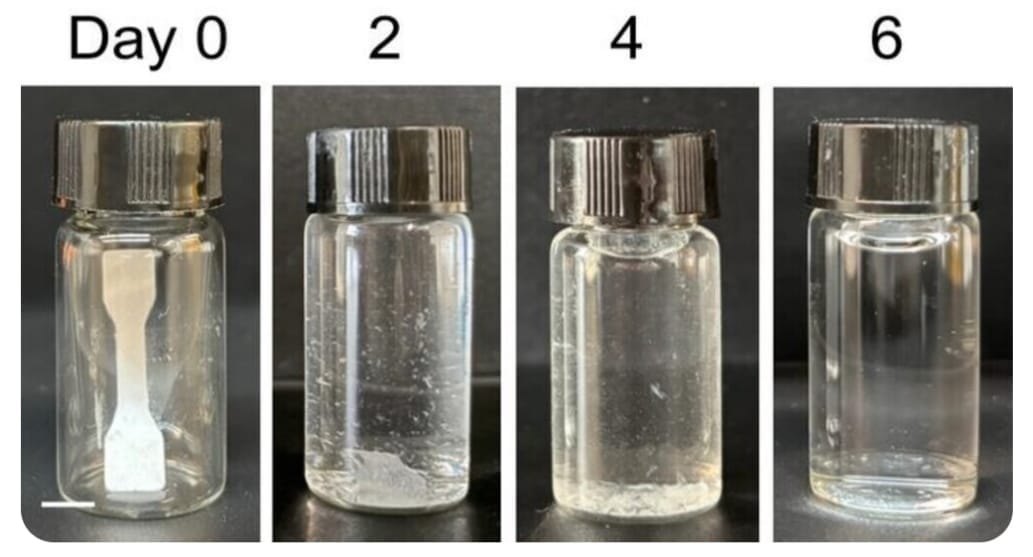
Unlike traditional biodegradable materials, the new polymer contains genetically modified bacteria inside it that trigger the self-destruction process only on command, writes Techno.nv.
In a Nutshell
· Scientists have created a "living plastic" with embedded Bacillus subtilis bacteria.
· After activation, the material completely degrades in six days.
· The new plastic does not form microplastics and breaks down into safe compounds.
· The technology could become an alternative to traditional biodegradable plastics.
· The development is currently at the stage of laboratory testing.
How "Living Plastic" Works
The basis of the new technology is the Bacillus subtilis bacteria, placed inside the polymer structure in a dormant state.
As long as the material is used for its intended purpose, the microorganisms remain inactive and do not affect its properties. However, after special activation, the bacteria begin to synthesize enzymes that rapidly break down the polymer matrix.
As a result, the plastic completely degrades in just a few days, without turning into microplastics — one of the main environmental problems of modern polymers.
Why This Differs from Ordinary Biodegradable Plastic
Most modern biodegradable plastics require special conditions — high temperature, humidity, and the operation of industrial composting facilities. In the natural environment, many of them degrade much more slowly or simply break down into small particles.
The new technology uses a different principle: the microorganisms are inside the material itself and only begin to break it down after receiving a corresponding signal. Thanks to this, the developers hope to avoid the formation of persistent microplastics.
Where the Technology Can Be Applied
According to the study's authors, such materials could primarily be used for short-lived products:
· packaging;
· disposable tableware;
· medical materials;
· agricultural films.
After the end of their service life, such products could quickly degrade without accumulating plastic waste in the environment. At the same time, the scientists emphasize that the technology is still undergoing laboratory testing, and issues of production scaling and material cost need to be resolved before industrial implementation.
What This Means for Kazakhstan
The problem of plastic waste is becoming increasingly relevant for Kazakhstan as well, where a significant portion of packaging is still made from traditional polymers.
Previously, Hunn.kz reported on the development of Australian scientists who managed to turn plastic waste into hydrogen using sunlight. This technology solves the problem of already accumulated plastic, while the new "living plastic" offers a different approach — creating materials that are initially programmed for safe degradation after the end of their service life.
Both developments show that global science is gradually moving from combating the consequences of plastic pollution to creating fundamentally new materials and waste management technologies.
Author's Conclusion
Plastic has become one of the symbols of modern civilization, but at the same time — one of the most complex environmental problems. The new "living plastic" is interesting because it changes the very philosophy of production: instead of materials that have to be recycled for decades, scientists propose creating products with a pre-built mechanism for safe self-destruction. If the technology moves beyond the laboratory, it could become one of the most promising directions for the development of the polymer industry.


Comments ()