Netherlands closed canals between The Hague and Rotterdam due to drought.
Europe's summer of 2026 keeps setting unprecedented precedents. Dutch authorities have, for the first time in the region's history, closed all canal locks between The Hague and Rotterdam.
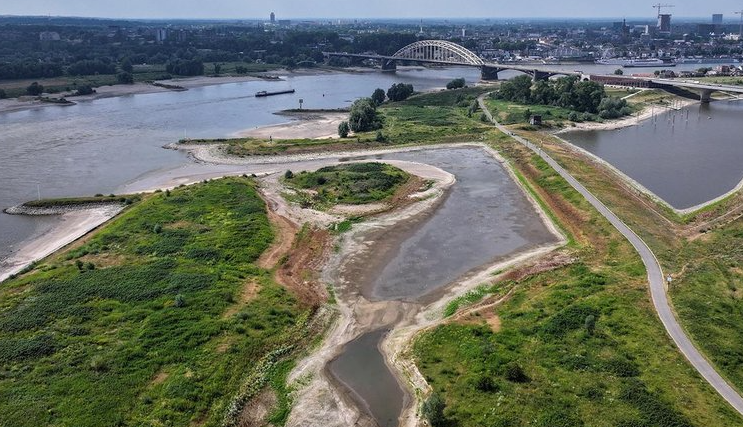
After the shutdown of nuclear reactors in France, Romania, and Hungary, the drought has now reached the Netherlands — this time it is not electricity that has been hit, but shipping and drinking water, reports snob.ru.
The gist in brief
- The Delfland water authority has, for the first time in the region's history, completely closed all locks on the canals between The Hague and Rotterdam, halting traffic for both commercial and recreational vessels.
- The water inspection has banned the withdrawal of water from open sources — rivers, canals, ditches — for watering fields, gardens, lawns, sports grounds, golf courses, and equestrian centers; fines are provided for violations.
- The restrictions are designed to save about 1 m³ of fresh water per second; as early as mid-July, the Netherlands officially declared a state of actual drinking water scarcity.
- The Netherlands has become the fourth European country to face the consequences of abnormal heat and drought this summer — after France, Romania, and Hungary.
What exactly was closed and why
The decision to completely stop the locks on the canals between The Hague and Rotterdam was made by the Delfland water authority — according to officials, such measures have never been taken in the region before. At the same time, the water inspection banned the withdrawal of water from open sources, including ordinary ditches — the restrictions apply to municipalities, businesses, sports organizations, and ordinary residents, and even extend to watering golf courses and equestrian centers. Delfland board member Stijn van Boxmeer explained the need for these measures by a direct shortage of the resource: water reserves are melting away quickly, and control over water levels is needed simultaneously to protect dikes, preserve nature, and maintain environmental quality.
Salt advances from the sea
The Dutch crisis also has a less obvious side effect. The abnormal heat has caused a critical drop in the water level of the Rhine, which means less fresh water reaches the region overall — and the freed-up space in the canal beds is beginning to be filled by salty seawater, penetrating ever deeper inland. This creates a dual threat: in addition to the shortage of water for irrigation and shipping, the quality of drinking water and the condition of agricultural land are under threat, as soil salinization could cause problems for years to come, not just for one dry season.
The European tally — already four countries
The Netherlands continues the list of countries whose infrastructure has been crippled this summer by the same anomaly. Earlier, French reactors were shut down because the water in the Seine and the Rhône became too warm for safe cooling, while Romania faced the opposite problem — the Danube shallowed to a historic low, which forced authorities to blast rocks from the riverbed to save the Cernavodă plant. A few days later, Hungary completely shut down its only nuclear power plant, Paks, for the first time in 44 years — also because of the Danube. Damage from wildfires amid the same heat wave has already exceeded €3 billion across Europe. The Netherlands shows that drought hits not only the energy sector: the entire water infrastructure is under threat — from drinking water supply to inland shipping.
Why this matters for Kazakhstan
Kazakhstan is no stranger to similar crossroads, although the causes and scale differ. According to UN data, the level of stress on Kazakhstan's water resources already stands at 34.6% — exceeding the threshold at which water scarcity is recorded. The Shardara Reservoir, a key link in the cascade on the Syr Darya, was filled to only 79% of the norm for that period as of January 2026, compared to 98.6% a year earlier. The difference in scale with the Netherlands is obvious: there, shipping between two cities was threatened, while in Kazakhstan, irrigation water for entire agricultural regions in the south of the country is at stake. But the logic is the same: the narrower the safety margin of a water system becomes, the faster one abnormally hot wave turns into decisions that never had to be made before — whether it is closed locks in the Netherlands or revised water withdrawal quotas in Central Asia.
Author's conclusion
The list of European precedents this summer is growing faster than the public can process: at first it looked like isolated local stories, but now it is coming together into a single narrative — Europe's climate system has encountered a load for which existing infrastructure was not designed. For Kazakhstan, where its own water safety margin is also not infinite, this European experience is not a reason for gloating over others' problems, but yet another practical confirmation that water sustainability issues must be addressed in advance, not after a shortage has already set in.
Comments ()