New field in Ustyurt does not yet solve Uzbekistan's gas problem
Uzbekneftegaz discovered the Koratau gas-condensate field on the Ustyurt Plateau in Karakalpakstan.
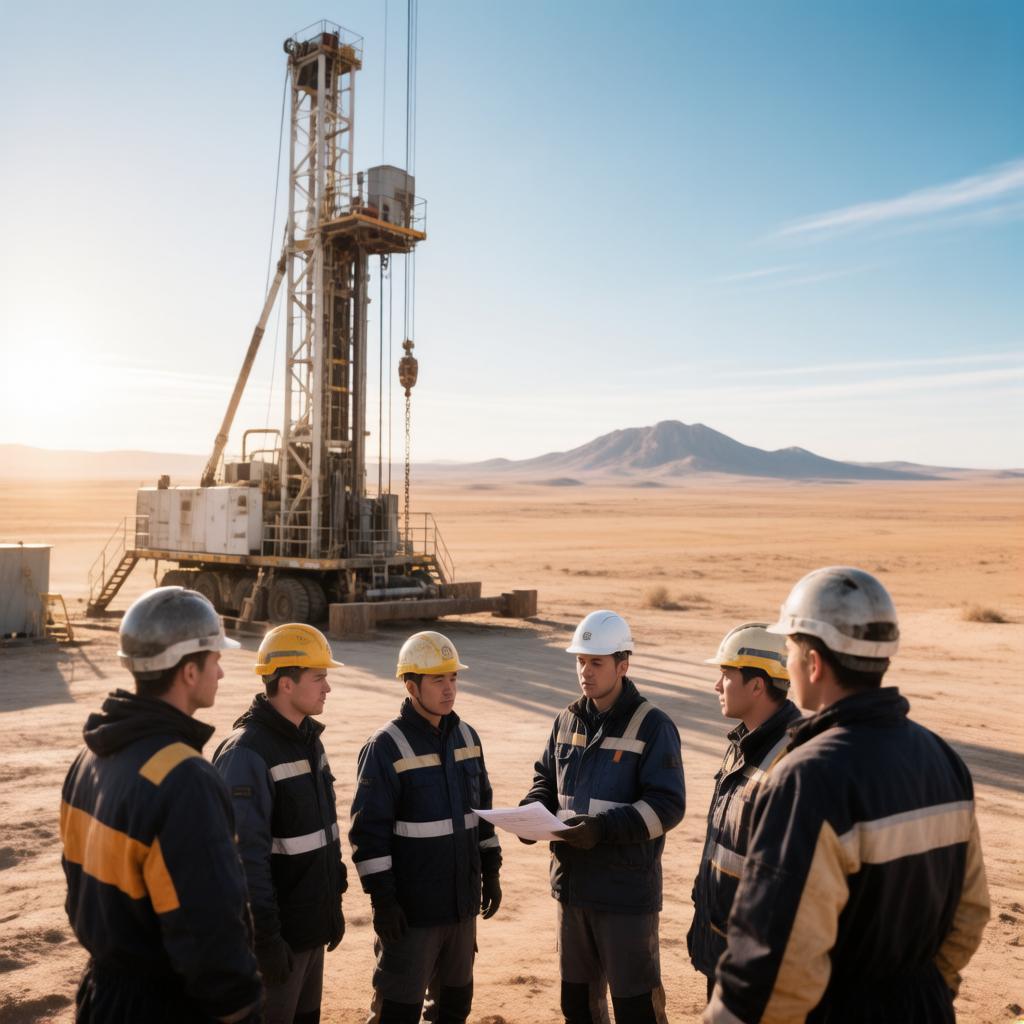
This is already the fifth gas discovery in Uzbekistan since the beginning of the year, Fergana.News reports, but gas production in the country continues to fall rapidly. The company has not yet reported anything about the reserves or flow rate of the new field.
The gist in brief
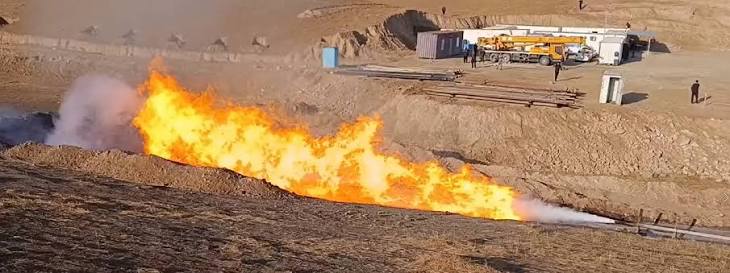
- On October 3, during testing of exploration well No. 1 with a depth of up to 4,860 meters, a commercial inflow of gas and condensate was obtained from Lower Jurassic deposits. This is how the Koratau field was discovered in the Muynak district of Karakalpakstan.
- Koratau became one of five gas fields discovered in Uzbekistan since the beginning of 2026. This year, 80 wells have been drilled in the country, and another 40 are planned by the end of the year.
- The company did not disclose the volume of reserves, the well flow rate, or the timing for the start of production.
- In the first eight months of 2026, Uzbekistan produced 24.2 billion cubic meters of gas, 16.3% less than a year earlier. The country is covering the deficit with imports, including Russian gas, which transits through Kazakhstan.
What was found at Koratau
The discovery was announced by the press service of Uzbekneftegaz JSC. Exploration well No. 1 was drilled in the central part of the Koratau area to a depth of up to 4,860 meters. The inflow of gas and condensate was obtained from Lower Jurassic layers in the depth interval of 3,213-3,273 meters. The company believes the results "open new promising directions" for studying the deep horizons of Ustyurt.
So far, this is the first well and the first inflow. To understand how much gas the field contains and whether it is profitable to develop, appraisal wells are needed. By the end of the year, Uzbekneftegaz plans to finish drilling well No. 2 and begin drilling wells No. 3 and No. 4.
Exploration is accelerating, production is falling
The new discoveries were discussed on October 5 at a presentation of major oil and gas projects held for President Shavkat Mirziyoyev. In total, since the beginning of 2026, five gas fields have been discovered in Uzbekistan. 80 wells have been drilled in the country's regions, some of them to a depth of 6,000 meters or more, and another 40 are planned in the fourth quarter. The volume of 3D seismic exploration is promised to be increased fivefold compared with last year.
At the same time, production is falling faster than before. According to the National Statistics Committee, in January-August 2026 the country produced 24.2 billion cubic meters of gas, 16.3% less than in the same period last year. The peak came in 2021, when Uzbekistan produced 53.8 billion cubic meters. By 2024, production had fallen to 44.5 billion, while purchases of imported gas doubled and exceeded $1.6 billion. The management of Uzbekneftegaz explained the decline by saying that geological exploration had not been given sufficient attention for many years: some fields are almost depleted, while the recovery rates of others remain low.
From exporter to importer
Uzbekistan is covering the deficit with imports from Russia and Turkmenistan. Gazprom's supplies grew from 1.28 billion cubic meters in 2023 to 5.64 billion in 2024. Uzbekistan's Minister of Energy Jurabek Mirzamakhmudov warned that if exploration in Ustyurt does not yield the expected results, imports could reach 10-11 billion cubic meters per year by 2030.
But exploration is not the only answer to the gas deficit. In parallel, Uzbekistan is reducing its dependence on gas in the power sector: the country is attracting up to $15 billion for renewable energy projects and preparing for a second nuclear power plant, even before completing the first. The scarce and increasingly imported resource has also forced the authorities to tighten payments for it: since July 2024, enterprises have paid for gas and electricity entirely in advance. Only in September of this year, for businesses with digital metering and no debts, the prepayment was reduced to 15%. Efforts to save gas are also being made within the gas transmission system itself: modernization of compressor stations, according to Uzbekneftegaz estimates, will save up to 125 million cubic meters of gas per year.
What Kazakhstan has to do with it
Russian gas enters Uzbekistan through the territory of Kazakhstan, via the Central Asia-Center gas pipeline. According to Kazakhstan's Ministry of Energy, in 2025 the transit volume could grow to 7.3 billion cubic meters. Therefore, any success by Uzbekistan in its own production directly affects the utilization of Kazakhstan's transit infrastructure. The Ustyurt plateau itself is shared by the two countries and continues into the territory of the Mangystau region.
At the same time, Kazakhstan is also expanding its own gas industry. Its development program envisages growth of the resource base by 10% by 2029, and new gas processing capacity at Karachaganak and Kashagan could provide about 7.5 billion cubic meters of marketable gas per year. Against the backdrop of record global gas demand, this also expands export opportunities. But a significant portion of the new gas will most likely go to the domestic market: Kazakhstan's gasification rate is still about 64%, three regions are not gasified at all, and the president has set the task of raising it to 80%.
Author's conclusion
Five discoveries in nine months and 80 drilled wells show that Uzbekistan has seriously taken up geological exploration that it had postponed for years. But the production figures speak to a different scale of the problem: a drop of 16.3% in just eight months means that old fields are depleting faster than new ones are being discovered. Between a commercial inflow from one well and actual production capable of replacing imports, years of appraisal, development, and infrastructure construction lie ahead. So far, neither for Koratau nor for other new fields have reserves been stated, so it is too early to judge their contribution to the country's gas balance. In the coming years, Uzbekistan will most likely continue to depend on imports, and therefore also on transit through Kazakhstan.
Comments ()