Nobel Prize in Physiology or Medicine awarded for a way to turn brain cells on and off with light
The 2026 Nobel Prize in Physiology or Medicine goes to American Karl Deisseroth and Germans Peter Hegemann and Georg Nagel.
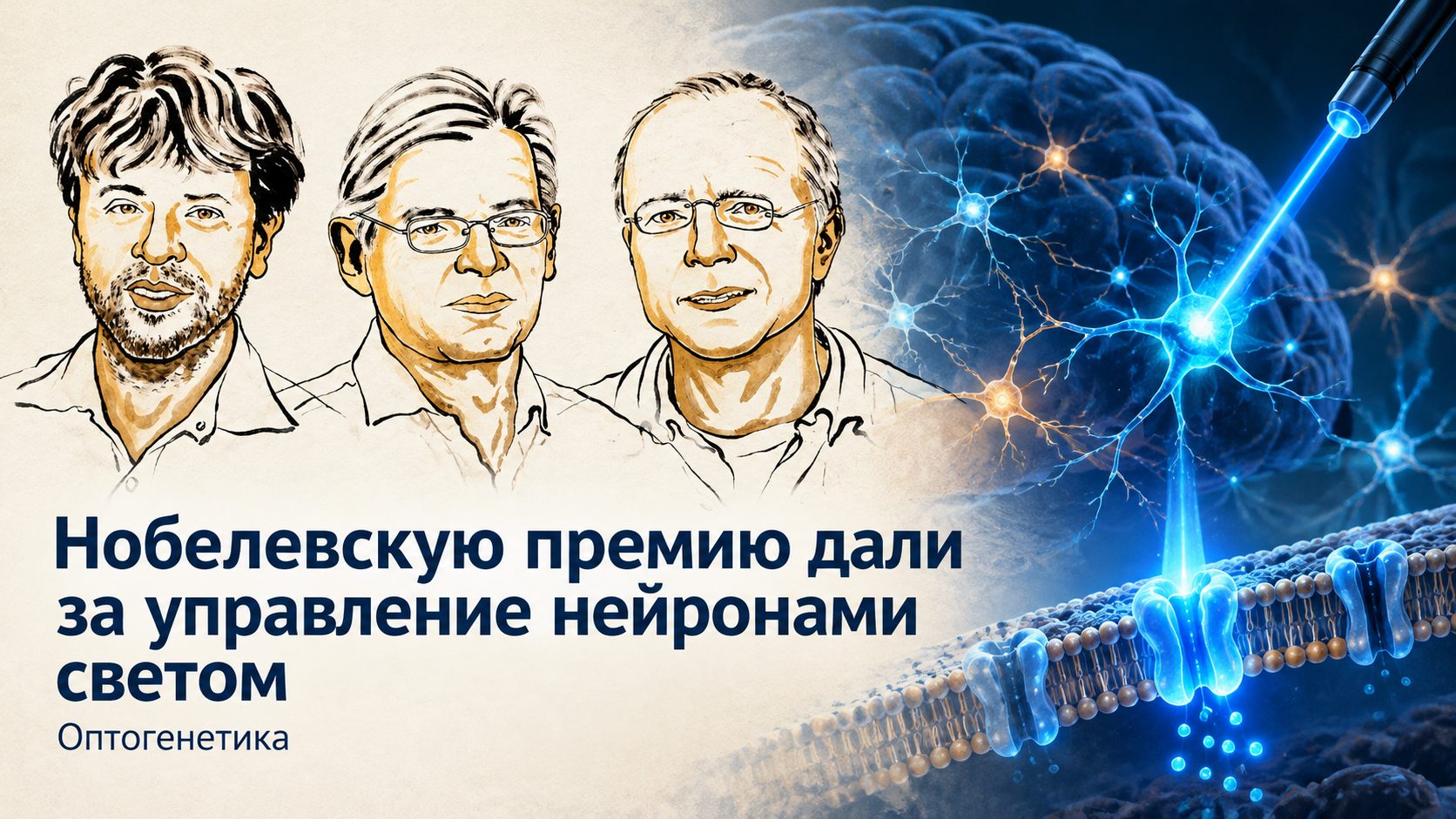
The award was given for discoveries in the field of light-sensitive ion channels and optogenetics — a method that allows controlling individual nerve cells in a living brain using light. The decision was announced by the Nobel Committee of the Karolinska Institute on October 5.
The essence in brief
- The prize was awarded to Karl Deisseroth (USA, 54 years old), Peter Hegemann (Germany, 71 years old) and Georg Nagel (Germany, 73 years old).
- The method is based on the light-sensitive protein channelrhodopsin, which opens a "gate" in the cell under the action of blue light.
- With its help, scientists study how neurons influence memory, fear, addiction and movement.
- The prize amount is 12 million Swedish kronor, about $1.2 million.
Who received the prize
Karl Deisseroth is a professor at Stanford University, a physician and bioengineer. Peter Hegemann is a professor of experimental biophysics at Humboldt University of Berlin, Georg Nagel is a professor of neurophysiology at the University of Würzburg. According to the Secretary General of the Nobel Assembly, Thomas Perlmann, optogenetics makes it possible to turn the activity of individual nerve cells in a living brain on and off.
How the method works
It all started with the single-celled alga Chlamydomonas. Hegemann studied how it moves toward light, and together with Nagel found in it the protein channelrhodopsin. It is located on the surface of the cell: under the action of blue light, a channel opens in it, through which charged particles — ions — pass inside, and an electrical signal arises. This protein makes any cell into which it is introduced light-sensitive.
Deisseroth introduced the channelrhodopsin gene into the nerve cells of rats, and blue light began to trigger nerve impulses in them. He published the work in 2005, and later showed that the method also works in the brain of living mice. Thus optogenetics was born: the gene for a light-sensitive protein is introduced into the desired cells, and then they are turned on or off with light.
Where this is used
Optogenetics makes it possible to see which groups of neurons are responsible for specific reactions. With its help, learning, fear, addiction and movement are studied, as well as neural circuits associated with neurological and psychiatric diseases. The Chairman of the Nobel Committee, Per Svenningsson, said that the method makes it possible to map the brain in a way that was previously only dreamed of.
In clinical practice, its use is still only being studied. Scientists are investigating the possibility of restoring vision to people with impairments, and also hope to improve cochlear implants so that they stimulate the auditory nerve more precisely than current electrical devices.
Author's conclusion
Optogenetics remains primarily a research tool: it helps to understand how the brain works, rather than treating patients. Practical results depend on clinical trials, which are only ongoing.


Comments ()